Solar Bonding Jumper needed?

Status
Not open for further replies.

Coppersmith

Senior Member
Location
Tampa, FL, USA
Occupation
Electrical Contractor
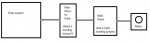
I'm trying to determine if a bonding jumper is required in the main disconnect for two different solar systems. In each case the main panel already has a bonding jumper.

In system 1, the connection to the main panel is a line side tap. The main disconnect for the solar system would be in my opinion the first point of disconnect and therefore should have a bonding jumper even though the main panel already has one. Am I correct?

In system 2, the connection to the main panel is a backfed breaker. In this case, since the main panel is the first point of disconnect, no bonding jumper should be in the main disconnect for the solar system. Correct?
 

Attachments

  • Solar bonding jumper.jpg
    Solar bonding jumper.jpg
    11.9 KB · Views: 16
I'm trying to determine if a bonding jumper is required in the main disconnect for two different solar systems. In each case the main panel already has a bonding jumper.

In system 1, the connection to the main panel is a line side tap. The main disconnect for the solar system would be in my opinion the first point of disconnect and therefore should have a bonding jumper even though the main panel already has one. Am I correct?

In system 2, the connection to the main panel is a backfed breaker. In this case, since the main panel is the first point of disconnect, no bonding jumper should be in the main disconnect for the solar system. Correct?

For system 2, that is correct. For system 1, AHJs disagree; some want it, and a ground rod at the disco bonded to building ground, and no EGC back to the service (for me, CPS in San Antonio); some want it configured just like a load side connection (for me, every other AHJ in Texas).
 
To concur with gguun...

2) does not require a bond and this is not controversial.

1) has been controversial in this forum and you need to ask your AHJ. For what it's worth, if the 2020 NEC first draft does not change in the final edition then it will finally clarify that an N-G bond is required. The issue up til now has been trouble nailing down whether the disconnect is a service disconnect or not.
 
I have also have same situation except our AHJ cannot determine and left it to contractors. Code is not clear simple and no local amendemnts are in place. In a line side tap the first AC disconnect should it require neutral to bond or should it be no neutral to bond just neutral pass thru. Our AHJ accepts it both ways and delays alot of projects thinking which is more safer.

I would like someone to tell me where AHJ cannot determine, which is the most acceptable way more than 50 percent of time: neutral to bond in PV AC disconnect first one from line side of service disconnect tap or No neutral to bond . Pretty please.
 
Last edited:
As long as you have good ground fault path then to doesn't really matter. That's part of the problem.

There will be cases where it will be much to your advantage as an installer to argue for one or the other. For example, if you don't need a neutral for system functionality, then argue that it isn't a service disconnect and you can ignore 250.24(C). If you do need a neutral, and you don't need a GEC tap (because GEC terminates at the meter, for example) then argue that it is a service and run only a neutral and save on material. The stakes are low if the conductors are, like, 8awg, and higher if they're something like 250mcm.
 
I'm confused , if the PV creates a noodle, then do we treat it like an SDS or not?
:eek:hmy:
~RJ~

What would a neutral have to do with whether it is a sds or not? For some reason, they never used the sds concept for pv systems, which led to all sorts of confusion. Now most inverters are transformerless so they do not provide isolation between the DC and ac sides, so they would not be considered an sds (if that concept was used which it is not).
 
What would a neutral have to do with whether it is a sds or not? For some reason, they never used the sds concept for pv systems, which led to all sorts of confusion. Now most inverters are transformerless so they do not provide isolation between the DC and ac sides, so they would not be considered an sds (if that concept was used which it is not).

well, to my understanding ,and using an Xformer analogy, it is the creation of a noodle that requires a complete earthing system much like an incoming service would electro


that said, using a genny analogy would most likely change this objective view


i'm still confused....
~RJ~
 
I'm confused , if the PV creates a noodle, then do we treat it like an SDS or not?
:eek:hmy:
~RJ~

Grid tied systems don't create neutrals. (If any part of a PV system is an SDS, it would be the DC side, but there's generally no neutral there either.)

This thread is solely about whether a supply side (of the service disconnecting means) PV disconnect is considered an additional service disconnect, or whether it somehow is not.
 
well, to my understanding ,and using an Xformer analogy, it is the creation of a noodle that requires a complete earthing system much like an incoming service would electro


that said, using a genny analogy would most likely change this objective view


i'm still confused....
~RJ~

Read the parts of 250 that deal with bonding when there are multiple service disconnects. That's what at issue here. Earthing is actually not really the question in this thread, although some AHJs may conflate them.
 
Grid tied systems don't create neutrals. (If any part of a PV system is an SDS, it would be the DC side, but there's generally no neutral there either.)

This thread is solely about whether a supply side (of the service disconnecting means) PV disconnect is considered an additional service disconnect, or whether it somehow is not.

last weeks PV configuration spat out 240V w/a noodle on the AC side , because there were two PV inverters, both AC outputs went to a 4 cir serv rated can w/ two 60A ocpd's , then out to the net meter.


>>>>>

dXBCosU


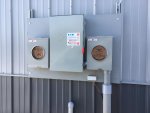
said disco is inside , behind the net meter (left) , the main (fused)disco w/MBJ being in the middle, poco meter to the right

for clarity, this is what we did>
wqTBlI9.jpg

~RJ~
 

Attachments

  • IMG_2064.jpg
    IMG_2064.jpg
    129.2 KB · Views: 0
Last edited:
last weeks PV configuration spat out 240V w/a noodle on the AC side , because there were two PV inverters, both AC outputs went to a 4 cir serv rated can w/ two 60A ocpd's , then out to the net meter.

Okay, but the PV doesn't "create" that neutral any more than any load that uses a neutral. In fact, a single phase 240V inverter almost certainly doesn't put any current on that neutral, and uses it only for measuring voltage and phase angle to properly sync with the utility. The neutral is still created by the windings in the utility transformer.

And to repeat, this is all thread drift from the question of bonding for a separate PV disconnect.
 
well, to my understanding ,and using an Xformer analogy, it is the creation of a noodle that requires a complete earthing system much like an incoming service would electro


that said, using a genny analogy would most likely change this objective view


i'm still confused....
~RJ~

RJ,

A few points:

1. An SDS requires a GEC/GES whether it is a grounded system or not.
2. The presence of a derived neutral may result in that SYSTEM being required to be grounded, but see #1.
3. One could tie primary and secondary neutral/grounded conductors together to make it a non SDS (but quite rare in the low voltage world).
4. Often we have an SDS serving a PV system, usually when the service voltage is different from the inverter AC voltage, but this is just a "normal" SDS.
 
Okay, but the PV doesn't "create" that neutral any more than any load that uses a neutral. In fact, a single phase 240V inverter almost certainly doesn't put any current on that neutral, and uses it only for measuring voltage and phase angle to properly sync with the utility. The neutral is still created by the windings in the utility transformer.

And to repeat, this is all thread drift from the question of bonding for a separate PV disconnect.

RJ,

A few points:

1. An SDS requires a GEC/GES whether it is a grounded system or not.
2. The presence of a derived neutral may result in that SYSTEM being required to be grounded, but see #1.
3. One could tie primary and secondary neutral/grounded conductors together to make it a non SDS (but quite rare in the low voltage world).
4. Often we have an SDS serving a PV system, usually when the service voltage is different from the inverter AC voltage, but this is just a "normal" SDS.

I'm reading 690's Part V. Grounding and Bonding.

There are many art 250 references

My Q follows the OP's bonding

In that the AC panel that combines the two inverters , (not shown, directly inside ) is installed between them and the net meter.

The noodle in it floats, the ground is made back to the main MBJ

The Q is ,to MBJ or not MBJ the 'PV ser rated disco'

Don't most service disco's in from a meter have an MBJ? :? ~RJ~
 
I'm reading 690's Part V. Grounding and Bonding.

There are many art 250 references

My Q follows the OP's bonding

In that the AC panel that combines the two inverters , (not shown, directly inside ) is installed between them and the net meter.

The noodle in it floats, the ground is made back to the main MBJ

The Q is ,to MBJ or not MBJ the 'PV ser rated disco'

Don't most service disco's in from a meter have an MBJ? :? ~RJ~

Your diagram really just shows a service disco feeding two feeders. Nothing special here. Your PV is load side connected in a subpanel. Nothing special, just one MBJ at the service disco like usual. The net meter in the circuit for the PV subpanel is completely irrelevant.

The issue comes up when one is making a new connection on the supply side of the service disconnecting means (informally known as 'tapping the service conductors') and running those conductors to a separate disconnect. In that situation one will of course have an MBJ in the main (existing) service equipment. The question arises if the separate disco for the PV is officially a 'service disconnect' requiring its own MBJ, or not.

Also, article 690 is pretty irrelevant here. The debate is basically 230 vs 705.
 
Status
Not open for further replies.
Top