Strobing LEDs correlate to tankless water heater operation.

11bgrunt

Pragmatist
Location
TEXAS
Occupation
Electric Utility Reliability Coordinator
A recent complaint was focused on the LED fixtures in the house began strobing when the Rheem 13kW tankless water heater in the shop came on.

This is an off the shelf tankless from Home Depot for $300.
All is new construction.
After extensive testing in the shop and in the house, the tankless water heater seems to be the only issue.
There was a voltage transient that appeared only when the tankless water heater was powered on.
The THDV increased slightly when the tankless was on, but we never saw more than 2.3 THDV.

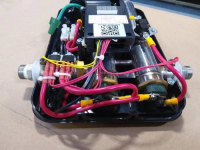
I assumed the tankless used an element similar to a conventional stored water heater.
Can anyone shed light on this? I suggested the customer to contact the manufacture.
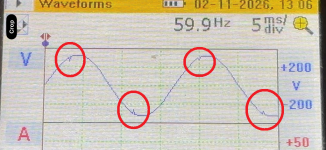
 

Attachments

  • Waveform.PNG
    Waveform.PNG
    996.3 KB · Views: 16
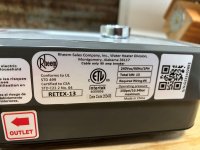
  • dataplate.JPG
    dataplate.JPG
    115.2 KB · Views: 16
Cheaper LED's don't like voltage fluctuations or wave distortions. I can see a tankless contributing to both issues. Even if you ran pretty heavy supply lines, POCO may still have undersized transformer causing voltage drop when heavy load like this is running. I can also see them having solid state switching controls vs dry contacts for control which could cause distortions on waveforms.
 
The POCO transformer is 37.5 kVA. Another 50A steamer load tested, did not have the same effect. There is no visible voltage sag on HVAC start.
 
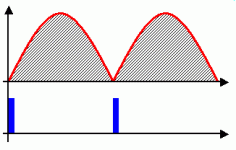
I agree: the scope is picking up voltage transients that are related to the water heater SCRs switching.

I think that you can reliably confirm that these transients are coming from the water heater as follows: My _guess_ is that if you operate the water heater and change the setpoint temperature (thus changing power level and trigger time of the SCRs) that the voltage transients will move to different parts of the AC cycle.

What is probably happening is that these _tiny_ voltage transients are being picked up by the part of the LED driver circuit that is supposed to detect dimming waveforms, and then the LED driver circuit is varying the LED drive current. Bang: everything flickers.

A solution might be a suitably rated common mode noise filter on the water heater circuit.

-Jonathan
 
Even though the water heater is applying a line-to-line load, I suggest measuring the L1-N and L2-N waveforms with your scope if you haven't already done so, since that is what the lights are being supplied with. That's just to make sure there isn't something going on with the neutral that could be relevant.
 
Top