
Tapping with parallel bus

Tainted

Senior Member
Location
New York
Occupation
Engineer (PE)
My goal is to feed a transformer primary disconnect. To get the power for it I must tap on the load side of a 3000A service fuse. The length of the tap is between 10-25 feet so I would need 1000A minimum wires...

I am thinking of running 3 sets of 4#400KCMIL copper to get the 1000A minimum however I probably cannot do that due to the arrangement of the busses being parallel per phase. Would 300.3(B)(1) be violated if I do 3 sets of 4#400KCMIL by tapping the left bus with 2 sets and tapping right bus with 1 set per phase?

See photo below:
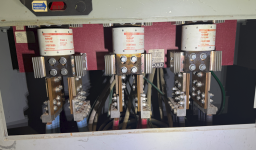
1771218477220.png
 
Last edited:
I dont see that as 300.3 violation. Only issue i can think of is the load rating of each side. Is it half of switch rating or fully rated? :unsure:. I guess if your calculated load on the side with more terminations is still under 1500A, that would be the worst caseso you should be good.
 
Are those bus landing pads really in parallel, per the NEC definition of being electrically connected on both ends?
 
The doubled up buss extension pieces?

You can buy expansion plates, no?

Land them on both sides? Did you check the space between phases? You might also be able to buy different lugs to offset. Like the double up lugs where you can land two wires per termination. Then move the existing to doubled up lugs and put yours on similar. If i counted right you have 4 used, one empty. IF you used an even number you might just be able to land on the empty existing terminations, one on each bar.

P.S. those plates seem different. Like some are squared off and some are rounded edges. I think someone put those in. You might be able to get something with more space.

Or tap the wire with Ilisco taps or something. Wire way might be large enough.
 
I dont see that as 300.3 violation. Only issue i can think of is the load rating of each side. Is it half of switch rating or fully rated? :unsure:. I guess if your calculated load on the side with more terminations is still under 1500A, that would be the worst caseso you should be good.
Hmm I'm not sure about that. The way I'm reading 300.3 says all taps must connect to all conductors of the paralleled set. The busses are paralleled set.

Connections, taps, or extensions made from paralleled conductors shall connect to all conductors of the paralleled set, grounded and ungrounded, as applicable.

Also not sure of the thickness and depth of the bus bars I could assume 1000A/Sqinch but 300.3 wants me to tap all the busses equally.

Are those bus landing pads really in parallel, per the NEC definition of being electrically connected on both ends?

They are parallel in their own phase.

Just use 4 sets of smaller conductors, two on each side.
I can but I'm trying to save space, copper and conduit if possible. :unsure:
 
can but I'm trying to save space, copper and conduit if possible.
I hear you. Then it that case you'll probably need to verify the current carrying ampacity of each side of the load side of the fuse bus if you want to load them unevenly.
 
Are those bus landing pads really in parallel, per the NEC definition of being electrically connected on both ends?
Little tricky there. In strictest definitions no. If they are listed/recognized for that use they might be ok assuming balanced parallel conductors is what was initially being supplied. Otherwise if one were to field install two conductors (any length) then make same parallel additions to it probably a no go.
 
I hear you. Then it that case you'll probably need to verify the current carrying ampacity of each side of the load side of the fuse bus if you want to load them unevenly.
This 3000A fuse is feeding a switchboard, so giving that these busses are the same size, I think the capacity and load on each side is the same. So to keep the load even on both sides of the bus I would need 4 sets unfortunately. It has 2 spare lugs on each side, but I would need 4 lugs on each phase. I would probably need to put double lug sets on each bus bar to achieve this.

Lug landing pads, such as these, often have a different number of conductors on each side. I think this is the first time I have heard them called parallel bussing.
Wasn't sure what to call them. I do have 2 empty lugs per phase but now I need 4 empty lugs per phase since I would have to make sure the buss loads are evenly distributed. Usually I leave it up to electrician for means and methods but what product would they use to expand the bus or the amount of available lugs per phase? Would that void UL listing? Would the electrician need to order a custom bus to expand the number of lugs and just screw it in there?
 
Wasn't sure what to call them. I do have 2 empty lugs per phase but now I need 4 empty lugs per phase since I would have to make sure the buss loads are evenly distributed.
If you use crimp terminals you can ditch the existing mechanical lugs and put one on each side of the bus with a single set (two) of bolts.
 
Last edited:
UL Listing applies to how it was shipped from the factory. Anything added after it leaves the factory requires AHJ approval.

Lug landing pads are commonly field fabricated.
Never really installed such items, won't say I never encountered something similar that was existing though. Wouldn't they need to meet certain cross sectional areas depending on how much current they are expected to carry? If you have two separate sections like in OP, wouldn't each need to have full current carrying ability as related to the fuse setting or else you start to encounter the kind of things the OP was questioning? If factory installed then I'd say listing/instructions hopefully tell you what you can do with them.
 
Top