Thumb pull boxes

steve66

Senior Member
Location
Illinois
Occupation
Engineer
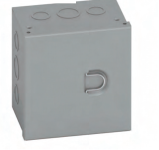
Is there anything that would prevent these from being used as pull or splice boxes for line voltage wiring?

It seems like they can be opened by simply pulling the thumb ring. But most line voltage boxes require a screwdriver to open.

Would there be any limitations on the voltage these can be used at, or the locations they could be placed?

1768838734775.png
 
Is there anything that would prevent these from being used as pull or splice boxes for line voltage wiring?
No.
It seems like they can be opened by simply pulling the thumb ring. But most line voltage boxes require a screwdriver to open.
No requirement for junction boxes to have screw covers.
Would there be any limitations on the voltage these can be used at, or the locations they could be placed?
Only limit would be the listing of the box.
 
I have always assumed that boxes needed a tool to open in order to protect access to live parts. Most equipment and UL requirements say this, but I can't find it in a code for general enclosures or boxes. I have a box just like the one pictured that has CT wires in it that go to the back of a meter. So no kidding live parts if you open the box with a pull handle. However, my box came with a screw in the front to hold it closed which must be removed before you can pull that front door open. It also came with stickers warning to remove power from the circuit with the CT's before opening the box.
 
I could be wrong, but I don't think that box has a screw at all. I assumed the same thing as above - that live parts would be kept behind something that requires a tool to open.

So, just playing devil's advocate - could a box like this go in a school corridor? Somewhere where students could have access?
And assuming there is 120V wiring, and maybe wirenuts inside.

If not, how about a janitor's closet? Less frequently accessed by students, but still, there might occasionally be a student sent to get a mop or something.

Or, and I think I've actually seen this, how about back stage in a school auditorium? Now I'm starting to get Deja vu, and I may have asked a similar question in the past.
 
NEC 110.27(A) on Guarding of Live Parts says that the options are "approved enclosures" or one of the listed locations with restricted access.

So the AHJ is free to not approve of junction boxes that can be opened without tools, but is also free to approve them. [See Article 100 definition of "approved" if not familiar with it.]

Cheers, Wayne
 
NEC 110.27(A) on Guarding of Live Parts says that the options are "approved enclosures" or one of the listed locations with restricted access.

So the AHJ is free to not approve of junction boxes that can be opened without tools, but is also free to approve them. [See Article 100 definition of "approved" if not familiar with it.]

Cheers, Wayne
is an insulated conductor a "live part"?
 
No. If you had an exposed plug fuse holder in the box then yes but insulated splices or conductors no.
OK, good point.

FWIW, 110.2 requires all equipment and conductors to be approved. So I don't think there's anything stopping an AHJ from declining to approve of the use of a "thumb pull box." But 110.2 is a pretty broad hammer, surprised there is nothing more specific.

Cheers, Wayne
 
What's to stop you from drilling a hole in the side opposite the hinge and putting a self tapping screw like in.
 
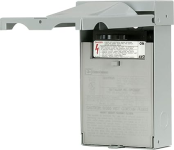
Still better than say a 240v 30a safety switch. Shut it off, press the latch and open the door, you can put your fingers on line terminals.

I never thought of that. Same with the pullouts Roger posted. I was tempted to say these are less likely to be accessible to the public, but then I realized they are installed on the outside of just about every house and building and school there is.

That also makes me think of a tabletop incandescent lamp - really nothing to stop anyone from taking out the lamp and inserting a finger except common sense.

What's to stop you from drilling a hole in the side opposite the hinge and putting a self tapping screw like in.

It's just easier to have the contractor use a similar box that already has a screw in the front cover.
 
Is there anything that would prevent these from being used as pull or splice boxes for line voltage wiring?
I wouldn't hesitate in allowing my contractors to use these as simple pull boxes when reducing the number of bend-degrees between A and Z. Once a wire nut or polaris tap enters the mix, though, I'd want mechanical access deterrence (screws, latch, padlock, etc.) of some kind.
 
Top