Timed disconnect suggestions

marmathsen

Senior Member
Location
Seattle, Washington ...ish
Occupation
Electrical Contractor
I have a project coming up where I need to wire for an outdoor residential 9kW sauna. In the installation instructions they state:
When this heater is not installed for use with an attendant, a timed-cutoff switch must be connected in the input circuit to disconnect all ungrounded conductors of the heater circuit from the supply source at the end of 1-hour of operation. The timed-cut-out switch shall be located outside the heater room, or mounted to a wall or door inside the heater room. The time feature of
the switch must not lend itself to being overridden.
I haven't talked to the manufacturer but does anyone have a suggestion on what I might use here? The unit has a separate 24v keypad for turning the heater and lights on and off. Is there something that could be wired in either AS the disconnect or adjacent to it that would automatically start a 60 min timer after the heater turns on that could disconnect power and reconnect it after some period of time?

Also, I wonder what they mean by "attendant"

Rob G
Seattle
 
A rated contractor for the correct amperage and voltage. With 24v coil. And you could also use a timer a digital timer switch to pull in the coil as well.
 
A rated contractor for the correct amperage and voltage. With 24v coil. And you could also use a timer a digital timer switch to pull in the coil as well.

And perhaps some sort of current sensor that triggers the timer?

I assume I could piece together an expensive, complicated setup.

I'm wondering if this is a more common setup in other areas of our industry. Is there some all in one product? Or does everyone just build their own with individual components (current sensor, contactor, timer, some sort of logic controller, all in a pretty little box)?

Rob G
Seattle
 
Well I could set up a small PLC, an HMI with Wi-Fi connection, but a simple one-hour spring wound timer controlling a contactor should work. Don't get the timer with the hold feature.
I thought about that too. The disconnect is on the house before the circuit dives into the ground over to the free standing sauna. The 24v controller is mounted on the side of the sauna itself. I suppose I could put the timer on the side of the sauna next to the controller downstream of the disconnect. I guess I was hoping for some sort of automated setup so no one needs to touch the timer, it starts automatically and ends kills power after an hour automatically.

Rob G
Seattle
 
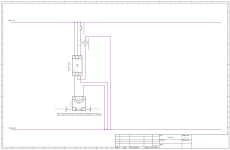
Could try something like in this diagram. Using an ABB Off-Delay relay (P/N: 1SVR500110R0000), a SPST relay, and a pushbutton you could have it run for 1 hour at a single button press and then stop. The single-pole relay is do disable the start button until the 1 hour period has elapsed as to make sure it doesn't run over it via someone continuously pressing the button.
 

Attachments

  • Sauna 1-Hour Timer (NON-RESETABLE).png
    Sauna 1-Hour Timer (NON-RESETABLE).png
    142.3 KB · Views: 8
A chance for design . . .
I suspect energy codes are at work here.
First, for the “easy” way: the Intermatic #FF460M switch is spring-wound, runs up to an hour, can interrupt 240 (two pole) circuits, and is rated for ten amps of 240v or 20 amps of 120. Is that enough?
If you need more amps, just combine this timer with the appropriate contactor.
If you can wire a light switch you can handle this.
 
Why wouldn't the sauna manufacture include the timeout function with their controls if they tough it was important?
My sauna controller energizes the unit only after a temperature and time has been entered. I’ve never tried to enter a time more than an hour. My default is 40 minutes. It takes about 20 minutes to get up to my desired temperature (170F) and 20 minutes at that temperature is just right for me.
 
I'm embarrassed.

This is a perfect example of "I should have asked the manufacturer FIRST". As it turns out, the controller/keypad has the one hour timer built in. The only reason they state the one hour requirement is in the rare scenario where you're not using their controller and instead using some other means to turn it on and off.

Thanks everyone for all your input. Even though I didn't actually need these suggestions, it was still informative.

Rob G
Seattle
 
Top