Transformer and bus bar

DanIBEW481

Member
Location
Indiana
Occupation
Inside Wireman
I have a production line that I am troubleshooting and thought I would ask the forums their opinion. The line is a tempering furnace with three 460v to 24v transformers which in turn feed heater elements. I got a call on Sunday that one of the transformers went bad. I've checked the resistance across the phase windings on the primary and the secondary, confirmed a lack of shorts from the primary to the secondary, and megged the primary to secondary as well. I have found no issues on the transformer itself.

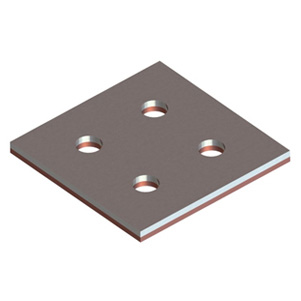
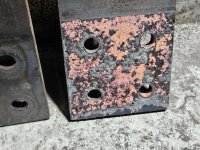
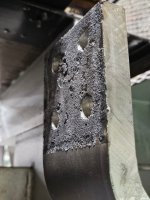
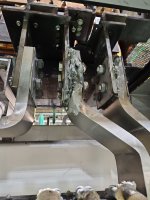
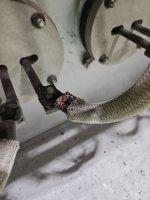
There is a section of tinned copper bus that connects to a larger aluminum bus that the elements are landed on. On b-phase, the aluminum is completely shot; the metal is powdery and soft. I can actually split it apart with a screwdriver. Separating these two parts, there is a large amount of oxidation and deep pitting on the aluminum and exposed copper on the other. C-phase is similar but the aluminum is not as far gone. I still believe this copper was tinned at one point but what could have caused a failure of this magnitude? The breaker for the transformer never tripped and supposedly everything had still been working until that point.
 
What was their reasoning for saything the transformer was bad?

You cannot really test the resistance of a transformer using a standard hand held multimeter.

Ideally the copper and aluminum bussing would both be tin plated, but one is better than none.

The transformer primary side protective device is not likely to trip on a simple overload on the secondary side, especially if it has been sized larger than 125%.
 
Last edited:
I think you mean 480:240V transformers ? Sounds like classic case of galvanic corrosion exacerbated by thermal cycling, leading to a runaway failure or a "hot joint." While the transformer appeared to be the culprit, the real failure is at the metallurgical interface of the bus connection. Even with tinned copper, if moisture or industrial vapors (common in furnace environments) penetrated that joint, a battery effect was created. Because aluminum is much more "anodic" than copper, it sacrificed itself to protect the copper, leading to the deep pitting and "soft" metal you observed.
If you replace the aluminum sections with copper, you eliminate the dissimilar metal interface. Copper-to-copper joints are far more forgiving of thermal cycling.
Once the line is back up, hit those joints with a thermal camera. A healthy joint should be at or near the temperature of the bus bar itself; any "hot spot" indicates the oxidation process has started again.
 
I think you mean 480:240V transformers ? Sounds like classic case of galvanic corrosion exacerbated by thermal cycling, leading to a runaway failure or a "hot joint." While the transformer appeared to be the culprit, the real failure is at the metallurgical interface of the bus connection. Even with tinned copper, if moisture or industrial vapors (common in furnace environments) penetrated that joint, a battery effect was created. Because aluminum is much more "anodic" than copper, it sacrificed itself to protect the copper, leading to the deep pitting and "soft" metal you observed.
If you replace the aluminum sections with copper, you eliminate the dissimilar metal interface. Copper-to-copper joints are far more forgiving of thermal cycling.
Once the line is back up, hit those joints with a thermal camera. A healthy joint should be at or near the temperature of the bus bar itself; any "hot spot" indicates the oxidation process has started again
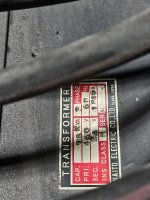
It is actually a 460:24, not 460:240, as crazy as that seems; I've got the nameplate if you want proof. I'm thinking it's the galvanic reaction as well with the level of corrosion and pitting on the copper. There is plenty of humidity and oil around the joints.

My thought with a breaker not tripping is that it's not a major failure on the transformer itself as that would be a rapid spike in current rather than a slower corrosive overload. I appreciate the help!
 
What was their reasoning for saything the transformer was bad?

You cannot really test the resistance of a transformer using a standard hand held multimeter.

Ideally the copper and aluminum bussing would both be tin plated, but one is better than none.

The transformer primary side protective device is not likely to trip on a simple overload on the secondary side, especially if it has been sized larger than 125%.
Their reasoning was that it looked like there was molten metal that had dripped down, seemingly from the transformer. It looks more like aluminum slag where the tinned copper and aluminum joint was made.

The resistance testing is just between phases on the primary and again on the secondary. Another quick check with a multimeter to ensure there isn't an obvious short from the primary to the secondary. I then used a 1000vdc megger to test insulation from primary to secondary.

I don't have a lot of experience in testing transformers but thought this was a decent path with the tools at my disposal.
 
Interesting so you have a 480 delta to 24V wye?
The resistance testing is just between phases on the primary and again on the secondary.
And did you measure a 'short' or very low ohms? if the transformer is good make sure your furnace is good.
You might of had some other kinda failure that caused the bus to fail, I'd comb over the furnace and look for other issues, elements good?
You might look into what kinds of vapors off gassing in your plant process. Do they use a degreaser? Look for things like Salt Mist / Chlorides, Caustic Vapors, Sodium Hydroxide / Alkalines ?
 
There's no 4th wire coming off the wye, appears to be 24v line to line. I found very low ohms on phase to phase, about .2 to .3. There are a few lugs on the jumpers between the bus and the elements that look near burnt. The factory either performs their own preventative maintenance with the elements or another contractor that isn't me but I have heard from some of the line supervisors they have seen glowing bolts on the bus before.

There are plenty of caustics in the factory but not necessarily near this furnace; it's a tempering furnace that i know uses a mixture of nitrogen and CO2 but i don't know too much beyond that.
 
I'm thinking it's the galvanic reaction as well with the level of corrosion and pitting on the copper. There is plenty of humidity and oil around the joints.
It is most definitely galvanic corrosion. When you replace the bussing I would recommend either moving away from aluminum bussing (if possible), or using some deox grease on the dissimilar metal junctions.
 
I think the wire / terminations are being overloaded and cooled in cycles which is leading to looser connections and more heat and so on. It could be a reaction between dissimilar metals as well but I don't know how long the install has been there. Maybe photos would help discern if the dissimilar metals is the only issue.

You could put overload protection in each 24V furnace conductor rather than on the line side of the transformer. It might be code complaint as is, but that doesn't mean a little design change can't save them money. Especially if this is effecting production.

Do you have the VA of the transformer, VA of the load, and wire sizes on the 24V side?
 
Crispy! Looks like some wicked pitting and oxidation to me. One thing to remember is this: heat accelerates any kind of oxidation reaction. So the corrosion COULD simply be a side-effect of overheating from an issue with loose connections, like Elect117 stated.
 
You could put overload protection in each 24V furnace conductor rather than on the line side of the transformer. It might be code complaint as is, but that doesn't mean a little design change can't save them money. Especially if this is effecting production.
It would probably be easier to put CTs on the secondary feeding a relay that opens the primary side breaker.
 

If you look under the left busbar piece it has some melted metal there. I think you issue is overloaded that was made worse by corrosion. You might be able to get bus rated CTs in there but I would also inspect the heating element rod location(s) and sort out if the furnace is MUCH hotter on some rods (towards middle) than others. I was at a glass plant and they were constantly changing out that wire. But to them it was cheaper to change out that wire a couple times a year than to have the furnace cool and the production stop.

Since the rods cloth insulation looks impacted I am going to assume your issue is similar. I would evaluate whether you should change the termination type (to something rectangular or square) so that the entire surface area is flush and maybe look into larger wire and larger terminations. That melting of the tin is common on high loading, connections either start loose or get looser due to thermal expansion and hot general environments. They all add up. I am also guessing they are running for long periods.

I once saw a 4000A switchgear melting while a business was only pulling 3200A. It was the tin plating at bolted connections that were loosing with thermal expansion. If it is all rigid bus then you might want to try a flexible bus or parallel runs. Rigid conductors bolted to rigid conductors bolted to rigid conductors being exposed to high amounts of heat will have to expand somewhere.
 
Last edited:
I can't tell you guys how much I appreciate the help and feedback on this, it's a huge boon. It helps to know I'm not too crazy with my line of thinking on what may be the cause.
 
Top