Transformer Primary Conductors

busman

Senior Member
Location
Northern Virginia
Occupation
Master Electrician / Electrical Engineer
All,

It's Monday morning. I don't design a lot of transformer installations. It is my recollection that where Secondary OCPD is provided (1,000V or less), the primary can OCPD can be up to 250% of the primary rating. Does this mean the primary conductors need to be sized for the 250% OCPD? Seems kind of stupid if it does, but I cannot seem to find the Code reference this morning.

Thanks if you have this on the top of your heads.

Mark
 
When over sizing the primary OCPD to allow for inrush current you would also have to use a minimum conductor size to match the OCPD.
That is what I am reading, but I can't understand why. It's not the same with motors or hermetic compressors where the OCPD is upsized for inrush. It seems that the transformer secondary protection would protect against overloads. Am I missing something.

Thanks,

Mark
 
That is what I am reading, but I can't understand why. It's not the same with motors or hermetic compressors where the OCPD is upsized for inrush. It seems that the transformer secondary protection would protect against overloads. Am I missing something.

Thanks,

Mark
Motors have overloads for the running current overload protection for the conductors. Their OCPD provides the conductor short circuit and ground fault protection. The conductors on the primary side of a transformer do not have equivalent protection.

There is nothing to prevent primary conductor damage if the transformer fails.
 
Motors have overloads for the running current overload protection for the conductors. Their OCPD provides the conductor short circuit and ground fault protection. The conductors on the primary side of a transformer do not have equivalent protection.

There is nothing to prevent primary conductor damage if the transformer fails.
I appreciate that, but the two issues are overload and short circuit, correct? If the secondary OCPD protects against overloads, then isn't the primary protection really just short circuit, similar to a motor?

Mark
 
I appreciate that, but the two issues are overload and short circuit, correct? If the secondary OCPD protects against overloads, then isn't the primary protection really just short circuit, similar to a motor?

Mark
The motor windings are after the overloads. The transformer windings are before the overload protection (i.e. the secondary OCPD).
 
The motor windings are after the overloads. The transformer windings are before the overload protection (i.e. the secondary OCPD).

Fair point, but what about tap conductors? They are overload protected at the load end and short circuit protected at the source. I promise, not trying to argue, just to understand.

Is there any reason I could not use the tap-rules to cover the primary conductors? There is just a turns ratio involved.

Thanks,

Mark
 
This is for primary side protection of the secondary. I thought you were asking about the primary side only.
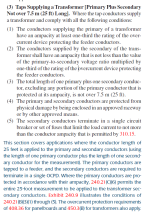
I'm not sure I understand the comment. The above says that the primary conductors can be as small as 1/3 the ampacity of the primary OCPD which is exactly (I think) what I said originally. I admit, I did not mention taps in my OP, but that is what I had in the back of my head.

Thanks,

Mark
 
This is for primary side protection of the secondary. I thought you were asking about the primary side only.
The quoted section is (2017 NEC) 240.21(B)(3), which is feeder taps, not 240.21(C) transformer secondaries. If the primary conductors are feeder taps that directly supply a transformer, that needs its own section under 240.21(B), as the primary conductors do not terminate on an OCPD like the other feeder tap rules. If you are using 240.21(B)(3) on the primary side, then 240.21(C)(5) covers the secondary side.

Cheers, Wayne
 
The quoted section is (2017 NEC) 240.21(B)(3), which is feeder taps, not 240.21(C) transformer secondaries. If the primary conductors are feeder taps that directly supply a transformer, that needs its own section under 240.21(B), as the primary conductors do not terminate on an OCPD like the other feeder tap rules. If you are using 240.21(B)(3) on the primary side, then 240.21(C)(5) covers the secondary side.

Cheers, Wayne
Likely due to early onset alzheimers but I find the math involved confusing...ratios and I are not friends. :)
 
Top