081206-1259 EST
Mike:
Much of what I am saying you know.
I think this statement
Supplementary grounding electrodes shall be permitted to be connected to the equipment grounding conductors specified in Section 250-118, but the earth shall not be used as the sole equipment grounding conductor.
is perfectly clear and makes sense.
What is a major problem is that CNC servicemen and maybe some manufacturers suggest removing the ECG and solely grounding the machine with a local ground rod. This is technically wrong from a safety point of view, and from the NEC. It might marginally solve an RS232 communication problem, but that does not make it the correct solution.
Another wrong is that these same CNC people may suggest floating the computer at the other end of the RS232 cable from its EGC by using a three prong to two prong adapter. It is the same problem, just the other end.
A more correct solution is to use electrical isolation in the RS232 communication path, such as the products we make.
It is my opinion that in almost all CNC applications the addition of a supplemental ground rod at the CNC machine is only of marginal value in reducing communication noise problems. The impedance to earth is generally high compared to the DC resistance of the required EGC. Above some transition frequency the AC impedance of the EGC maybe higher than the earth path. In experiments on AC noise voltage from a CNC machine using a Simpson 270 VOM with and without a supplemental ground rod showed no great reduction in noise level. The Simpson used has a AC bandwidth of about 300 kHz. My Fluke 27 and 87 are only good to about 25 to 50 kHz.
The ratio of DC resistance of a supplemental ground rod to that of the EGC is in many applications probably in excess of 100 to 1. Thus, not much current flows in the ground path.
If there are no supplemental ground rods in a building and earth grounding is at the service entrance, then I suggest there is probably less current flowing into the building from a lightning strike, than if there were supplemental rods at machines.
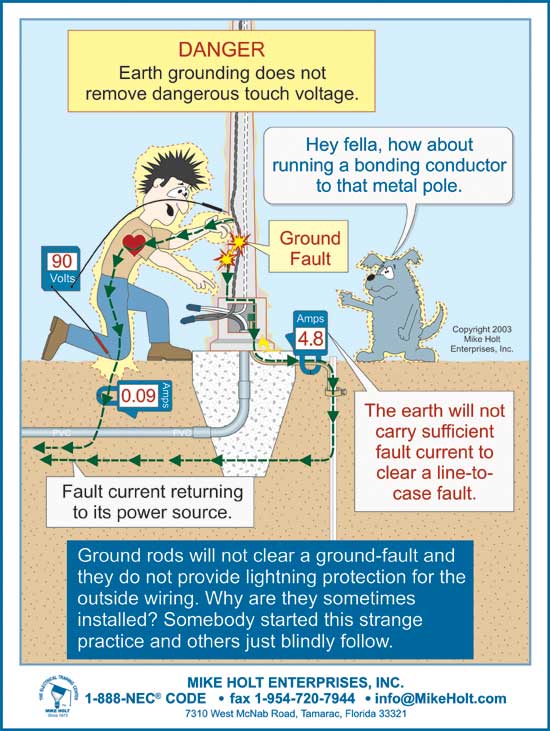
There is a significant problem with directly connected RS232 circuits that develops when a short circuit occurs between a hot wire and the frame of the machine. Neither a supplemental ground rod or just using the ground rod and no EGC will solve this problem. The "ground rod only" is the worst case. So only consider the EGC case. We assume the same wire size for the EGC and the energized wire. Both of these wires have the same resistance. Thus, when the short occurs the voltage at the point of the short, the machine frame (chassis), rises to about 1/2 of the source voltage back at the service entrance relative to neutral and earth ground at the service entrance. In other words the service entrance point is the voltage reference point for this discussion.
Assume the computer back in an office is correctly connected to its EGC which connects to the service entrance and has a direct RS232 connection to the CNC machine. The computer chassis is connected to the CNC chassis by maybe a #22 wire in the RS232 cable. When the short at the CNC occurs this places a voltage difference across the RS232 cable equal to approximately the said 1/2 source voltage. This may burnout the #22 common wire in the 232 cable, but almost certainly will burnout the RS232 interface components at each end unless there is some circuit protection of the signal lines. A 120 V circuit will have a peak voltage of 170 V, and half of this is 85 V. Ordinary RS232 interface components can not tolerate this level of voltage.
Electrical isolation at both ends of the RS232 connection can solve this problem as well as the ground path noise problems. Fiber optic connections are going to provide the greatest protection, multi-millions of volts. LED optical isolators generally fall in the range of 2000 to 4000 V.
.