Trying to understand EGC & local ground

Merry Christmas
Status
Not open for further replies.

Designer69

Senior Member
I know that the egc must be run all the way back to the service ground and bonded with the neutral and not create separate ground paths.

how come though a motor for instance is grounded locally? I've seen it done on drawings, is it not supposed to be or is there some inherant difference on the purpose of the grounding itself?

thanks
 
I know that the egc must be run all the way back to the service ground and bonded with the neutral and not create separate ground paths.
It can terminate at the grounding bar in a remote panelboard, too.

how come though a motor for instance is grounded locally? I've seen it done on drawings, is it not supposed to be or is there some inherant difference on the purpose of the grounding itself?

thanks

The motor must have its egc routed with the circuit conductors, too. See 250.118 for types.:)
 
As long as the grounding electrode was connected to the motor equipment grounding conductor by a grounding electrode conductor this would be acceptable. What purpose would this serve? To stabilize voltage?
 
well one of the engineers here was talking about locally grounding a motor, chasis to building steel or something.
 
I can see bonding the building steel to the service as is required, but bonding the motor to building steel might have the effect of dividing a fault current between the equipment grounding conductor of the motor circuit and along the building steel which might limit the current on the egc to the extent the OCPD would not open. What say you?
 
He's likely referring to this, a supplementary, now called auxiliary electrode.

1004224701_2.gif
 
I can see bonding the building steel to the service as is required, but bonding the motor to building steel might have the effect of dividing a fault current between the equipment grounding conductor of the motor circuit and along the building steel which might limit the current on the egc to the extent the OCPD would not open. What say you?
No matter when the fault current flows after the fault, it is all supplied by the OCPD. The current on the EGC could be 0 and the breaker would open if the fault current was greater than the breaker rating.
 
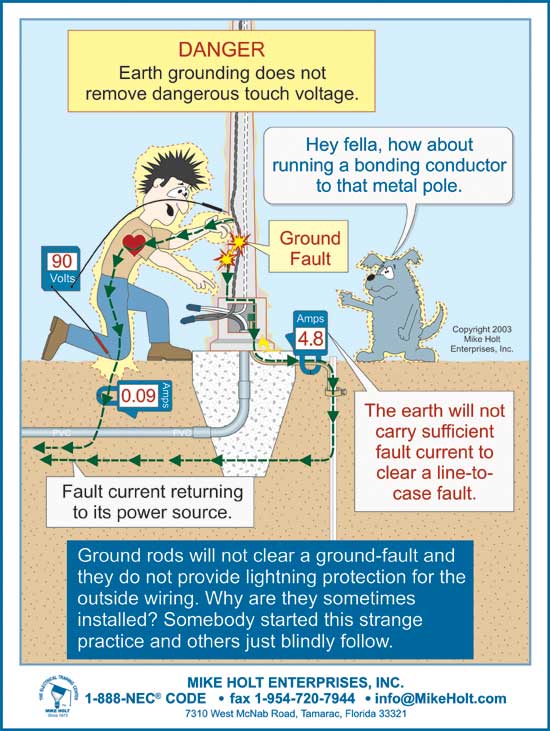
Auxillary ground rods DO ABSOLUTELY NOTHING!!! For a warm up, here is a link to a newsletter from Mike Holt.

More links

some misconceptions

Clarity

GroundBondPoster001.jpg


Rockyd says -Inside, or outside, grounding light poles, motors, building steel,etc, to an auxillary ground rod, and depending on an earth return path for current, will not facilitate in tripping an OCPD!(250.54~08 NEC)​


From an old article, but principle is still the same
Mike Holt?s Final Comment

Answer No. 6 states "Don?t violate the Code. A building is to have one and only one grounding system. He can drive an extra rod if he so desires but he must tie it into the whole building grounding system."


I though and taught for many years that the NEC contained this requirement, but it doesn?t (never did as far as I know). As a matter of fact the NEC [250-54] recognizes the use of a supplement grounding electrodes, which is often required by CNC machine instructions, RF grounding grids, etc. The key is that the earth itself cannot be used for equipment grounding, but a supplement electrode can be installed without bonding it to the building grounding electrode system.


1999 NEC Section 250-54. Supplementary Grounding Electrodes

Supplementary grounding electrodes shall be permitted to be connected to the equipment grounding conductors specified in Section 250-118, but the earth shall not be used as the sole equipment grounding conductor.


If after reading this, you would like to make any updates, comments, corrects, etc. please let me know. I want to keep this question and answer updated to the current standard.


God Bless,

Mike Holt
 
081206-1259 EST

Mike:

Much of what I am saying you know.

I think this statement
Supplementary grounding electrodes shall be permitted to be connected to the equipment grounding conductors specified in Section 250-118, but the earth shall not be used as the sole equipment grounding conductor.
is perfectly clear and makes sense.

What is a major problem is that CNC servicemen and maybe some manufacturers suggest removing the ECG and solely grounding the machine with a local ground rod. This is technically wrong from a safety point of view, and from the NEC. It might marginally solve an RS232 communication problem, but that does not make it the correct solution.

Another wrong is that these same CNC people may suggest floating the computer at the other end of the RS232 cable from its EGC by using a three prong to two prong adapter. It is the same problem, just the other end.

A more correct solution is to use electrical isolation in the RS232 communication path, such as the products we make.

It is my opinion that in almost all CNC applications the addition of a supplemental ground rod at the CNC machine is only of marginal value in reducing communication noise problems. The impedance to earth is generally high compared to the DC resistance of the required EGC. Above some transition frequency the AC impedance of the EGC maybe higher than the earth path. In experiments on AC noise voltage from a CNC machine using a Simpson 270 VOM with and without a supplemental ground rod showed no great reduction in noise level. The Simpson used has a AC bandwidth of about 300 kHz. My Fluke 27 and 87 are only good to about 25 to 50 kHz.

The ratio of DC resistance of a supplemental ground rod to that of the EGC is in many applications probably in excess of 100 to 1. Thus, not much current flows in the ground path.

If there are no supplemental ground rods in a building and earth grounding is at the service entrance, then I suggest there is probably less current flowing into the building from a lightning strike, than if there were supplemental rods at machines.

There is a significant problem with directly connected RS232 circuits that develops when a short circuit occurs between a hot wire and the frame of the machine. Neither a supplemental ground rod or just using the ground rod and no EGC will solve this problem. The "ground rod only" is the worst case. So only consider the EGC case. We assume the same wire size for the EGC and the energized wire. Both of these wires have the same resistance. Thus, when the short occurs the voltage at the point of the short, the machine frame (chassis), rises to about 1/2 of the source voltage back at the service entrance relative to neutral and earth ground at the service entrance. In other words the service entrance point is the voltage reference point for this discussion.

Assume the computer back in an office is correctly connected to its EGC which connects to the service entrance and has a direct RS232 connection to the CNC machine. The computer chassis is connected to the CNC chassis by maybe a #22 wire in the RS232 cable. When the short at the CNC occurs this places a voltage difference across the RS232 cable equal to approximately the said 1/2 source voltage. This may burnout the #22 common wire in the 232 cable, but almost certainly will burnout the RS232 interface components at each end unless there is some circuit protection of the signal lines. A 120 V circuit will have a peak voltage of 170 V, and half of this is 85 V. Ordinary RS232 interface components can not tolerate this level of voltage.

Electrical isolation at both ends of the RS232 connection can solve this problem as well as the ground path noise problems. Fiber optic connections are going to provide the greatest protection, multi-millions of volts. LED optical isolators generally fall in the range of 2000 to 4000 V.

.

 
Many large industrial machines include a supplimental ground to building steel (connected directly to building steel). These are often not intended to have anything to do with clearing fault currents, the EGC is intended for that.

These supplimental grounds are often intended as a better high frequency ground path for noise currents. You will often find them connected via a wide wire braid or copper strap.

At high frequencies the EGCs wire inductance may be too high for it to be an effective high frequency ground.

The rule of thumb in high frequency grounding is a 5 to 1 rule. For every 5 inches in length you want 1" of width conductor. The conductor does not have be be thick , just wide to provide a larger surface area for the high frequecy current to flow. This is the theory, although often hard to accomplish in practice.

I have worked on lots of large machines, such as Ion Implanters in Semiconductor fabs that utilize this type of supplimental high frequency ground.
 
I can see bonding the building steel to the service as is required,
but bonding the motor to building steel might have the effect of dividing a fault current between the equipment grounding conductor of the motor circuit and along the building steel
which might limit the current on the egc to the extent the OCPD would not open. What say you?

WBalsam,

The total of the available current
will flow through the total of the available conductors.

View the EGC as a conductor, and
view the building steel ground as a conductor.

The Voltage divides according to the conductance.
This action is parallel in these parallel conductors.

So, the lesser conductance of the building steel
only means that less current will flow through it.
The larger share will flow through the EGC.

The OCPD will trip if this total is sufficient.
A proper EGC will allow enough current to trip the OCPD, by itself,
without any help from an additional path (building steel).

Hope you enjoy the forum.
Comments are welcome.
...
 
WBalsam,

The total of the available current
will flow through the total of the available conductors.

View the EGC as a conductor, and
view the building steel ground as a conductor.

The Voltage divides according to the conductance.
This action is parallel in these parallel conductors.

So, the lesser conductance of the building steel
only means that less current will flow through it.
The larger share will flow through the EGC.

The OCPD will trip if this total is sufficient.
A proper EGC will allow enough current to trip the OCPD, by itself,
without any help from an additional path (building steel).

Hope you enjoy the forum.
Comments are welcome.
...

I messed up in post # 6, Don the Moderator got me back on path in post #9, I acknowledged it in post #10. I was totally off base thinking about something else entirely....(senior moment I call it).... Thanks for your further explanation. I learn from everyone. I do enjoy the Forum very much. Thanks.:)
 
081206-1259 EST
...
If there are no supplemental ground rods in a building and earth grounding is at the service entrance, then I suggest there is probably less current flowing into the building from a lightning strike, than if there were supplemental rods at machines...
Your suggestion is quite valid. Where lighting performance is critical, e.g. radio antenna sites, a single-point ground is usually used to eliminate potential differences during a lightning strike. A supplemental ground rod could not be used here because surge current would flow through the egc and cause a large potential difference during a lightning strike.
 
I understand from the above discussions as well as my own research that grounding rods used for this type of application do nothing towards eliminating dangerous fault potentials.

What is the NEC's overall take on such ground rod installations? I had a contractor once who tried telling me that there were not enough ground rods installed on columns on an A-Frame type building. He stated that the NEC required ground rods driven and connected to columns every certain number of feet. I was just curious what the NEC's overall stance was on such single ground rod installations.

Also I have done several projects where rebar in a concrete pad was connected to the grounding system. From another post on this site, it appears that this is referred to as a UFER system and is to help to lessen the earth resistance. I always was curious weather this was done to protect the concrete from cracking during fault currents or to be used as a path to ground. After reading the article posed in the other thread it now appears to me that this is used as another means of a low resistance path to earth since concrete in more conductive than soil.
 
The NEC permits building steel as a GROUNDING ELECTRODE CONDUCTOR (GEC).

The NEC does ot permit the building steel to be used as an EQUIPMENT GROUNDING CONDUCTOR (EGC).


With that being said, I believe the OP may be stating that the company is trying to use steel as the EGC means based on a misunderstanding of ;

250.136 Equipment Considered Grounded.
(A) Equipment Secured to Grounded Metal Supports.

The last sentence of this section prohibits the use of building steel as an EGC.
 
The NEC permits building steel as a GROUNDING ELECTRODE CONDUCTOR (GEC).

The NEC does ot permit the building steel to be used as an EQUIPMENT GROUNDING CONDUCTOR (EGC).


With that being said, I believe the OP may be stating that the company is trying to use steel as the EGC means based on a misunderstanding of ;

250.136 Equipment Considered Grounded.
(A) Equipment Secured to Grounded Metal Supports.

The last sentence of this section prohibits the use of building steel as an EGC.


So with the building steel being used as a GEC it does nothing towards clearing faults or lowering touch potenetial as has been cited in other instances in this tread. Basically since it is not used as an EGC it cannot assist for clearing faults or lowering touch potentials.

The only thing I see it doing is establishing a ground reference and contributing towards the overall ground grid resistance.
 
Status
Not open for further replies.
Top