
U.S. Equivalent(s) for EN50160?

Location
South Carolina/USA
Occupation
EE
We're a United States' industrial park that owns and operates a 13.8kV delta "grid" that tenant factories can tie into, rather than paying a utility to run a dedicated feed to them. We do not generate, we just have a large amount of capacity from the local utility that we can divide among customer facilities, and we have a long standing agreement with the utility that gives us slightly lower per/kWh and demand charges. Very land-lordish.

A European company is considering joining our site and is asking for us to put pecs in the electrical term sheet for power quality parameters; harmonics, flicker, inrush current, voltage unbalance, fault contribution, grounding method, frequency tolerance, relay coordination, and the standard to be applied. IEEE-519-2022 for harmonics, for example.

Our legal team has asked me what specs we would put in the contract.
I'm new to contracts (and this position, and IEEE), and I believe that they're likely referring to Euronorms EN50160. I understand that most IEEE values for supply voltage tolerance are recommendations, but I've also heard that utilities will put them in contracts anyway, with things like harmonic distortion at the point of common coupling falling under shared responsibility between the POCO and consumer.

I found this table below from an article, I believe these are values that would be expected in a contract for a European grid connection.

My question is:

Is there a United States'/IEEE version of this standards or a list of equivalent standards and specs that I can go off?
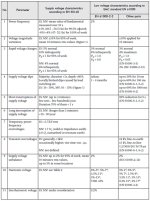
EN50160 Parameter Table.jpg
 
Sounds like a very unique park, your tenants are all basically sub meters on your primary feeder, I guess the NEC applies to your entire setup since your not a utility?
Keep all the terms in your contract exactly what your utility gives you, dont translate anything
and let either the local utility or the tenant do the translating, refer your tenant to the local utility for questions.
As you mentioned your not generation (or maintaining your own frequency reserve) so don't promise anything more or less than your utility offers, the lawyers dont want you sticking your neck out.

The neat thing about your park is you can offer a tenant 416/240 wye 60hz thats a little known North American voltage ( now a standard voltage in the NEC as of 2026 ) that is very compatible with EU 400/230 and your EC can simply use 480/277 gear and deliver 416/240.
Thats a big advantage if they have lots of 416V 3ph 50/60 hz compatible gear and they are comparing your site to one with only 480V.
Note by convention typically 416V denotes 60hz and 415V denotes 50hz.
 
Last edited:
It is unique as far as I know. We recently contracted a coordination study out to a utility engineering firm and they'd never seen anything like our setup. You are correct that they are submetered, and yes, NEC applies.

I agree with not doing more than what our utility does - as you said we don't control most parameters anyway, to include voltage or frequency. My goal is to provide the legal team with as little neck as possible.

There is the question of harmonics that makes me think we owe the tenant some responsibility, and should perhaps dictate a shared responsibility. Our tenants all connect to two redundant busses (we split them at our main feed). All tenants run a large amount of motors on variable drives. While we don't currently monitor for harmonic distortion (probably should?), my understanding is that the harmonic contributions from another tenant will "backfeed" through their 13.8kV/480V transformer onto that buss and then be experienced by a parallel tenant.

As the owner of that common buss, my feel is that we are responsible to ensure that no single tenant is producing harmonic signals above a certain threshold to the detriment of any other tenant. Am I within reason to think that?


Good point about the voltage offerings, thanks for putting that in my head. We haven't used that ability but I think that's a function of most companies having a U.S. footprint already before coming here. This is the first time we may get a tenant that has never built outside of E.U. before, I'll look into that option.
 
It is unique as far as I know. We recently contracted a coordination study out to a utility engineering firm and they'd never seen anything like our setup. You are correct that they are submetered, and yes, NEC applies.

I agree with not doing more than what our utility does - as you said we don't control most parameters anyway, to include voltage or frequency. My goal is to provide the legal team with as little neck as possible.

There is the question of harmonics that makes me think we owe the tenant some responsibility, and should perhaps dictate a shared responsibility. Our tenants all connect to two redundant busses (we split them at our main feed). All tenants run a large amount of motors on variable drives. While we don't currently monitor for harmonic distortion (probably should?), my understanding is that the harmonic contributions from another tenant will "backfeed" through their 13.8kV/480V transformer onto that buss and then be experienced by a parallel tenant.

As the owner of that common buss, my feel is that we are responsible to ensure that no single tenant is producing harmonic signals above a certain threshold to the detriment of any other tenant. Am I within reason to think that?


Good point about the voltage offerings, thanks for putting that in my head. We haven't used that ability but I think that's a function of most companies having a U.S. footprint already before coming here. This is the first time we may get a tenant that has never built outside of E.U. before, I'll look into that option.
I see you want to put some wording in there to prevent one tenant from disturbing other tenants. So if new tenant C moves in and long time tenants A and B start have power quality issues.. thats something to consider.
 
If you are not a source of power most of these items will not be under your control, unless you own transformers and voltage regulators.
Harmonics might be an issue, but you don't generate them, you would simply need to make sure your customers/clients comply with IEEE 519.
 
Ask the local utility for their specs, copy and paste.

There are a bunch of specs you could call out but a majority of them are not going to matter much. I would tell them you are allowed to deliver 10% plus or minus nominal voltage and they are responsible for surge protection on their end. You protect your lines, they protect their equipment. That is really the fundamentals of utility rules anyway.

Then put in some requirements for load additions and large motors to cover yourself incase they keep tripping the line side protection or overload the feeder wire.

I would also suggest requiring approval of their overcurrent protection settings on the primary side or tell them your required settings for coordination.
 
Top