Using well casing as grounding electrode

Status
Not open for further replies.
No, see Section 250.50 and 250.52(A)(7) of the 2005 NEC.

And no, it would not make a very good electrode - or least not any more effective than any other. Depth of the electrode is not a significant factor other than possible reduction in overall resistance which is not all that important. It would perform about as well as (no pun intended) any typical metal underground water pipe used as an electrode.

Many documents and engineers call for deep driven electrodes or will claim a 10' rod is better than an 8' rod, however there is no evidence of this and in fact is quite the opposite in recent studies. Well casings are just overgrown ground rods on Barry Bonds vitamins.

Short radial electrodes installed no more than a couple feet under earth appear to dissipate lightning discharges in a more effective manner verses the typical systems. The bottom 6' of a ground rod is useless.
 
Bryan,

So my interpretation of this after rereading 250.50 and 250.52 is that I dont have to bond the well casing to the grounding electrode system, but I can use it as the (sole) grounding electrode if none are present.
 
Electrofelon,

Here is a comment from one source regarding your questions:
From MIL-STD-1542B (USAF), Electromagnetic Compatibility and Grounding Requirements for Space Systems Facilities, Department of Defense, Washington DC, 1991, p. 19:

"This Standard, MIL-HDBK-419, and MIL-STD-188-124 do not recommend the use of deep wells for the achievement of lower impedance to earth. Deep wells achieve low dc resistance, but have very small benefit in reducing ac impedance. The objective of the earth electrode subsystem is to reduce ac and dc potentials between and within equipment. If deep wells are utilized as a part of the earth electrode subsystem grounding net, the other portion of the facility ground network shall be connected to them."

Pierre,

There have recently been several published papers that have indicated the conventional earthing system is not adequate for the typical lightning strike discharge. As the physics and dynamics of lightning are becoming better understood and through observations in laboratory testing and rocket initiated lightning discharges, better strike termination and earthing concepts are being developed. This is indicated by the significant change in philosophy and methodology of lightning protection techniques in the new standard - IEC 62305 (TC-81).

For example, the paper How to Improve Lightning Protection by Reducing Ground Impedance by C. Bouquegneau - ICLP paper 2.3 page 89 states,

It is generally better to install short-length vertical or inclined electrodes in multiple ground electrode arrangements (prismatic or pyramid - truncated arrangements) than single deep ground electrodes. The study showed that the optimal configuration shall stand with multiple earth electrode arrangements with 3 or 4 short-length inclined electrodes separated about 2m from each other and making an angle of 30? with respect to the vertical direction.

And another, An Examination of Lightning Strike Grounding Physics by C.B. Moore, G.D. Aulich, and William Rison which states,

The inductance of an 8' long, 5/8" diameter ground rod is about 2.4 microhenries which would present a siginifcant impedance to an impulsive discharge. On strike contact to the top of the rod, the potential of the charge at the tip of the negative leader would create a radial electric field in excess of several hundred kV/m. Under such an electric field, radial streamers develop and propagate outward connecting the strike to surrounding induced charges on the ground surface. The primary destination of the strike is the induced charge on the ground surrounding the strike point. It follows that a vertical ground rod is much less effective in connecting a cloud-to-ground lightning strike to earth than would be served by several buried conductors that extend radially outward from the top of the ground.

There are a couple of things to understand about this information. To start off with, a LPS can only protect against direct lightning strikes to a building or structure. It does not protect against surges on the service, ground potential rises, and other transient surges that may effect a structure and the premise wiring and equipment. So in reality, this information may only be applicable to LPS and not to typical grounding electrodes systems used for electrical services.
 
bphgravity said:
...page 89 states...
Bryan, I am just writing to express how overcome I am with your continuing research on this subject, and sharing it, which benefits us all so greatly.

Be glad you're in Florida, because otherwise you'd endure a very awkward (for the both of us) hug. :lol:

:!: Thanks again! :!:
 
Thank you for the nice comments George. 8)

I have become very passionate (obsessive) about the whole lightning and grounding/bonding aspect of our industry. My biggest issue right now is that I don't have the mathematical or engineering background to fully understand some of the concepts and equations involved with this type of research. It is quite frustrating. :oops:

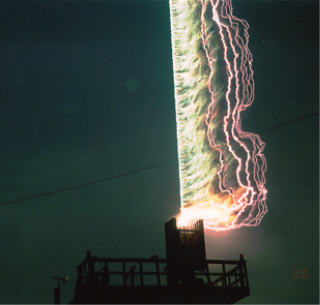
I am hoping to get some time in up at Camp Blanding at the University of Florida this summer to observe rocket-initiated (triggered) lightning discharges. It is quite a amazing to see! :shock:


lightn04.JPG
 
Status
Not open for further replies.
Top