VA to A

I prefer to think of the computation as VA / 120V L-N / 3 lines. It's the same answer. If the loads are all 120V then it is also sort of obviously correct.

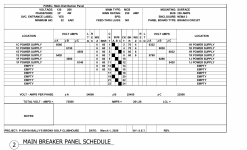
BTW, a reminder that that panel schedule has an error, CKT 4 is overloaded at 9030 VA. 70A * 120V = 8400 VA max.

Cheers, Wayne
 
Ahhhh. What is the 1.732 for?
One answer is the 208V is the L-L voltage, but you are using 3 lines, so obviously you need to divide by some additional amount, and it turns out to be sqrt(3).

Another answer is that if you start with the "VA / 120V L-N / 3 lines" formula as correct, if you switch the voltage from 120V to 208V (which is just 120V * sqrt(3)), then you have to reduce the extra divisor of 3 lines to 3 / sqrt(3) = sqrt(3).

Cheers, Wayne
 
One answer is the 208V is the L-L voltage, but you are using 3 lines, so obviously you need to divide by some additional amount, and it turns out to be sqrt(3).

Another answer is that if you start with the "VA / 120V L-N / 3 lines" formula as correct, if you switch the voltage from 120V to 208V (which is just 120V * sqrt(3)), then you have to reduce the extra divisor of 3 lines to 3 / sqrt(3) = sqrt(3).

Cheers, Wayne
Thanks.
 
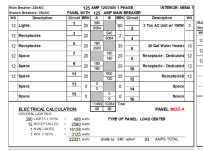
Ok so in this panel schedule they give the calculated load and went about it differently then my 1st pic above. So is it the same end result( a calculated load) but just going about it two different ways?

Also this a 1 phase panel and calculated load is 93amps. I could feed it with a 2P-100A breaker?

1776110392485.png
 
Ok so in this panel schedule they give the calculated load and went about it differently then my 1st pic above. So is it the same end result( a calculated load) but just going about it two different ways?

Also this a 1 phase panel and calculated load is 93amps. I could feed it with a 2P-100A breaker?

View attachment 2582766
sqrt(3) applies to 3-phase, but not to single phase.

It has to do with the fact that what really adds up, is amps-per-phase times voltage-to-neutral (Vpn). When you think in terms of the inter-phase voltage (Vpp) instead, the ratio is sqrt(3). With balanced current on all 3 phases (I), you'll have 3*I*Vpn as the total VA. To use Vpp instead of Vpn, multiply by 1 in a fancy way, i.e. sqrt(3)/sqrt(3), and when substituting Vpp = Vpn*sqrt(3), you get 3/sqrt(3)*I*Vpp, which simplifies to sqrt(3)*I*Vpp.

Single phase-to-neutral loads in a split-phase panelboard, combine such that current on each busbar adds up, and the total VA is the Vpn*I1 + Vpn*I2. If we speak in terms of Vpp instead of Vpn, and currents balance, it's Vpp*I. Vpp = 2*Vpn for split phase, because it's mathematically equivalent to two phases with a 180 degree phase shift, instead of 3 phases with a 120 degree phase shift. The 2 is taken care of, since adding I1 + I2 (both equal to I) will equal 2*I.
 
Top