DukeSilver
Member
- Location
- California
- Occupation
- Electrician
The control xfmr is fried as well but that was supplied by Phase a and b. This is for a soft start.
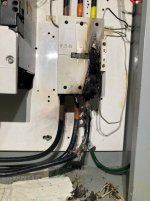


Thank you that is great advice.Loose connection? Those IEC disconnects need to be torqued. As opposed to a NEMA, the lugs are smaller, being touch safe, are recessed and it’s hard to visually observe. IR temp on a routine basis. I always used Burndy Penatrox E which is a copper only anti seeze


The work is about eight months old. Thank you for the advice. I appreciate you taking the time to assess the photo.Hard to say. Did this happen fairly soon after it was put into service? If so my suspicion would be some whiskers were not captured in the lug and eventually caused a short circuit that wasn't enough of a short to trip the circuit breaker.
If it took a relatively long time like years for this to develop, probably improper torque.
But without taking it apart and looking at it really closely it's hard to make a call. And even then you might not really know. Best to just repair it and move on.

Looks to me like probably the same two conductors emerging from behind the unit on the top left, since they seem to be only two smaller conductors to it probably supplies the contactor coil?Just curious, what is on the right side of the breaker with the wires going through the cable tie offs?
Is that an aux contact, or a shunt trip?

That’s not a breaker, it’s a bypass contactor for the soft starter. Those are the coil wires of the contactor.Just curious, what is on the right side of the breaker with the wires going through the cable tie offs?
Is that an aux contact, or a shunt trip?

Loose connection at the C phase cable to breaker terminal. Now we have seen this so many times where the cable lug allen screw that holds the cable) is torqued and tight but the CABLE LUG TO BREAKER STAB is loose. The lug to stab is usually held together by either a screw (hex head or straight blade type) that can be seen and accessed after the cable is removed from the lug. Or, worst case, the lug is held to the stab by a screw that is screwed in from the back of the breaker stab. In this case, the breaker has to be removed from the back pan and the head of the screw can be accessed and tightened from the back of the breaker. We usually find this problem using a Ductor test set or DLRO (Digital Low Resistance Ohmmeter) as part of a routine PM test. Sometimes you can grab the cable and wiggle it (depending on the cable size) to uncover the loose connection.The control xfmr is fried as well but that was supplied by Phase a and b. This is for a soft start.
View attachment 2561405
Ok but what was stated in post #11 still applies since the construction is the same.Again, that’s not a breaker, it’s a contactor…
I'd never call that operating coil a control transformer. I'd call control voltage source a control transformer but never coil that the primary function is to operate a mechanical load.Loose connection at the C phase cable to breaker terminal. Now we have seen this so many times where the cable lug allen screw that holds the cable) is torqued and tight but the CABLE LUG TO BREAKER STAB is loose. The lug to stab is usually held together by either a screw (hex head or straight blade type) that can be seen and accessed after the cable is removed from the lug. Or, worst case, the lug is held to the stab by a screw that is screwed in from the back of the breaker stab. In this case, the breaker has to be removed from the back pan and the head of the screw can be accessed and tightened from the back of the breaker. We usually find this problem using a Ductor test set or DLRO (Digital Low Resistance Ohmmeter) as part of a routine PM test. Sometimes you can grab the cable and wiggle it (depending on the cable size) to uncover the loose connection.
This severe damage does not happen overnight. As I recall, the OP stated it happened several months after installation.
As for the "control transformer" being fried. You may be referring to a shunt trip coil that would be inside the breaker as evidenced by the white and black control wires coming out of the breaker, mentioned in another post.
Finally, as I look closer at the photo, the "breaker" appears to be a Contactor and the control wires power the contactor operating coil (called control transformer) as Kwired mentioned. The breaker to the left must be the supply power to the contactor.

I think to those bones are part of the 'arc chute' that fell.Did you guys miss the BONES in the picture? I say RATS caused the arc. Plastic got burned to produce carbon, carbon started conducting at some point and finished the job long after the skin disappeared.
Did you guys miss the BONES in the picture? I say RATS caused the arc. Plastic got burned to produce carbon, carbon started conducting at some point and finished the job long after the skin disappeared.
I agree, arc chute remnants.I think to those bones are part of the 'arc chute' that fell.
Without a doubt.Loose connection?

