
Flicker Index
Senior Member
- Location
- Pac NW
- Occupation
- Lights
Not just this, but things like metal benches at station are also connected like this. 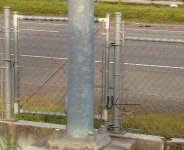


But why? Isn't the physical conductivity from the hardware enough? I don't know why this gate needs a jumper to frame.Looks like a bonding jumper.

The hinges may not be adequate, so a bonding jumper is added. You can see the same thing in large Type 4 and 12 enclosures/control panels.But why? Isn't the physical conductivity from the hardware enough? I don't know why this gate needs a jumper to frame.

electrocution hazards arise when there are two different voltage potentials. assuming that pole right in front of the gate is a high-voltage power pole, there could be large magnetic fields surrounding that metal fence/gate.But why? Isn't the physical conductivity from the hardware enough? I don't know why this gate needs a jumper to frame.
That's backwards- typically the tracks are the intended return but being imperfect conductors on imperfect insulators (wood ties) they leak to the dirt. Earth return is definitely not desired (this was a known issue pretty much since the origin of electric railroads), in newer installations the running rails are insulated from the ties to lessen the leakage.Light rail is typically single-wire-earth-return, technically speaking, (although the tracks provide a lot of conductivity for the 'earth').
'tain't just the NEC, compare the laws of animal abuse vs human abuse.the NEC cares more about cows and pigs than it does our own children.
That's backwards- typically the tracks are the intended return but being imperfect conductors on imperfect insulators (wood ties) they leak to the dirt. ...