

lbeachmike
Member
- Location
- Long Beach, NY
Hi there -
My electrician did this work about 8 months ago. As you can see, it didn't hold up so well. This was fastened to cement-based stucco.
Thanks for your help.
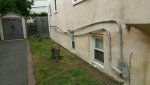
View attachment 18608View attachment 18609
I agree would have definitely buried or used some sort of metallic rigid conduitPVC expands and contracts quite a bit with temp. changes.
I would guess these straps mounted to the stucco didn't allow the PVC conduit to move freely.
There are better straps that can be used. There is a block type that can be mounted to the stucco that will allow more movement
Probably need an expansion coupleing in there to.
I would either run those long runs lower (below windows or buried) or use EMT so it could be painted.
If you did use real electricians this could still be under warranty. I don't know your laws but here it's one year.
PVC expands and contracts quite a bit with temp. changes.
I would guess these straps mounted to the stucco didn't allow the PVC conduit to move freely.
There are better straps that can be used. There is a block type that can be mounted to the stucco that will allow more movement
Probably need an expansion coupleing in there to.
I would either run those long runs lower (below windows or buried) or use EMT so it could be painted.
If you did use real electricians this could still be under warranty. I don't know your laws but here it's one year.
...
2. In the second photo you can see one plastic anchor pulled right out of the wall. Plastic anchors, to me, don't appear to the be proper product for cement stucco. I don't see how plastic would anchor in a cement-based product. Is this the proper fastener?
How long is the PVC run around the corner, after the LB?
That PVC run needs to be able to expand and contract. So the broken brackets should be replaced with ones that allow movement in the direction perpendicular to the wall. Or else an expansion fitting should be added to that run around the corner, so that the pictured short run can be rigidly anchored.
Cheers, Wayne
Well, another thing could be if they used a masonry drill that was a size or two too big for the anchors. That would be bad.
This was fastened to cement-based stucco.
Anchor bolts or Tapcons would be better than those plastic anchors.
The anchors are plastic. Doesn't masonry call for metal anchors?
Hi there -
My electrician did this work about 8 months ago. As you can see, it didn't hold up so well. This was fastened to cement-based stucco.
Thanks for your help.
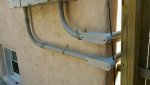
View attachment 18608View attachment 18609
:thumbsup: Or any anchoring system, you need long enough screw to hit whatever is behind the foam, if there is anything solid behind it.If it's just a veneer of stucco with styrofoam behind it there is not much for a tapcon to hold to.
The fact that most of the anchors stayed in place and the straps broke should tell how strong they can be.
When he says it's cement based stucco I don't think there is a block wall behind it. That would be a real stucco. I would assume ( and we know that gets you into trouble) than this is what I call a fake stucco product. They all have a certain amount of cement in the mixture.
If it's just a veneer of stucco with styrofoam behind it there is not much for a tapcon to hold to.
If you look at the thickness of the wall, especially around the windows, I would almost bet that is a block building with the stucco finish over it.
Either way it was not installed correctly to allow for expansion and contraction.
