Winter Storm Generator

Irving LaRue

Member
Location
Warrenton, Virginia
Occupation
Electrician Apprentice
Friend of mine has a question regarding generators for the upcoming winter storm this weekend. I mostly do commercial work, so I’m not sure how to answer a question like this. Help is appreciated!

They asked me this question, “How much generator do you think I would need for a gas furnace and a couple of appliances (a couple of fridges, an upright freezer)?”

He said he has a switch (which I’m assuming is an automatic transfer switch) for his generator to plug in. He’s looking into 5,000W generators. Does this seem like it will be enough? If you don’t mind, I’d be curious to see how you came to that answer.

Also, should I steer him toward a whole home generator for the future? Obviously it’s too soon for this weekend’s storm. Thanks!
 
I would assume that he has a breaker interlock and not an automatic transfer switch. The generator breaker on most of the interlock kits I have seen is a 30 amp breaker. So no need for a generator larger than 7.5kW.
 
How much generator do you think I would need for a gas furnace and a couple of appliances (a couple of fridges, an upright freezer)?”
5000 watt should do it. I would choose an inverter type even though they cost more money. I have an 8000 watt with a natural gas conversion kit and can continuous power all of the necessities.
 
I do a lot of this stuff, and the way it goes is people think NONE right until there is impending drama! A proper inlet is preferred but I've had to do what I must.

Honda EU3000 or comparable will cover that load with ease. That is a 120V backfeed ONLY, so no 240V, and that needs considered. I consider this deployment, the "survival package" That means you better fill some jugs and do a little planning. The generator will run the furnace and fridges easily. Bigger generators with minimal load just drinks fuel. The Honda 3000 inverter will do about 20 hours in a fill in that situation.
 
Should be fine assuming the furnace blower isn't massive. If they are typical residential refrigerators I doubt they are any more than 500W.

Some things just to think about:

1. The big number on the side of the generator box is almost always the peak rating, not continuous.
2. The inrush current from the starting of the compressors can be several times the running current. You will likely be able to notice the voltage drop from starting if you also have lighting loads connected, especially if you have a long cable connecting the transfer switch/interlock to the generator, or if you have an inverter in eco mode.
3. If the loads are 120V, make an attempt to balance them between the lines. If you have them all on L1 you have essentially cut the generator output in half.
4. If you are connected into building wiring with a transfer switch (assuming residential and non-SDS) or interlock, make sure you do not have an additional bonding jumper at the generator. Many portable generators have one from the factory in order to clear ground faults when plugging directly into the 5-20s. You can typically remove it by unscrewing the cover on the end of the alternator and taking it out.
 
A standard fridge takes about 5 amps so that =10
Freezer probably a little more so..............................= 8
Gas furnace ( if its a boiler it won't draw only a couple of amps)
A furnace could have a 1/2 or 3/4 hp motor which is 15 amps

so that's 33 amps at 120v

or 16.5 on a balanced 240 system
5500 watt is 23 amps

So the 5500 should do it easily and they won't all run 24/7 at the same time
 
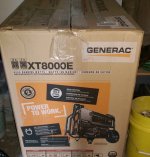
Is that true of newer generators? My older Generac is not labeled that way.
Certainly is true for some. Perhaps I may be wrong on "almost always" but for most I've seen I would say so, but I don't know if it is really a new/old thing. I've used a Northstar that was 8kW starting and had a big "8000" on the side of it, but was only 6600W running. That gen was fairly old. All the Predators I've seen list starting (although no surprise there - it is Harbor Freight after all...). I recall some Champions listing both on the side in the same size font, but some only listing starting.

I just did some quick homedepot.com research, and who would have guess it...the Generacs I see only list the running watts on the side of it. Everyone else either lists only starting, or they list both.

Gotta love marketing :)
 
Friend of mine has a question regarding generators for the upcoming winter storm this weekend. I mostly do commercial work, so I’m not sure how to answer a question like this. Help is appreciated!

They asked me this question, “How much generator do you think I would need for a gas furnace and a couple of appliances (a couple of fridges, an upright freezer)?”

He said he has a switch (which I’m assuming is an automatic transfer switch) for his generator to plug in. He’s looking into 5,000W generators. Does this seem like it will be enough? If you don’t mind, I’d be curious to see how you came to that answer.

Also, should I steer him toward a whole home generator for the future? Obviously it’s too soon for this weekend’s storm. Thanks!


5000 to 7500 kW will be plenty for that.

As much as it pains me to say it, the Honda EU7000is is a great generator. Super quiet, reliable, and it’s an inverter generator, so power is very clean.

I can go into the load calcs a little more, but right now I’m contemplating my recent business decisions over a whiskey sour. Or 2.
 
Whole house generators with an ATS are incredible. They are not cheap, but they are the best.

You literally sit still for 20 seconds when the power goes out, and wait for everything to light back up. You usually don’t even notice when utility is restored.

The unit itself is about $6K or so for a 22kW, and for me at least, install is a little more than that, so 12-14k is minimum buy in. I’ve done ones for less, I’m doing one now for about 3500, but he has an MTS already installed, he is doing all the trenching, and gas is very close by.
 
Vodka/club soda for me right now. After all day prepping for the slap in the face, called weather. I don't care about the snow, it's the nasty cold that causes drama.

I work a lot around generators. most of the ones being discussed are what I call "screamers". They are 2 pole generators running at 3600rpm. They do NOT have the torque to maintain frequency or voltage very well. I've also caught the EXACT same generator labeled as both a 5000w, and a 6500W.

people now associate "inverter" with "quiet". That ain't the case! It's just in the design. Screamers are at the extremes of economy. BTW, Let me remind people of a HUGE advantage no one ever things about. Inverters will sync to each other. What this means is you can run a pair to serve bigger day loads, and step down to one over night or something.

If you find a generator that runs at a lower 1800rpm, it will not only be much quieter, it will take an inrush hit much better, but the engine must be bigger! This is why they are not common as "portable units". I have a 5500W, non-inverter Onan that is church mouse quiet, even running next to my Honda EU3000 inverter! An absolute beast for taking compressor hits, but the fuel consumption matches....

Another thing to remember is generator, or ANY engine's efficiency is a function of load. The higher the load, the more efficient.

When you are looking at screamers, always look at the actual engine displacement. This is a good indicator of what you're dealing with.
 
Don't believe the manufacture's ratings. My understanding is the rating is a no load rating and that is reduced if it's a dual fuel
run on fuel other than gas.
I was loaned a pair of 5000 watt generators to do some welding. The output considerably reduced when run on LPG and what
the under load output was. Smoking mirrors.
 
Don't believe the manufacture's ratings. My understanding is the rating is a no load rating and that is reduced if it's a dual fuel
run on fuel other than gas.
I don't understand what you mean by saying that the power rating of a generator is a "no-load" rating. The full load power output can't be at no load - that doesn't make sense.

Yes, dual-fuel and tri-fuel generators often have lower power outputs running on LPG or natural gas. The full output can only be achieved using gasoline. LPG typically gives more output than NG.
 
Top