Wire laid in mortar-less brick joint ??

Status
Not open for further replies.

James L

Senior Member
Location
Kansas Cty, Mo, USA
Occupation
Electrician
I have a residential job with a gas insert being installed into a wood burning fireplace in a finished basement. A gas line was run into the fireplace when the house was built.

The insert has a blower which needs 120 volts, but there's not a good way to get power in there.

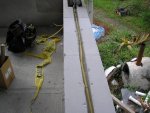
The general contractor is planning to apply a stone veneer over the brick. He wants to use a grinder to remove about one inch of the depth of a horizontal mortar joint, and have me lay a wire in the joint and leave it without mortar. Then apply the stone veneer and cover it.

I told him I will not lay a piece of Romex in that joint, but I'm wondering about a piece of UF cable? I also wondered about covering a cable with a small wire loom to add a small amount of protection.

The mortar joint is just a bit smaller than 1/2"

Any suggestions?
 
What code provision would prevent you from putting Romex in there?
nothing specific that I'm aware of, only thing I can think of are provisions for grooves and notches in wood.

it just seems there wouldn't be any prohibition against something inconceivable.

maybe if I laid the cable in there and then feel the groove with foam caulking backer? I don't know, I'd still have a hard time walking away from it feeling that it's totally legit
 
You could use MC cable without the protection required for UF.
I thought about using MC cable, but it will be at the face of the existing brick and I'm supposed to leave six to eight feet of wire laying loose, long enough to reach the junction box on the fireplace wherever it might be located

I'm a little concerned about the coil sheath being folded 90 degrees by the fireplace installers.

can you think of UF protection requirements which would directly apply in this scenario?
 
nothing specific that I'm aware of, only thing I can think of are provisions for grooves and notches in wood.

it just seems there wouldn't be any prohibition against something inconceivable.

maybe if I laid the cable in there and then feel the groove with foam caulking backer? I don't know, I'd still have a hard time walking away from it feeling that it's totally legit

I'm having a hard time understanding why you think there's something wrong with this idea. The Romex is both concealed and protected. I just don't see anything wrong with it. I'm not all that worried that somebody might try to nail through the stone into the Romex.
 
I thought about using MC cable, but it will be at the face of the existing brick and I'm supposed to leave six to eight feet of wire laying loose, long enough to reach the junction box on the fireplace wherever it might be located

I'm a little concerned about the coil sheath being folded 90 degrees by the fireplace installers.

can you think of UF protection requirements which would directly apply in this scenario?
Rules for UF in a dry location are pretty much same as NM rules. What is it you think you need extra protection from? It is better protected as is then if it were in similar chase behind wood or drywall.

Even if someone did drill into it someday - there is non combustibles surrounding it.
 
I'm having a hard time understanding why you think there's something wrong with this idea. The Romex is both concealed and protected. I just don't see anything wrong with it. I'm not all that worried that somebody might try to nail through the stone into the Romex.

I don't know. I suppose it just seems weird.

That's why I asked here - I keep saying there's something wrong with it but I can't demonstrate why.
 
I don't know. I suppose it just seems weird.

That's why I asked here - I keep saying there's something wrong with it but I can't demonstrate why.

i was in a commercial building where they were moving a wall that had an electrical panel in it..
there was a piece of 12-2 romex disappearing from the bottom of the panel into the floor...
it was a tile floor, with brick sized tiles. i turned off the breaker feeding the romex,
and the fountain in the center of the lobby went off. they laid the romex in a herringbone
pattern in the 1/2" mortar joints across the floor.....

while not code compliant, nobody ever drove a nail or screw and shorted out the romex.
refeeding it was a bit of a problem, however. :(
 
Here is a picture of one of the times I did exactly what the op is asking about....

Here is a picture of one of the times I did exactly what the op is asking about....

Using Romex, inside a channel cut into Aireated concrete block walls , which can easily be cut using a router or drilled using a plain old flat bit and a cordless drill. Duct tape was applied over the channel in order to prevent the thin set mortar from landing directly onto the cable sheath. Here is a Wikileaks link to the construction method. I have done a few dwellings using this method of construction. https://en.wikipedia.org/wiki/Autoclaved_aerated_concrete

2491-axel.jpg
 
Using Romex, inside a channel cut into Aireated concrete block walls , which can easily be cut using a router or drilled using a plain old flat bit and a cordless drill. Duct tape was applied over the channel in order to prevent the thin set mortar from landing directly onto the cable sheath. Here is a Wikileaks link to the construction method. I have done a few dwellings using this method of construction. https://en.wikipedia.org/wiki/Autoclaved_aerated_concrete

Excellent
 
What code provision would prevent you from putting Romex in there?

This might if I have it right.
NEC 334.12(B) (2) and (3)
I'm paraphrasing here:
Type NM cable shall not be embedded in masonry, concrete,fill or plaster; nor run in shallow chase in masonry 01' concreteand covered with plaster or similar finish.
 
I thought that type NM was _not_ permitted to be installed embedded in concrete or masonry, but that type NMC _was_ permitted for such installations.

Meaning that 'it depends on the specific markings of the cable'. Is it possible that some UF cable is also marked NMC?

According to southwire, 'UF-B can also be used in applications permitted for NMC in Section 334.10(B)'
http://www.southwire.com/products/UFBOEM.htm

-Jon
 
This might if I have it right.
NEC 334.12(B) (2) and (3)
I'm paraphrasing here:
Type NM cable shall not be embedded in masonry, concrete,fill or plaster; nor run in shallow chase in masonry 01' concreteand covered with plaster or similar finish.


(B) Types NM and NMS. Types NM and NMS cables shall not
be used under the following conditions or in the following
locations:
(1) Where exposed to corrosive fumes or vapors
(2) Where embedded in masonry, concrete, adobe, fill, or
plaster
(3) In a shallow chase in masonry, concrete, or adobe and
covered with plaster, adobe, or similar finish
(4) In wet or damp locations

I don't see how it is embedded or covered with the prohibited materials.
 
post #11 :eek:hmy::thumbsdown:

i would have at least put that in pvc.
and what do those NM staples nail into?
 
I don't see how it is embedded or covered with the prohibited materials.

(3) In a shallow chase in masonry, concrete, or adobe and
covered with plaster, adobe, or similar finish.

Where I come from, anyone who installs NM through concrete directly is called a hack. I'm not say you are. :D
I don't know of any inspector that would allow you to run a standard romex/ NM through concrete or masonry. It needs to be in a sleeve.


(3) In a shallow chase in masonry, concrete, or adobe and
covered with plaster, adobe, or similar finish.

Where I come from, anyone who installs NM through concrete directly is called a hack. I'm not say you are. :D
I don't know of any inspector that would allow you to run a standard romex/ NM through concrete or masonry. It needs to be in a sleeve.


Read the whole line. The OP's proposal is a shallow chase (it seems to me), but it is not covered with plaster, adobe or similar finish. It is not covered with finish at all. It is covered by the next row of AC blocks, with a mortar joint.

It seems to me that the section describes and prohibits cutting a chase into the inside or outside face of a wall or ceiling and plastering in the wire with a thin enough layer of finish as to leave it subject to physical damage, including a picture mounting nail, etc.

The construction method of a surface grove filled with cement or other finish is commonly used in Europe, among other places, where conduit is almost unheard of in residential wiring.
 
Status
Not open for further replies.
Top