Wire nick

Merry Christmas

Jimmy7

Senior Member
Location
Boston, MA
Occupation
Electrician
I found a nicked #14 neutral wire in a ceiling box, and it’s too close to where it enters the box to cut and splice. Other than replacing the cable ( It’s a non-accessible ceiling, I would have to punch holes) is there anything else I can do to cover the nick? Could I just tape it since it’s in a box?
 
Since it’s the neutral, can I use white tape? I wasn’t sure if marking tape carry the same ratings
Yes colored electrcial tape is listed the same as black electrcial tape. I've heard many times my career that they're not the same which is incorrect.
 
If the conductor itself is nicked, you are pretty much out of luck. Though the limit of 'too close to cut and splice' depends heavily on the wire connector you use; a 'wago lever connector' needs much less free wire than a wire-nut. 'Set screw wire nuts' need little space and give you a splice that is very tight and verifiable, thought they are pricy and a pain to obtain.

I very much like insulated fiberglass sleeve for this sort of insulation repair. It is really hard to wrap tape around something at the back of a box near the cable clamp, but you can just slide the sleeve on to cover nicked insulation. See for example: https://www.mcmaster.com/2573K42

The stuff comes in various sizes and in black or white. Make sure you get the 'expandable' kind, and get the correct diameter for your wire.

McMaster is probably the most expensive place to get it, but they have it in stock and will get it to you quickly.

-Jonathan
 
Another vote for heat-shrink here, especially if you can get a color that matches the existing insulation. I'll also often use small rings on my modbus and bacnet/mstp lines to help keep track of what goes where. Both smaller and a LOT cleaner than tape, and won't fall off like the numbered strips from Ideal.
 
White heat-shrink is readily available. I always have some in the tool box.

In-laws have "crumble-wire" romex in their 1950 house, and got in trouble with a ceiling fan replacement. They couldn't tell black from white...both wires were a slightly decomposed brown. I was called in to save them. I had to stretch an extension cord in from a properly-wired outlet to establish which was the grounded conductor, then put a stick of white heat-shrink around it. The other wire got black heat-shrink, mainly to maintain integrity of the insulation.
 
White heat-shrink is readily available. I always have some in the tool box.

In-laws have "crumble-wire" romex in their 1950 house, and got in trouble with a ceiling fan replacement. They couldn't tell black from white...both wires were a slightly decomposed brown. I was called in to save them. I had to stretch an extension cord in from a properly-wired outlet to establish which was the grounded conductor, then put a stick of white heat-shrink around it. The other wire got black heat-shrink, mainly to maintain integrity of the insulation.
I’m not to familiar with using heat shrink. Is there a brand you prefer? Is there a rating you need to look for when purchasing it?
 
I’m not to familiar with using heat shrink. Is there a brand you prefer? Is there a rating you need to look for when purchasing it?
When I'm using it to ID my comm lines, I use whatever's cheapest. If it's an actual insulation repair/augment, can't go wrong with 3M.
 
I'll also often use small rings on my modbus and bacnet/mstp lines to help keep track of what goes where. Both smaller and a LOT cleaner than tape, and won't fall off like the numbered strips from Ideal.

The above means using small rings of heat shrink material to color code signal cables so you know where they go. You can even buy printed heat shrink labels for this application.

While I like heat shrink in general, I don't like it for repairing insulation at the back of a box, because you have to get the tube all the way to the back and then heat it to shrink the wire. Ideally you heat from all sides but at the back of the box you don't really have access.

The nice thing about the sleeves is that the just slide on. The downside of the sleeves is that they can slide off...

-Jonathan
 
Are a few wraps of tape, heat-shrink tubing, or liquid tape "suitably rated" per 200.2(A)?
As long as the tape, heat shrink, or liquid tape is rated for the voltage of the system it can be used. I checked some 3M tape says rated for 600 volts, Heat shrink 600 volts, and liquid tape some are rated for 1117 volts/mil thickness so any of the three could be used to repair a nick in a conductor.
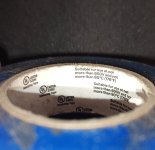
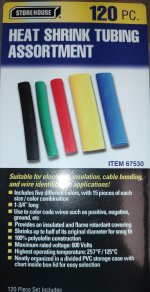
Colored Tape.jpgColored Heat Shrink.jpg
 
Top