
How did this 400amp service ever pass?

Status
Not open for further replies.

Dsg319

Senior Member
Location
West Virginia
Occupation
Wv Master “lectrician”
Here’s the scenario, 400amp delta(high leg) 3ph service already existing. Metering is through CTS at the top of the pole.

Service disconnect, no high leg identification, no neutral to EGC bond. All most be done at down stream panels because I have continuity between the two.

The main feeders go into a big junction box that from there feeds other panels out in the field which I have not seen.

Our job was to tap into the existing feeders to supply a new garage building (industrial).

I seen the guys that terminated our installed 200amp fused disconnect had bonded the neutral and EGC. As I noticed I figured that wasn’t right because we were downstream of the service disconnect, but after opening it and finding there was no bond, I left the bond in our disconnect for the feeders suppling the building.3675DDD8-D4AC-4943-B6E4-67FCF635E75D.jpeg
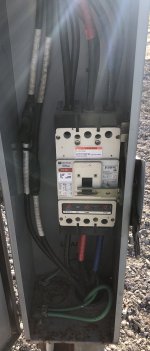
 
I assume the pic is of the service disconnect. Thus you do need a neutral to ground bond but that may be done in the meter. I am not certain if that would be compliant.

At the main structure you do need to separate the neutral and equipment grounding conductor. Then install ground rods and connect the grounding electrode conductor to the equipment grounding conductor and keep the neutral separate.
 
I assume the pic is of the service disconnect. Thus you do need a neutral to ground bond but that may be done in the meter. I am not certain if that would be compliant.

At the main structure you do need to separate the neutral and equipment grounding conductor. Then install ground rods and connect the grounding electrode conductor to the equipment grounding conductor and keep the neutral separate.
Yes it is the service disconnect and I do not believe there is any EGC routed to the meter . As it’s just the wires from the CTS down to the meter.

I follow you on the n-g separation at the structure. But I believe although it’s not correct, I would be best to leave the neutral to EGC Bond in our 200amp disconnect that is right after the tap into the feeders.

For the reason of clearing faults in a timely manner. Without the bond we have made if there was a fault in the structure, it would have to go all the way back on the EGC where spliced in the main junction box and all the way down to another downstream panel where I believe they had made there neutral to EGC bonds.
 
I would say they didn’t order the neutral kit, and just used inline splices instead, so there wasn’t a convenient way to bond it, unless they bonded it in the meter as Dennis suggested that they might have done.
 
I would also say the original installer thought it was going to be a 120/208 volt service, or was unfamiliar with delta services given they phased it with red. Did they actually get the high leg on “B” phase? If on “C”, they definitely were not familiar with delta installations, or again, they thought it was going to be a wye, and it didn’t get flipped at the load side of the meter base.
 
I would also say the original installer thought it was going to be a 120/208 volt service, or was unfamiliar with delta services given they phased it with red. Did they actually get the high leg on “B” phase? If on “C”, they definitely were not familiar with delta installations, or again, they thought it was going to be a wye, and it didn’t get flipped at the load side of the meter base.
It was actually on B phase. Maybe original install was a WYE than had poco change transformer bank.
 
The code requires the MBJ to be in the disconnect regardless of any neutral to ground bonds that may be upstream. Can't tell from the photo the details but it is very likely that there is no fault path at all without the MBJ. They need to add a neutral bar and a MBJ to be compliant. And as mentioned the color of the high leg is wrong.
 
Conductors may be subject to derating as parallel are in 1 conduit?
 
Yes it is the service disconnect and I do not believe there is any EGC routed to the meter . As it’s just the wires from the CTS down to the meter.

I follow you on the n-g separation at the structure. But I believe although it’s not correct, I would be best to leave the neutral to EGC Bond in our 200amp disconnect that is right after the tap into the feeders.

For the reason of clearing faults in a timely manner. Without the bond we have made if there was a fault in the structure, it would have to go all the way back on the EGC where spliced in the main junction box and all the way down to another downstream panel where I believe they had made there neutral to EGC bonds.

The meter doesn't get an equipment grounding conductor . The one going to the building is there and is correct. The neutral from the meter is bonded to ground at both the meter base and the panel so no equipment grounding conductor is needed.
 
Another violation probably, existing but havnt done any calcs. 400amp service with parallel 4/0.
Can't tell from photo, but sizing is close enough if CU, parallel 3/0 would be min; but if AL. 4/0 would be undersized for 400A.
 
The meter doesn't get an equipment grounding conductor . The one going to the building is there and is correct. The neutral from the meter is bonded to ground at both the meter base and the panel so no equipment grounding conductor is needed.
Sorry if I had made this confusing, I should have provided a sketch of the set up downstream of the main service disconnect.

There’s is no 400amp meter only the one from the CTs around the service drop conductors.

These service conductors go straight from the drop to the main service disconnect. Where there is no bonding at all.

From there goes into a big Hoffman box and taps are made into the feeders and go from there to different panels serving who knows what.

From looking at the service disconnect there would be know way of clearing any type of ground fault, but after checking with a ohm meter it appears they have done all there bonding at the down stream panels. (Which I know is wrong).

But I am not here and able to fix all these violations, so with this set up we are also forced to have a neutral to EGC bond in our first disconnect after the taps are made.

Sorry for any confusion.
 
Question for all. If this is an "emergency disconnect not service equipment" and seperate service feeder taps, can the seperate structures be bonded individually with own grounding systems? 2020 would seem to be so. If that is an allowable installation under the newest code would all that be needed is signage?
 
Status
Not open for further replies.
Top