Polaris connector absolutely destroying aluminum wire at required torque

brycenesbitt

Senior Member
Location
United States
I work in jurisdictions that require demonstrating torque on every job, or at least a video of connectors being torqued with a tool.

But there's been a big problem with old aluminum feeder wires in apartments.
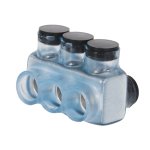
When torqued to the NSI/Polaris specifications, the bolts simply tear the aluminum conductors.
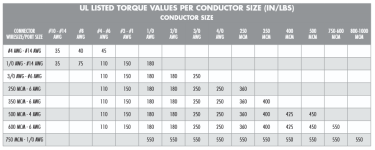
1764212632103.png
For example at 180 in/pounds for 1/0 AWG stranded aluminum.

This has been a problem when the AHJ insists on seeing a live demonstration of torque on the connector, and it tears.
You don't get too many chances on this, as these wires come out of the wall without a whole lot of slack.

Split bolts like the APS06 have similarly difficult to achieve torque values, but the design of a split bolt does not dig at the old cable quite as much.
Anyone deal with this situation and found a solution?
 
What size wire?
You may want to get your wrench or screwdriver calibrated.

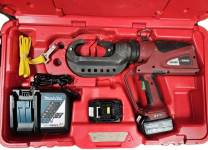
I see more and more guys using mechanical crimp tools
Burndy makes a 15-Ton Crimper
That takes 18V Makita batteries.
There are a few others like greenlee and lesser known brands.
1764215418956.png
 
What do you mean by tear into the conductors? Are they completely sheared off? Is the problem the fact that the conductors are old?
With NSI Polaris connectors, there's no plate that the screw pushes on, that then pushes the wire.
The screw directly rotates against the wire. In the ones we've done the steel screw literally mashes the wire a to pulp. The aluminum is the 1950's 1960's 1970's era stuff which is pretty brittle to start with.

That much torque is not doing what the AHJ wants it to do. Not a good connection
 
What does the inspector suggest when he witnesses this happens?
Depends of course. "Just get it as tight as you can" for example.
What the hell can they say, other than "use part number APS11 instead" maybe. They are not working electricians, they don't know.

What size wire?
You may want to get your wrench or screwdriver calibrated.
Recent examples
70A - assumed #3 Al Str 1958 THW
100A - assumed #1 Al Str date unclear probably 1990's
Both of those the tool was a #2466-22 M12 FUEL™ 1/2" Digital Torque Wrench from Milwaukee tool

The project goal is always a NEC tap rule connection to the old wiring, with a smaller gauge tap.
 
Last edited:
What does the inspector suggest when he witnesses this happens?
I had a solar project - the City of Berkeley inspector required the solar contractor who was from out of the area to torque the terminals
which were already tight. I doubt they were used to the scrutiny level that's applied locally on that issue.

Snapped the entire lug off. A week later the same inspector was back to check the torque on the new panel. Snapped the lug off. I was not supervising or responsible for that job, so I don't know the details of the tool used. But I won't torque an already tight connection, rather will back off the screw and give it one go until the wrench hits the target.
 
That may allow it to shear more easily. Older Al alloys were soft.

Crimps, pressure plates and appropriate split bolts.

To clarify, I wasn't suggesting Noalox on the screw threads, but on the conductors themselves. That would reduce friction between the tip of the bolt and the aluminum, no?
 
For example the set screw design Polaris Vision #IPLD350-3CB
View attachment 2580806
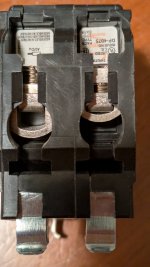
As opposed to the Square D QO design which compresses the wire, rather than bite into it. Click for full size image.
View attachment 2580807
Supply house I use has more Burndy connectors of this type than Polaris. some of them are rated for fine strand conductors. Major difference is they also have a plate to compress the conductor instead of direct set screw contact which would lessen chances of damaging small strands and possibly would give you more success with OP situation I would think. The Burndy ones have the suffix-FX in catalog number if they are rated for fine strand conductors.
 
To clarify, I wasn't suggesting Noalox on the screw threads, but on the conductors themselves. That would reduce friction between the tip of the bolt and the aluminum, no?
Nolox would set things back in this situation.
The screw is pushing the stranded conductors apart first, then destroying them.
What's needed is crimp or clamp.


Existing situation
  • Existing 70A Bryant breaker.
  • Existing insanely stiff #2 or #3 stranded aluminum wire TRIMMED TO FIT in 1958. No sign of heat stress.
Desired outcome
  • Pigtail modern copper wire to the historic 70A Bryant breaker. #4 probably (**).
  • Tap in the historic aluminum wire
  • Tap in new #10 or #8 stranded copper wire
I'm seeking this forum's help in figuring the best tap method, given the problems with
the NSI Polaris tearing the aluminum wire. The taps could be aluminum I suppose, but there's no real telling if the original Bryant 70A breaker was Cu/Al rated at this point.


(**) We can't replace the 70A Brant breaker because the local AHJ won't allow us to trim the deadfront cover to
match a newer breaker. If we fabricate a new deadfront we have to show a UL test certificate for each cover. If we supply a new old stock cover we have to prove that it's for the particular model of panel. The old Bryant used the VW Split Rear Window approach with a metal bar. If we remove that bar to put in a modern BR breaker, the AHJ will fail the project as having violated the listing of the 1958 panel cover.
 
Do you have a picture of the old breaker/cover? I would like to understand what you are talking about.

Why not leave the exiting #2 to breaker terminations alone and just use IDC connectors to tap into the existing #2's?
 
Top