Plan checker wants AIC rating for obsolete equipment. Is 110.24B being applied correctly?

Merry Christmas

brycenesbitt

Senior Member
Location
United States
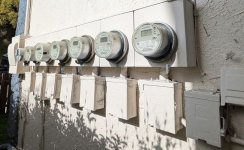
We have seven crufty and jam-prone FPE unit main breakers on a six unit apartment.
There is no capacity problem, just the jamming breaker risk. These are two circuit apartments with
no interior sub-panel.
Capture.JPG
The proposal was a like for like swap of the panels below the meter bases to resolve the breaker jamming
risk.

The correction came back
Provide series rated or engineer rated electrical design system. When modifications to
the electrical installation occur that affect the maximum available fault current at the
service, the maximum available fault current shall be verified or recalculated as
necessary to ensure the service equipment ratings are sufficient for the maximum
available fault current at the line terminals of the equipment [NEC/CEC 110.24.B]

Is it reasonable to attempt to comply with NEC 110.9 and NEC 110.10 in a like for like replacement situation ?
 
If you're not changing anything line side of the FPE boxes then you're not making "modifications to the electrical installation ... that affect the available fault current at the service", and it's not appropriate to enforce this rule.

The service disconnect is that switch to the left of the meters. Maybe make clear on your application that you're not touching the service disconnect.

If you're replacing that disconnect or anything on the line side of it then it would be appropriate to enforce, even if it wasn't reasonable. There's no requirement in the code that AHJs be reasonable. But maybe you should make a public input to add that to 90.4 in the next version of the code. ;)
 
110.9 and 110.10 always apply. There are no exceptions to these rules. These rules apply through out the entire electrical installation not just at the service entrance. While it doesn't happen in residential situations, it is theoretically possible to violate 129.9 and 119.10 by simply adding a large enough motor to an existing system.

When utilities change their system it can also impact installed equipment. Yhis is one reason they ask for equipment with what seems to be excessively high SCA/AIC ratings, so these situations are minimized.

Breakers have had AIC ratings for some 70 years now. Somewhere in the 60s the default AIC rating was increased from 5kA to 10kA.

The good part is that conductors are very good at dropping the available fault current. Have you tried one of the online calculators to see what fault current you might have at the panels you aren't touching?
 
Those aren't the rules that the AHJ cited. Also its stupid to throw red tape in the way of replacing FPE equipment that maybe doesn't even have an interrupting rating on the label.
it looks like the plan checker cited 110.24(B). The OP specifically asked about 110.9 and 110.10.
 
Is this project in CA? I can provide you some helpful code citations, but they are CA specific...
OP here. Yes California. Bay Area.

The disconnect was made clear the the plan checker, who is better at checklists than understanding SLD's.
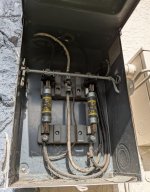
70A fused main, 70A hot gutter, 60A meters, then FPE outdoor panels with two breakers (each unit has a single MWBC with #12 wire and no interior sub-panel).

There is NO interrupt rating on the old FPE breakers, they're crap so I don't care, but maybe on a good day they were 5k?


For @jaggedben I am considering making a PI related to electrical retrofits of existing buildings. Too damn many cases the
sensibile retrofit can't be done, and the owner freaking hides and defers. The result of the requirements is contrary to the purpose of the requirements.
 
First off, you have to start with what they say is the AFC, otherwise you are shooting blind. If it's under 10kA, then you are done. If it's over 10kA, then go look up the Series Rating of the new Eaton panels, with the fuses that are in that Main Disconnect. Looks like from this chart, if they are Class T or J fuses**, up to 400A, the series rating is 65kAIC anyway, and I seriously doubt they are anywhere near that. If they are not Class T or J, you may have to change out the fuse holders to make them so and if you can't do that, you may need a new disconnect that will take them.

As I interpret it, that's all they are asking for you to confirm.

** Those are the only fuses listed in that document, but it's entirely possible that Eaton has them listed with others, so it's would be worth asking them if anything that will fit in that disconnect with work.
 
I would cite some provisions from the 2022 California Existing Building Code. It's rarely used but it does regulate any existing building that's not within the scope of the residential code, and it's tied to a bunch of state laws. The entire code can be viewed for free here:


Specifically, check out this CA specific amendment:

101.7 Maintenance. [BSC, DSA-SS, DSA-SS/CC, HCD 1, HCD 2] Buildings and structures, and parts thereof, shall be maintained in a safe and sanitary condition. Devices or safeguards which are required by this code shall be maintained in conformance with the code edition under which installed. The owner or the owner's designated agent shall be responsible for the maintenance of buildings and structures.
The requirements of this chapter shall not provide the basis for removal or abrogation of fire protection and safety systems and devices in existing structures.
 
If you're not changing anything line side of the FPE boxes then you're not making "modifications to the electrical installation ... that affect the available fault current at the service", and it's not appropriate to enforce this rule.;)
Technical we are make a line side change. The wire between the meter base and the unit panel gets replaced.
My plan checker does not realize that actually increases AFC, but it does, every so slightly.
 
Technical we are make a line side change. The wire between the meter base and the unit panel gets replaced.
My plan checker does not realize that actually increases AFC, but it does, every so slightly.
No, you're not! The service disco is the disco on the left, and it stops there. You're making a load side change. The electrical code does not care where the meters are.
 
No, you're not! The service disco is the disco on the left, and it stops there. You're making a load side change. The electrical code does not care where the meters are.
Ok, ok, you're right. (That said the 70A fuses don't have a series rating, so it does not do me any good).

---
Actual fuse panel pics
 

Attachments

  • Capture.JPG
    Capture.JPG
    194.6 KB · Views: 8
Top