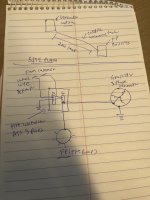
Neutral bring to disconnect

Merry Christmas
To summarize, my understanding is that the code allows either
1) SBJ at XF and no SBJ at both disconnects, with SSBJs run to both disconnects
2) SBJs at all three locations, with neutral (and no SSBJ) run to both diaconnects..

There are two problems with OP's description of situation:
First, no SBJ at XF, which is required.
Second, SWB was done according to (2) above, and fire pump was done according to (1), which results in objectionable neutral current on the fire pump SSBJ if both disconnects are grounded to the building GES as required.

The fire pump and SWB can be done either way but must both be done the same way to avoid the objectionable current.

YES fire pump controller 3 phase, 3 wire fed by the transformer secondary feeder with EGC and no neutral.

If the description is of what is already installed, I hope that 'EGC' is large enough to be a black wire that can be retaped white and satisfy table 250.102(C)(1).
 
To summarize, my understanding is that the code allows either
1) SBJ at XF and no SBJ at both disconnects, with SSBJs run to both disconnects
2) SBJs at all three locations, with neutral (and no SSBJ) run to both disconnects..
Upon reflection, I don't believe that (2) is an option when you have more than one disconnect at the building from a single outdoor SDS. Configuration (2) relies on 250.30(A)(1) Exception 2, which requires that the extra SBJ at the first means of disconnect not "establish a parallel path for the grounded conductor."

But if you have multiple disconnects at the building, the building GEC/GES connection at each disconnect will interconnect the EGC systems at each disconnect, as well as the grounded conductors at any disconnects with SBJs. So if you have at least 2 disconnects with SBJs, each SBJ is establishing a parallel path for the associated grounded conductor, via GES/GEC to one of the other SBJs to its associated grounded conductor.

So I think that 250.30(A)(1) Exception 2 can only be used when an outdoor SDS supplies only a single feeder to the building. Which means that (1) above is the only compliant option for the installation in the OP.

Cheers, Wayne
 
To summarize, my understanding is that the code allows either
1) SBJ at XF and no SBJ at both disconnects, with SSBJs run to both disconnects
2) SBJs at all three locations, with neutral (and no SSBJ) run to both diaconnects..

There are two problems with OP's description of situation:
First, no SBJ at XF, which is required.
Second, SWB was done according to (2) above, and fire pump was done according to (1), which results in objectionable neutral current on the fire pump SSBJ if both disconnects are grounded to the building GES as required.

The fire pump and SWB can be done either way but must both be done the same way to avoid the objectionable current.


If the description is of what is already installed, I hope that 'EGC' is large enough to be a black wire that can be retaped white and satisfy table 250.102(C)(1).

I dont get what you’re saying. Fire pump is in separate building A and switchboard is in totally separate building B.

Giving they bring neutral and SSBJ to fire pump controller and do neutral to ground bond in the fire pump controller, no SBJ in transformer, their is one SBJ in switchboard how can it create objectionable current?
 
The fire pump controller has ATS that is also fed from 480/277V generator. The ATS is three poles.

Should neutral be brought over from generator to the fire pump controller as well?
 
I dont get what you’re saying. Fire pump is in separate building A and switchboard is in totally separate building B.
Ah, the OP does say that, although I believe this detail has been overlooked so far in this thread. Certainly my responses were based on the two supplies from the transformer going to one building, which is not the case.

Your last post mentions a generator supplying the fire pump controller at building B. Is this generator a second outdoor source, or is it attached to building B?

Also, you now have 3 or 4 different locations that have Grounding Electrode Systems, the transformer, buildings A and B, and possibly the generator. Are any of these GESs interconnected other than through earth?

Cheers, Wayne
 
Ah, the OP does say that, although I believe this detail has been overlooked so far in this thread. Certainly my responses were based on the two supplies from the transformer going to one building, which is not the case.

Your last post mentions a generator supplying the fire pump controller at building B. Is this generator a second outdoor source, or is it attached to building B?

Also, you now have 3 or 4 different locations that have Grounding Electrode Systems, the transformer, buildings A and B, and possibly the generator. Are any of these GESs interconnected other than through earth?

Cheers, Wayne

The generator is backup to the fire pump. It is outdoor far from building B, building A where switched board is and any other building in campus style.

Engineer doesnt show them interconnected directly except thru Earth.
 
Apparently the forum is not staffed 24/7, and so you won't necessarily get an answer in the middle of the night. : - )

Anyway, the usual choice for your outdoor transformer and outdoor generator is to configure them both as SDSs. In that case they should each have an SBJ at the source. And then from the source to the load you run an SSBJ along with the circuit conductors you need. [Or if there is OCPD at the source, the grounding conductor you run would be called an EGC, not an SSBJ.]

So as the fire pump doesn't need a neutral, there is no need to run any neutrals to the fire pump ATS, just SSBJs [or EGCs].

Cheers, Wayne
 
Apparently the forum is not staffed 24/7, and so you won't necessarily get an answer in the middle of the night. : - )

Anyway, the usual choice for your outdoor transformer and outdoor generator is to configure them both as SDSs. In that case they should each have an SBJ at the source. And then from the source to the load you run an SSBJ along with the circuit conductors you need. [Or if there is OCPD at the source, the grounding conductor you run would be called an EGC, not an SSBJ.]

So as the fire pump doesn't need a neutral, there is no need to run any neutrals to the fire pump ATS, just SSBJs [or EGCs].

Cheers, Wayne

As you know the existing outdoor customer owned transformer has no SBJ. SBJ is at existing SWBD. As a result, the newly added fire pump controller has SBJ. So then can the generator have SBJ, run only ssbj and not run neutral to the fire pump controller? Attached would be the setup

image-2025-12-22-08:48:32-337.jpg
 
As you know the existing outdoor customer owned transformer has no SBJ. SBJ is at existing SWBD. As a result, the newly added fire pump controller has SBJ.
If the fire pump controller supplies only loads without a neutral/grounded conductor, and the supplies from the transformer and the generator do not include a neutral/grounded conductor, then the ATS can't have an SBJ, as there is no neutral/grounded conductor at the ATS to bond to earth and the normally non-current carrying metal parts.

A few questions: how many wires are run between the transformer and SWBD, between the transformer and new ATS, and between the generator and new ATS? 4 (3 ungrounded plus either a neutral or SSBJ/EGC) or 5 (3 ungrounded, a neutral, and an SSBJ/EGC).

And does the generator have OCPD? OCPD there would make the grounding wire from the generator to the ATS an EGC, not an SSBJ. An SSBJ may sometimes be omitted (250.30(A)(2) exception), but an EGC may not be omitted.

Cheers, Wayne
 
If the fire pump controller supplies only loads without a neutral/grounded conductor, and the supplies from the transformer and the generator do not include a neutral/grounded conductor, then the ATS can't have an SBJ, as there is no neutral/grounded conductor at the ATS to bond to earth and the normally non-current carrying metal parts.

A few questions: how many wires are run between the transformer and SWBD, between the transformer and new ATS, and between the generator and new ATS? 4 (3 ungrounded plus either a neutral or SSBJ/EGC) or 5 (3 ungrounded, a neutral, and an SSBJ/EGC).

And does the generator have OCPD? OCPD there would make the grounding wire from the generator to the ATS an EGC, not an SSBJ. An SSBJ may sometimes be omitted (250.30(A)(2) exception), but an EGC may not be omitted.

Cheers, Wayne

There can be service rated fire pump controller/ats they would have that.

Transformer and 3 phase swbd: 4 wires plus ground

Transformer and 3 phase ATS: 3 wires plus ground

Generator and ATS: 3 wires plus ground

Generator has main 250AT

Main concern is how would effective ground fault current path would be in my scenario without sbj in transformer and sbj in swbd and sbj in fire pump controller.
 
I have customer owned delta to wye 13.8kv to 480/277V system and its located outside. The transformer does not system bonding jumper i.e no neutral to ground at the transformer.
Where is the service point? Are the 13.8kV conductors feeders or service conductors?
 
Where is the service point? Are the 13.8kV conductors feeders or service conductors?

13.8kV are existing feeder and is the primary of the existing customer transformer. The existing customer owned primary is fed from existing 13.8kV customer owned switchgear. The existing switchgear has existing relay/breaker feeding the existing transformer. None of that is within scope and all customer owned. The service point is on the line side of existing 13.8kV switchgear
 
OK:

1) As discussed previously, outdoor SDSs need to have an SBJ at the source. The lack of SBJ at the outdoor transformer (if accurate) is an existing violation. So if the new work is going to touch the transformer, then this violation needs to be fixed, which means adding an SBJ at the outdoor transformer.

2) Having SBJs at both the outdoor transformer and the SWBD, along with an SSBJ between them, is a violation. So either the SWBD SBJ needs to be removed, or the SSBJ needs to be abandoned. [Although if the SSBJ and the neutral are single conductors of the same size and type, the latter could happen by making the neutral two parallel conductors, possibly by simply recoloring the SSBJ to be white without actually changing any connections, depending on the exact details of the existing installation.]

If the choice is to remove the SBJ, then if the SWBD intermingles grounds and neutrals on a single terminal bar, they need to be separated onto separate terminal bars. [Not familiar with switchboard innards, so my use of the terms applicable to panelboards may not be appropriate.]

3) The generator, as an outdoor SDS, needs an SBJ.

4) The ATS, as it is powering only loads with don't require a neutral, does not require any neutral. 3 wires plus SSBJ come from the transformer, and 3 wires plus EGC come from the generator. The transformer supply needs to land on an OCPD, either within the ATS or separatelty just before it.

5) There should be 4 separate GESs, one at each source and one at each building. The source GESs connect via a GEC to the neutral conductor. The GES at the building with the SWBD connects to the grounding conductor if there is an SSBJ and no SBJ, and to the neutral conductor if there is an SBJ and no SSBJ. The GES at the firepump ATS connects to the grounding conductor.

Cheers, Wayne
 
Last edited:
OK:

1) As discussed previously, outdoor SDSs need to have an SBJ at the source. The lack of SBJ at the outdoor transformer (if accurate) is an existing violation. So if the new work is going to touch the transformer, then this violation needs to be fixed, which means adding an SBJ at the outdoor transformer.

2) Having SBJs at both the outdoor transformer and the SWBD, along with an SSBJ between them, is a violation. So either the SWBD SBJ needs to be removed, or the SSBJ needs to be abandoned. [Although if the SSBJ and the neutral are single conductors of the same size and type, the latter could happen by making the neutral two parallel conductors, possibly by simply recoloring the SSBJ to be white without actually changing any connections, depending on the exact details of the existing installation.]

If the choice is to remove the SBJ, then if the SWBD intermingles grounds and neutrals on a single terminal bar, they need to be separated onto separate terminal bars. [Not familiar with switchboard innards, so my use of the terms applicable to panelboards may not be appropriate.]

3) The generator, as an outdoor SDS, needs an SBJ.

4) The ATS, as it is powering only loads with don't require a neutral, does not require any neutral. 3 wires plus SSBJ come from the transformer, and 3 wires plus EGC come from the generator. The transformer supply needs to land on an OCPD, either within the ATS or separatelty just before it.

5) There should be 4 separate GESs, one at each source and one at each building. The source GESs connect via a GEC to the neutral conductor. The GES at the building with the SWBD connects to the grounding conductor if there is an SSBJ and no SBJ, and to the neutral conductor if there is an SBJ and no SSBJ. The GES at the firepump ATS connects to the grounding conductor.

Cheers, Wayne

Nice but our chief doesnt want sbj in medium voltage transformer. Any other alternative scenarios?
 
Nice but our chief doesnt want sbj in medium voltage transformer. Any other alternative scenarios?
Tell the chief the NEC requires the SBJ at the outdoor SDS and he doesn't have the authority to approve an NEC violation?

Install a new OCPD with enclosure next to the transformer, and put the transformer SBJ in that enclosure? Then proceed as previously with removing the SWBD SBJ, etc.

Supply the fire pump ATS with a feeder from the SWBD, rather than directly from the transformer, so that the transformer and its secondary conductors aren't being touched? Not familiar with the rules for fire pumps, perhaps they would not allow that.

Cheers, Wayne
 
A outdoor 13.8 kV system is basically a utility system if it were utility owned they would connect the secondary neutral to a GES at the transformer vault.
is the 13.8 kv is Multi Grounded Neutral system? If so it needs a earth reference at each outdoor transformer anyway, perhaps it has some GF protective relays. Either way grounding the secondary its a basic thing every utility does.
250.24(A)(2) would more explicitly cover this if the 13.8 KV side was service conductors thats why I asked where the service point is.
Nice but our chief doesnt want sbj in medium voltage transformer. Any other alternative scenarios?
I am not reading the code as allowing that in the configuration you described. I would be suprised if one does not exist and someone overlooked it and it is a mistake on the as built.
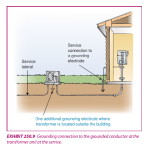
250.30(A)(1) seems to be requiring a single point of connection.
1766424481228.png
 
Tell the chief the NEC requires the SBJ at the outdoor SDS and he doesn't have the authority to approve an NEC violation?

Install a new OCPD with enclosure next to the transformer, and put the transformer SBJ in that enclosure? Then proceed as previously with removing the SWBD SBJ, etc.

Supply the fire pump ATS with a feeder from the SWBD, rather than directly from the transformer, so that the transformer and its secondary conductors aren't being touched? Not familiar with the rules for fire pumps, perhaps they would not allow that.

Cheers, Wayne

Take a look at NEC 2017 Article 250.28(D)(3). That would allow sbj in swbd and in fire pump controller/ats and no sbj in swbd. If outdoor was not allowed then it should say something. Correct or incorrect?
 
Top