Leaving ABB VFDs off

Saturn_Europa

Senior Member
Location
Fishing Industry
Occupation
Electrician Limited License NC, QMED Electrician
I work on a large fishing boat. There are 3 very expensive ABB VFDs that run deck winches. We’ve seen ground fault failures with the VFDs during ship yard maintenance. During this time, the VFDs are not in use and but are powered on. The main switch board had a ground fault and we traced the fault back to the ABB VFDs. The only solution was to replace the VFDs.

Is it better to turn off the power to the VFDs if we’re not going to be using them for a few months?

During ship yard maintenance there’s lots of welding and blackouts when switching from shore power to generator.

The only downside I can see to leaving the VFDs powered down is possibly condensation accumulation.
 
YASKAWA dealer here:

Absolutely shut them down. Put a trash bag around them. They need to be off when switching from shore to generator.
Yes, not just off, but breaker/disconnect open!

From experience, in a lot of shore power situations, they connect to an ungrounded delta system, or they have a bad neutral connection, which can cause damage in the front-end of the drive if there is any kind of ground fault anywhere. The drive has a grounding jumper that can be removed, but then it has to be put back on again when done, so it’s a PITA. If you just disconnect the line from the drive, it’s no worries.
 
Not a fan of ABB because they always gave me the run around. Anyway we had about a dozen Danfoss 40 to 75 HP drives on a roof. They came from the factory with a thermostat & heater to control humidity. Heater could only turn on while the drives were off. I was thinking about installing a humidity switch in parallel with heater thermostat. In the over ten years drives ran had a lot of false what Danfoss called " Earth faults " for a few years until I asked our Danfoss service tech about it. Here a ribbon cable to the control board was causing the problem and was covered by an extended warranty. Like others posted would power down the drives when not needed.You might want to install a 120 volt strip heater inside of drive panels if room permits to control humidity and keep panel from rusting. A contact could be installed on the HOA ( hand off auto ) selector switch if one is provided to only supply power to humidity control while drives are off. We had 100 to 150 HP ABB & Danfoss drives that powered chiller pumps so did not run in the winter. Danfoss had a thermostat for the door fans so they only ran when interior of cabinet got over above 90 degrees. ABB fans ran 24/7 pulling in dirty air so we had to blow out fan filters once a month when drives were off. When I questioned ABB if they had a hidden thermostat or other type of control they want to know why I was asking. Engineers like to keep all pump drives powered up because they liked to run them every few weeks to check shaft seals and observe suction & discharge pressures.
 
Definitely look at installing heaters to help prevent condensation*; heck, even stuffing a real 100 w light bulb in the cabinet will often do the trick for the time being.

*also useful in switchboards and larger panels
Years ago we had time clocks in large ( over 400' long ) meat coolers . We installed 1" inch round by maybe 8" long incandescent lamp in bottom of the time clocks to prevent condensation from forming. Same lamps as ones used in old Exit signs. Had a lot of trouble with two GE 13,200 volt dual service with automatic tie breaker switchgear until will installed strip heaters inside of switch gear. In one area you could smell ozone in the air before heaters were installed.
 
lol… good luck finding a “real” 100W incandescent light bulb…

But the heater issue is important for sure. I’m not a fan of light bulbs for a couple of reasons; they are too easy to break unless you put them inside of a protective fixture, and too easy for someone to “borrow” when their drop light breaks, then never remember to replace it.

Enclosure manufacturers all offer nice pre-packaged enclosure heaters with a built-in thermostat so that they are not running when not needed, or you can roll your own with a heat strip and a t-stat. If you do the heat strip, the trick is to get a 300-500W 240V heat strip, then wire it to a 120V source. That makes it 1/4 of the watts (P= V squared /R) but the reason to do it is to reduce the “watt density”, meaning the surface temperature will be lower because you have the larger physical size of the higher watt 240V heater, then with the lower wattage, the watts/square inch is lower and less likely to burn someone who accidentally touches it.
 
lol… good luck finding a “real” 100W incandescent light bulb…

But the heater issue is important for sure. I’m not a fan of light bulbs for a couple of reasons; they are too easy to break unless you put them inside of a protective fixture, and too easy for someone to “borrow” when their drop light breaks, then never remember to replace it.

Enclosure manufacturers all offer nice pre-packaged enclosure heaters with a built-in thermostat so that they are not running when not needed, or you can roll your own with a heat strip and a t-stat. If you do the heat strip, the trick is to get a 300-500W 240V heat strip, then wire it to a 120V source. That makes it 1/4 of the watts (P= V squared /R) but the reason to do it is to reduce the “watt density”, meaning the surface temperature will be lower because you have the larger physical size of the higher watt 240V heater, then with the lower wattage, the watts/square inch is lower and less likely to burn someone who accidentally touches it.
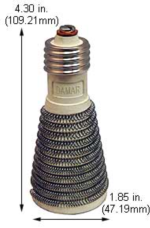
Danfoss used 120 volt cone shaped heaters screwed into a porcelain receptacle and they would burn you. None of them burned out in the over ten years they were on line. They all had larger 480 to 120 volt control transformers to handle one heater. Newer model drives leave next to no room, especially the ones with bypasses. They install two or three contactors behind a panel that if the person installing control wires do not leave a loop have to remove control wires to swing plate our.The ABB 18 pulse drives at least 40 HP & larger had large cabinets.
 
Danfoss used 120 volt cone shaped heaters screwed into a porcelain receptacle and they would burn you. None of them burned out in the over ten years they were on line. They all had larger 480 to 120 volt control transformers to handle one heater. Newer model drives leave next to no room, especially the ones with bypasses. They install two or three contactors behind a panel that if the person installing control wires do not leave a loop have to remove control wires to swing plate our.The ABB 18 pulse drives at least 40 HP & larger had large cabinets.
Screenshot 2025-12-08 201112.png
 
Light bulbs are only a temporary measure (did anyone think I meant otherwise?), but can help with a problem until a proper heater is installed. (I'm sure a lot of people have used one on occasion to keep the car engine warm enough to start in the morning, I sure have. If I needed that sort of thing all winter I'd just install a block heater.)
 
Danfoss used 120 volt cone shaped heaters screwed into a porcelain receptacle and they would burn you. None of them burned out in the over ten years they were on line. They all had larger 480 to 120 volt control transformers to handle one heater. Newer model drives leave next to no room, especially the ones with bypasses. They install two or three contactors behind a panel that if the person installing control wires do not leave a loop have to remove control wires to swing plate our.The ABB 18 pulse drives at least 40 HP & larger had large cabinets.

If you already have the screw in base for a bulb, then one option is:

But I rather like the idea of running 240V heaters at 120V. No reason to add a burn hazard to everything else....
 
When I was a kid my old man always had junk cars. I remember when he worked at the Post Office in the early 60s and got promoted to supervisor my mother said he was going to make $100/week. We thought we were rich.

Before that in the 50s he still had a 41' Plymouth that would never start in the cold. He had this big red "heat lamp" he would put under the hood near the distributor. He always complained that the distributor was too low to the ground. Covered the hood with a blanket as well. My BIL had a barn with an office and a bathroom in it and no heat. A 100watt light bulb near the toilet tank kept it from freezing
 
Light bulbs are only a temporary measure (did anyone think I meant otherwise?), but can help with a problem until a proper heater is installed. (I'm sure a lot of people have used one on occasion to keep the car engine warm enough to start in the morning, I sure have. If I needed that sort of thing all winter I'd just install a block heater.)
Still is somewhat common to see portable lamps in well pits or "dog house" enclosures for well equipment to keep things from freezing around here.

General purpose incandescent lamps are getting harder to find, rough service or other specialty incandescent lamps are still out there and halogen lamps (even with an edison base) are still around - I believe those are still around because they do comply with whatever the efficiency standards allow.
 
Top