TRANSFORMER ISSUES

Location
washington county, PA
Occupation
electrician
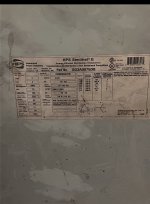
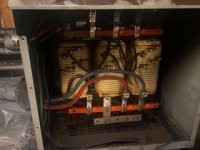
I was asked to look at this transformer. The transformer is being used as a step-up transformer, but I don't see any specs that state the transformer can be used this way. The wiring is 120/208v primary and stepping up to 240v secondary. The specs are labeled as 3-phase, corner grounded delta (primary) and 3-phase wye (secondary). The owner had the transformer wired so x1, x2, and x3 (secondary) were the primary and the H1, H2, H3 (primary coils) are the secondary feeding a 3-phase 240v panel. The 208v input is a 3-wire input without a neutral, so the x0 lug is not used. The EGC is bonded to the transformer chassis. The reading on the coils is 240v phase to phase (A-B/ B-C/ C-A). When reading to ground A-phase 240v to ground, C-phase 240v to ground. B-phase is 0v to ground.
The issue is the owner has a 3-phase oven that is on a 50 amp 3-pole breaker. The homerun to the oven lands on a 40-amp, 3-pole breaker in a control panel and this breaker feeds a 3-phase relay for the heating elements. When the oven is turned on, one phase is pulling up to 120A then the breaker trips in the control panel. Nothing else in the 240v panel is affected. Is this transformer capable of being used in this means? Is there a problem with the grounding? Does x0 need to be bonded with the EGC? Is this an oven issue?
 

Attachments

  • IMG_1221.JPG
    IMG_1221.JPG
    18 KB · Views: 25
  • IMG_1224.jpg
    IMG_1224.jpg
    347.4 KB · Views: 29
I see know reason this transformer cannot be run backwards. The nameplate lists High Voltage and Low Voltage not Primary and Secondary. But you could check with the manufacturer.

You say the specs require the 240V to be installed as a corner grounded system. But it appears you are questioning the fact that the B line reads 0V to ground.
 
Last edited:
The wiring appears to be correct,'
You don't want to bond XO.
What are the specs on the oven ?
 
The reading on the coils is 240v phase to phase (A-B/ B-C/ C-A). When reading to ground A-phase 240v to ground, C-phase 240v to ground. B-phase is 0v to ground.
Is this with the 240 volt output connected? Have you tried measuring the 240 volt side with nothing but the 208 volts connected to the Wye side?
 
If it says high voltage and low voltage, does that mean it cannot be run from the 208 to 240? I question if this was a reason to he oven elements were not staying in the 40a range
Transformers only care how they are wired when the Primary and Secondary are definitively identified on the nameplate.
 
Single phase range or oven?
Maybe why Augie is asking for specs.
Most ovens/ cook tops only need two hots and an EGC
Most ranges require a neutral which you do not have.

If single phase 240v only use the two ungrounded legs

Also a better pic of trans to show secondary (240) making sure you have GEC hook to one line.
If not than a fault may be grounding the system.
 
Single phase range or oven?
Maybe why Augie is asking for specs.
Most ovens/ cook tops only need two hots and an EGC
Most ranges require a neutral which you do not have.

If single phase 240v only use the two ungrounded legs

Also a better pic of trans to show secondary (240) making sure you have GEC hook to one line.
If not than a fault may be grounding the system.
The coils are the 240 side and according to the manufacturer diagram, the delta is internally grounded, the EGC is not spliced to the delta ground. The 208 input brings the EGC and is bonded to the chassis. I believe an EGC leaves the bonding lug and goes to the 240/ 3phase - 240v panel. Nothing in the transformer was manually grounded.
 
...
The issue is the owner has a 3-phase oven that is on a 50 amp 3-pole breaker. The homerun to the oven lands on a 40-amp, 3-pole breaker in a control panel and this breaker feeds a 3-phase relay for the heating elements. When the oven is turned on, one phase is pulling up to 120A then the breaker trips in the control panel. ...

I think we are mostly thinking that your problem is over here somewhere. Your description is still unclear, but drawing 120A on a 50A breaker suggests a fault or defect in the oven, or perhaps it's hooked up wrong. Nothing you've told us indicates that the transformer setup has any issues. Of course the oven must be designed to operate on a corner grounded system.
 
The coils are the 240 side and according to the manufacturer diagram, the delta is internally grounded,
Are you saying that one coil on the Delta side of the transformer in the photo is internally grounded? If you're referring to the short line on the Delta symbol it shows this from an old thread.
 
Last edited:
Sounds more like an oven problem than a transformer wiring problem.' Can you provide details on the "motor control breaker" that is tripping.'
Does it trip when you 1st supply power to the oven, etc,
 
As soon as power is supplied to the oven through the motor control circuit, the amperage shoots up to 120 A on one phase and tripped the motor control breaker which is a three pole 40 amp breaker
Sounds like an internal wiring issue with the oven. I would start with checking that your supply voltages are correct A-B, B-C, A-C at the line side of 40 amp breaker in the unit. If they're correct then you'll know that the issue is on the load side of the 40 amp breaker.
 
As soon as power is supplied to the oven through the motor control circuit, the amperage shoots up to 120 A on one phase and tripped the motor control breaker which is a three pole 40 amp breaker
If the transformer stays energized, your problem extremely likly with the oven.
Disconnect the heater elements, see if the 40A breaker holds.

Is it possible the transformer has a corner grounded phase, like B, and the oven has a different one like C?
 
I have an Acme transformer product book from maybe 40 years ago. Can remember reading that at that time their transformers above maybe 0.5 KVA were acceptable to be used as a step.up or step down transformer. Years ago one of the engineers told the German company that was building us a custom made $10 millon dollar machine that we had 440 volts. We had 480 volts and when line voltage was higher at nights & weekends machine would shut down due to one of the 24 volt DC power supp!y output voltage was too high. They had to spend over $2,000 to air freight a 440 to 480 volt transformer that we used as a step down transformer.
 
Top