Question about kitchen split receptacles and common trip breakers

speedball73

Member
Location
Ontario
Occupation
Retired
Hi,

I’m wiring up a kitchen and I decided to go with 15A split receptacles (if I was going to start over I’d probably do 20A but it’s too late for that - many kitchen receptacles are in exterior walls that are already insulated).

I have an EATON panel and was planning on using DNPL215215 breakers (Non-Common trip with just a handle tie do the split breakers), however I came across the “common trip” requirement and I’m trying to understand if that applies to kitchen receptacles under the current code?

Am I also correct that any 240V circuits that require a neutral will also require a common trip breaker? And conversely 240V circuits with no neutral do not require common trip?

The reason I’m asking all this is I’m am running a bit short of space on my panel and without the ability to use a non-common trip breakers I might have to take some additional steps (such as combining a few circuits - no drywall yet so I have options to run extra wire) to reduce overall circuit count.

Thanks for any help and suggestions on ways to address my shortage of panel space (please don’t suggest adding a subpanel, that’s my least preferred option)
 
I had inappropriately closed this thread, not having understood the purpose of this forum topic. It is now reopened. My apologies to speedball73.
 
I’m wiring up a kitchen and I decided to go with 15A split receptacles (if I was going to start over I’d probably do 20A but it’s too late for that - many kitchen receptacles are in exterior walls that are already insulated).
What do you mean by 15 amp split receptacles? Will there be two circuits on a duplex receptacle?
 
Am I also correct that any 240V circuits that require a neutral will also require a common trip breaker? And conversely 240V circuits with no neutral do not require common trip?

I am not familiar with the _Canadian_ electrical code, but I understand it to _usually_ be similar to the US NEC.

_All_ '240V' circuits will require a common trip breaker. By this, I mean that if the circuit supplies 240V loads, both legs must automatically disconnect on a fault. It doesn't matter if a neutral is present or not.

What _might_ be a situation that doesn't require a common trip breaker is a multi-wire branch circuit feeding only 120V loads. In this case you may have a handle tied breaker that will disconnect both legs when the handle is operated, but won't (necessarily) trip both legs automatically. I don't know if this applies in the Canadian code.

Reading between the lines, I assume that you want to use a 'quad' breaker but are dealing with the issue that the 'outer' poles are not common trip, but want to use the outer poles for a multi-wire branch circuit. As noted above, this _may_ be allowed, depending upon the specifics of the CEC for MWBCs. Additionally, you can get Eaton quad breakers were both the inner and outer poles are common trip. See for example https://www.eaton.com/us/en-us/skuPage.BRDC215215.html
 
_All_ '240V' circuits will require a common trip breaker. By this, I mean that if the circuit supplies 240V loads, both legs must automatically disconnect on a fault. It doesn't matter if a neutral is present or not.
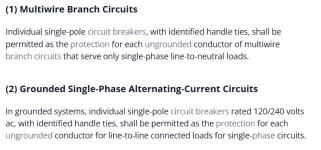
That's not actually correct for the NEC, see 240.15(B)(2). For a 2-wire 240V load on a 120/240V system, it suffices to use two single pole breakers with handle ties.

Cheers, Wayne
 
That's not actually correct for the NEC, see 240.15(B)(2). For a 2-wire 240V load on a 120/240V system, it suffices to use two single pole breakers with handle ties.

Cheers, Wayne

Well color me purple. Not sure when that changed, but @wwhitney is mostly correct. _Individual_ single pole breakers with handle ties can serve L-L loads.

For purpose of the OP, I don't believe this quite applies, because the outer poles of a quad breaker are not _individual_ single pole breakers. However reading the code section also says that my answer was wrong (again: NEC land). IMHO if you use a multi-pole breaker to supply a MWBC, none of the exceptions apply and you must have a common trip for all circuits have any wires in common (eg. MWBCs or L-L loads). For the OP's purpose of using quad breakers to supply MWBCs, common trip quad breakers must be used.

-Jonathan
 
_Individual_ single pole breakers with handle ties can serve L-L loads.
I don't see the use of the word "individual" in 240.15(B) as precluding the single poles from being part of a larger assembly. There's no reason to make that distinction.

Cheers, Wayne
 
Curious. The 'upcodes' version definitely has the word 'individual':
Sure, the word is there, but from context I think the intended meaning is simply "not common trip with the handle-tied poles" as opposed to "not part of any assembly containing other breaker poles."

Take 240.15(B)(1) on MWBCs that supply only L-N loads. Suppose you have a 3-phase MWBC that supplies load A L1-N, load B L2-N, and load C L3-N, and you want common trip on loads A and B for some reason, but want load C separate. You could use a double pole (common trip) breaker for L1 and L2, and handle tie it to a single pole breaker for L3. I can't see any reason the NEC would want to prohibit that flexibility and require you to use only 3 single pole breakers or a single 3 pole breaker.

Cheers, Wayne
 
You have to remember the OP is in Canada and is under the Canadian Electrical Code.
Also, this is the Canadian Electrical Forum. Answers need to take this into consideration.
 
(if I was going to start over I’d probably do 20A but it’s too late for that
Do you use a lot of appliances with 5-20P cords? You can put 5-15R on a 20amp circuit. The kitchen counter receps are SABC (Small appliance branch circuits) and are required to be 20a circuits, but it's common to use 5-15R devices. Don't know if canada is different but thats pretty universal here.
 
Do you use a lot of appliances with 5-20P cords? You can put 5-15R on a 20amp circuit. The kitchen counter receps are SABC (Small appliance branch circuits) and are required to be 20a circuits, but it's common to use 5-15R devices. Don't know if canada is different but thats pretty universal here.
I have been in my house 50 years and never had use for a 20 amp 120 volt plug, even had contractors do work here with a large table saw & 10" right angle circular saws. I probably have ten times more NM cable then came with the house . Went from six circuit breakers to almost 50. Only have a 20 amp GFCI receptacle in one bathroom because they did not have a 15 amp in the color the wife asked for. A few if the GFCI receptacles bin my garage are 20 amp type only because they were left overs. So for my two cents would rather only use 15 amp duplex receptacles in houses on #12 copper NM cable and use the money saved to purchase better quality devices like spec grade. Often thought the NEC should require spec grade or better receptacles on kitchen counter top laundry, bathrooms & all outdoor receptacles. Hated years ago when I removed cheapest back stabbed kitchen counter top receptacles.
 
I have always found the CEC sections on kitchens interesting, I think the relevant CEC section for the OP is
14-010 Protective and control devices required
Except as otherwise provided for in this Section or in other Sections dealing with specific equipment,
electrical apparatus and ungrounded conductors shall be provided with
a) devices for the purpose of automatically opening the electrical circuit thereto,
i) if the current reaches a value that will produce a dangerous temperature in the apparatus or
conductor; and
ii) in the event of a ground fault, in accordance with Rule 14-102;
b) manually operable control devices that will safely disconnect all ungrounded conductors of the
circuit at the point of supply simultaneously, except for multi-wire branch circuits that supply only
fixed lighting loads or non-split receptacles, and that have each lighting load or receptacle
connected to the neutral and one ungrounded conductor
; and
c) devices that, when necessary, will open the electrical circuit thereto in the event of failure of
voltage in such a circuit.

and here are the other CEC sections on kitchens:
26-654 Branch circuits for dwelling units
Branch circuits for dwelling units (including single dwellings) shall meet the following requirements:
a) branch circuits from a panelboard installed in accordance with Rule 26-602 shall not be connected
to outlets or electrical equipment in any other dwelling unit;
b) except as may be permitted by Items c) and d), at least two branch circuits shall be provided for
receptacles (5-15R split or 5-20R) installed for kitchen counters of dwelling units in accordance with
Rule 26-724 d) iii), iv), and v), and
i) no more than two receptacles shall be connected to a branch circuit; and
ii) no other outlets shall be connected to these circuits;
c) notwithstanding Item b), where the provisions of Rule 26-724 d) iii) require only one receptacle,
only one branch circuit need be provided;
d) notwithstanding Item b) i), receptacles identified in Rule 26-720 d) shall be permitted to be
connected to those receptacles required by Rule 26-724 d) iii), even though the circuit already
supplies two receptacles;
The kitchen requirements:
26-724
d) in dwelling units there shall be installed in each kitchen
i) one receptacle for each refrigerator;
ii) where a gas supply piping or a gas connection outlet has been provided for a free-standing gas
range, one receptacle behind the intended gas range location not more than 130 mm from
the floor and as near midpoint as is practicable, measured along the floor line of the wall
space intended for the gas range;
iii) a sufficient number of receptacles (5-15R split or 5-20R) along the wall at counter work
surfaces (excluding sinks, built-in equipment, and isolated work surfaces less than 300 mm
long at the wall line) so that no point along the wall line is more than 900 mm from a
receptacle measured horizontally along the wall line;
iv) at least one receptacle (5-15R split or 5-20R) installed at each permanently fixed island
counter space with a continuous long dimension of 600 mm or greater and a short dimension
of 300 mm or greater;
v) at least one receptacle (5-15R split or 5-20R) installed at each peninsular counter space with a
continuous long dimension of 600 mm or greater and a short dimension of 300 mm or
greater; and
vi) a sufficient number of duplex receptacles installed on the remaining finished walls in
accordance with Item a);
the receptacles specified in Item d) shall not be located
i) on the area of the wall directly behind the kitchen sink; or
ii) on the area of the counter directly in front of the kitchen sink;

Thats from my 2018 copy of the Canadian code, which may be out of date.
I think the idea is the receptacle face indicates to the user the capability of the circuit, if you see a 5-20 you know its on a 20A circuit, and a 5-15 indicates 15A circuit.
 
Top