Question about kitchen split receptacles and common trip breakers

speedball73

Member
Location
Ontario
Occupation
Retired
Hi,

I’m wiring up a kitchen and I decided to go with 15A split receptacles (if I was going to start over I’d probably do 20A but it’s too late for that - many kitchen receptacles are in exterior walls that are already insulated).

I have an EATON panel and was planning on using DNPL215215 breakers (Non-Common trip with just a handle tie do the split breakers), however I came across the “common trip” requirement and I’m trying to understand if that applies to kitchen receptacles under the current code?

Am I also correct that any 240V circuits that require a neutral will also require a common trip breaker? And conversely 240V circuits with no neutral do not require common trip?

The reason I’m asking all this is I’m am running a bit short of space on my panel and without the ability to use a non-common trip breakers I might have to take some additional steps (such as combining a few circuits - no drywall yet so I have options to run extra wire) to reduce overall circuit count.

Thanks for any help and suggestions on ways to address my shortage of panel space (please don’t suggest adding a subpanel, that’s my least preferred option)
 
I had inappropriately closed this thread, not having understood the purpose of this forum topic. It is now reopened. My apologies to speedball73.
 
I’m wiring up a kitchen and I decided to go with 15A split receptacles (if I was going to start over I’d probably do 20A but it’s too late for that - many kitchen receptacles are in exterior walls that are already insulated).
What do you mean by 15 amp split receptacles? Will there be two circuits on a duplex receptacle?
 
Am I also correct that any 240V circuits that require a neutral will also require a common trip breaker? And conversely 240V circuits with no neutral do not require common trip?

I am not familiar with the _Canadian_ electrical code, but I understand it to _usually_ be similar to the US NEC.

_All_ '240V' circuits will require a common trip breaker. By this, I mean that if the circuit supplies 240V loads, both legs must automatically disconnect on a fault. It doesn't matter if a neutral is present or not.

What _might_ be a situation that doesn't require a common trip breaker is a multi-wire branch circuit feeding only 120V loads. In this case you may have a handle tied breaker that will disconnect both legs when the handle is operated, but won't (necessarily) trip both legs automatically. I don't know if this applies in the Canadian code.

Reading between the lines, I assume that you want to use a 'quad' breaker but are dealing with the issue that the 'outer' poles are not common trip, but want to use the outer poles for a multi-wire branch circuit. As noted above, this _may_ be allowed, depending upon the specifics of the CEC for MWBCs. Additionally, you can get Eaton quad breakers were both the inner and outer poles are common trip. See for example https://www.eaton.com/us/en-us/skuPage.BRDC215215.html
 
_All_ '240V' circuits will require a common trip breaker. By this, I mean that if the circuit supplies 240V loads, both legs must automatically disconnect on a fault. It doesn't matter if a neutral is present or not.
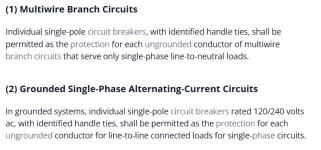
That's not actually correct for the NEC, see 240.15(B)(2). For a 2-wire 240V load on a 120/240V system, it suffices to use two single pole breakers with handle ties.

Cheers, Wayne
 
That's not actually correct for the NEC, see 240.15(B)(2). For a 2-wire 240V load on a 120/240V system, it suffices to use two single pole breakers with handle ties.

Cheers, Wayne

Well color me purple. Not sure when that changed, but @wwhitney is mostly correct. _Individual_ single pole breakers with handle ties can serve L-L loads.

For purpose of the OP, I don't believe this quite applies, because the outer poles of a quad breaker are not _individual_ single pole breakers. However reading the code section also says that my answer was wrong (again: NEC land). IMHO if you use a multi-pole breaker to supply a MWBC, none of the exceptions apply and you must have a common trip for all circuits have any wires in common (eg. MWBCs or L-L loads). For the OP's purpose of using quad breakers to supply MWBCs, common trip quad breakers must be used.

-Jonathan
 
Curious. The 'upcodes' version definitely has the word 'individual':
Sure, the word is there, but from context I think the intended meaning is simply "not common trip with the handle-tied poles" as opposed to "not part of any assembly containing other breaker poles."

Take 240.15(B)(1) on MWBCs that supply only L-N loads. Suppose you have a 3-phase MWBC that supplies load A L1-N, load B L2-N, and load C L3-N, and you want common trip on loads A and B for some reason, but want load C separate. You could use a double pole (common trip) breaker for L1 and L2, and handle tie it to a single pole breaker for L3. I can't see any reason the NEC would want to prohibit that flexibility and require you to use only 3 single pole breakers or a single 3 pole breaker.

Cheers, Wayne
 
You have to remember the OP is in Canada and is under the Canadian Electrical Code.
Also, this is the Canadian Electrical Forum. Answers need to take this into consideration.
 
Top