Service conductor above ground along exterior wall

zemingduan

Senior Member
Location
Philadelphia,PA
Occupation
Electrical Designer
I am an electrical engineer. Recently, we got question from electricians for some projects asking if they can run service conductors along the exterior wall like on the ground or 10' above the ground before entering into the building to avoid trenching... This has hazardous and a bad idea for me. But I didn't find a NEC code section that forbid it. Which code section governs it? Any distance limitation to run service conduit along exterior wall horizontally and vertically?

We have another project that has new 4.6kv underground incoming service to an existing building. The electrical room is on the second floor. Can I run the 4.6kv underground conduit stub up to ground and vertically on exterior wall then enters to the switchgear in electrical room behind the exterior wall? Any better idea?

Thanks!
 
Any distance limitation to run service conduit along exterior wall horizontally and vertically?
What is the wiring method SE cable? One thing that is applicable is will the location of the service conductors make them being subject to physical damage. If not then they can be run on the outside surface of the structure for an unlimited length.
 
What is the wiring method SE cable? One thing that is applicable is will the location of the service conductors make them being subject to physical damage. If not then they can be run on the outside surface of the structure for an unlimited length.

It is RGS conduit or Sch80 PVC. It's side alley without traffic. I think it's not an environment subject to damage.

Ok, if code permits it, is it rule of thumb installation? Does it increase fire hazardous to install live service conduit on building exterior wall?
 
It is RGS conduit or Sch80 PVC. It's side alley without traffic. I think it's not an environment subject to damage.

Ok, if code permits it, is it rule of thumb installation? Does it increase fire hazardous to install live service conduit on building exterior wall?
RMC and SCH80 PVC are both permitted when installed in areas where subject to physical damage. If there is a possibility of something like vehicle impact then additional protection in the form of guard rails or bollards can be used.
 
A following up question. We have an utility pad mounted transformer (208/120V 3ph 4wire secondary) inside the property. The GC wants to run the fire pump service conductors overhead or above the ground along exterior wall (over 300') from the pad mounted transformer to a location adjacent to the fire pump and drop and enter into the fire pump room. The GC wants to do this way only to avoid trenching due not having enough budget.

This proposal just looks very weird to me. Does NEC 695.6(A)(1) prohibit this?

As an engineer, it is a bad idea. For new buildings, mostly you don't want to run wire overhead. And I can't imagine you running 300' conduit along exterior wall on the front facade. And to me, the underground conduit provides better protection vs overhead conductor or conductor on exterior wall. How can I decline his request?
 
As an engineer, it is a bad idea. For new buildings, mostly you don't want to run wire overhead.

...asking if they can run service conductors along the exterior wall like on the ground or 10' above the ground before entering into the building to avoid trenching... This has hazardous and a bad idea for me

Dont take this the wrong way, but I think you are way off base here. I mean have you looked at 90% of buildings or ever looked up in the air? 😉

I see no issue whatsoever with it.
 
A following up question. We have an utility pad mounted transformer (208/120V 3ph 4wire secondary) inside the property. The GC wants to run the fire pump service conductors overhead or above the ground along exterior wall (over 300') from the pad mounted transformer to a location adjacent to the fire pump and drop and enter into the fire pump room. The GC wants to do this way only to avoid trenching due not having enough budget.

This proposal just looks very weird to me. Does NEC 695.6(A)(1) prohibit this?

As an engineer, it is a bad idea. For new buildings, mostly you don't want to run wire overhead. And I can't imagine you running 300' conduit along exterior wall on the front facade. And to me, the underground conduit provides better protection vs overhead conductor or conductor on exterior wall. How can I decline his request?
Done quite often.
 
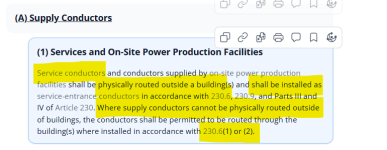
Guys thanks for the input. But does the NEC 695.6 (A) (1) states fire pump service conductors that are physically routed outside the building shall be installed in accordance with 230.6? And it states if the fire pump service conductors cannot be physical routed outside the building, it shall be installed in accordance with 230.6 (1) or (2) specifically. Overhead and on exterior wall for 300' are not options listed in 230.6.

Any thoughts?

1768581204197.png

 
Ove
Guys thanks for the input. But does the NEC 695.6 (A) (1) states fire pump service conductors that are physically routed outside the building shall be installed in accordance with 230.6? And it states if the fire pump service conductors cannot be physical routed outside the building, it shall be installed in accordance with 230.6 (1) or (2) specifically. Overhead and on exterior wall for 300' are not options listed in 230.6.

Any thoughts?

View attachment 2581489

Overhead and on an exterior wall are outside, are they not?
 
Wait. Are overhead and on an exterior wall installation in accordance with 230.6 (1) or (2) or (3) or (4) ? The way I understand NEC 695.6 (A) (1) is that it requires fire pump service conductors that are physically outside the building to follow 230.6 (1) or (2) or (3) or (4)? I think that is the literally meaning of the texts. Or do I understand it wrong?
 
Or do I understand it wrong?
You do....those are ways to have conductors that are actually inside the building envlope treated as being outside the building. The title of that section is "Conductors Considered Outside the Building" and nothing in that section applies to conductors that are actually physically outside the building envelope.
 
You do....those are ways to have conductors that are actually inside the building envlope treated as being outside the building. The title of that section is "Conductors Considered Outside the Building" and nothing in that section applies to conductors that are actually physically outside the building envelope.
I know what you are saying. I also thought of this interpretation but I swing between this and my previous interpretation. The reason that I can not persuade my self because if you read the NEC 695.6 (A) (1) literally, it distinguish two situations

1) Fire service conductors are physically routed outside the building. And it says you should follow 230.6 and 203.9 and Part III, IV of Article 230. Please note it uses "and" instead of "or". If the fire service conductors are physically/actually outside the building why bother to specify 230.6 here? It is very weird to me.

The only explanation make sense to me is that you need to follow one options of 230.6 in this situations even the 230.6 is talking about "Conductors considered as outside the building" not "Conductors actually outside the building".

2) Fire service conductors that cannot be physically routed outside the building. It says you should follow the 230.6. (1) or (2). Please note, it doesn't say 230.6 or the whole section of the 230.6. It only specifies (1) or (2).

Am I the only one who is bothered by NEC 695.6 (A) (1)...:cry:
 
If the fire service conductors are physically/actually outside the building why bother to specify 230.6 here? It is very weird to me.
Just to clarify that the provisions of 230.6 may be used to allow the conductors to be considered outside. Article 230 is only about services, so they need to specifically state that 230.6 can be used for article 695 conductors.
 
1) Fire service conductors are physically routed outside the building. And it says you should follow 230.6 and 203.9 and Part III, IV of Article 230. Please note it uses "and" instead of "or". If the fire service conductors are physically/actually outside the building why bother to specify 230.6 here? It is very weird to me.
I understand your concern, It appears that 695.6(A)(1) is written incorrectly. The first reference to 230.6 should not be there as it is confusing. The only reference should be the one in the last sentence. If you are running the conductors within the building envelope, you are permitted to use methods (1) or (2) in 230.6.
 
It is RGS conduit or Sch80 PVC. It's side alley without traffic. I think it's not an environment subject to damage.

Ok, if code permits it, is it rule of thumb installation? Does it increase fire hazardous to install live service conduit on building exterior wall?
Running PVC horizontally will result in sagging between supports and typically requires expansion couplings. RGS is a suitable but obviously more expensive. Is EMT allowed?
PVC is best buried and your electricians suggestion is one to consider.
 
Wait. Are overhead and on an exterior wall installation in accordance with 230.6 (1) or (2) or (3) or (4) ? The way I understand NEC 695.6 (A) (1) is that it requires fire pump service conductors that are physically outside the building to follow 230.6 (1) or (2) or (3) or (4)? I think that is the literally meaning of the texts. Or do I understand it wrong?
It can be ran on the interior, but must enclosed in a 2 hr firewall ( if I remember correctly) which can consist or a fire rated wrap, or box. Under the slab is also considered outside the building.
 
I was going to submit a Public Input to remove the first reference to 230.6 in section 695.6(A)(1) but the section has been revised and relocated in the 2026 code. 230.6 is no longer referenced so, no need for a PI.
695.7(A) Supply Conductors.
(1) Services and On-Site Power Production Facilities.
Service conductors and conductors supplied by on-site power production facilities shall be physically routed outside a building(s) and shall be installed as service-entrance conductors in accordance with 230.9 and Article 230 Parts III and IV. Where supply conductors cannot be physically routed outside of buildings, the conductors shall be permitted to be routed through the building(s) where installed in accordance with 695.7(A)(2)(d)(1) or695.7(A)(2)(d)(2).
 
Top