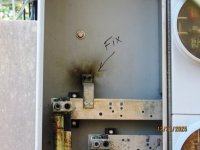
Fix neutral to enclosure bond

Sea Nile

Senior Member
Location
Georgia
Occupation
Electrician
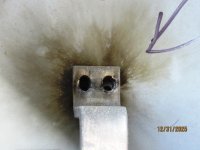
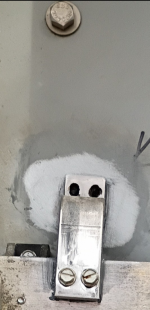
This is a cell Tower. Single phase power coming in this is the neutral to enclosure bond. The two screws are missing. I want to tell you what I'm thinking and get feedback please.

I'm thinking of cleaning the mating surfaces with some fine sand paper and applying some dielectric grease between the surfaces before putting in new grounding screws. 8 may have to tap it to a larger size if they are stripped.

Thanks.
 

Attachments

  • IMG_6839.JPG
    IMG_6839.JPG
    160 KB · Views: 26
  • IMG_6840.JPG
    IMG_6840.JPG
    141.2 KB · Views: 26
If the surfaces are cleaned properly your plan should work. I would probably opt for through bolts with nuts (if feasible) and not bother to try and tap the burnt metal.
 
I'm thinking of cleaning the mating surfaces with some fine sand paper and applying some dielectric grease between the surfaces before putting in new grounding screws.
Why would you put insulating grease between the surfaces?

As Infinity said use bolts instead to re-tapping to a larger size.
 
Someone vandalized it and stole the copper. Replacing it with Aluminum. Don't know the backstory of the burns
If you work on cell towers, you know that is a very common thing! LOL! We were upgrading from 24 vdc to 48 vdc on a lot of towers, and the grounds were missing on a lot of them. They would cut them off as high as they could reach up the tower!
 
Why would you put insulating grease between the surfaces?

As Infinity said use bolts instead to re-tapping to a larger size.
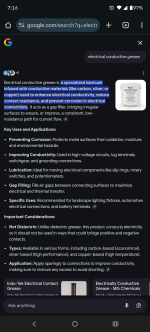
Yes you are right thanks. I was thinking about a conductive grease that would prevent corrosion. Do you think it's necessary? Or do you think I can get away without it?
 

Attachments

  • Screenshot_20260128-071629_Chrome.png
    Screenshot_20260128-071629_Chrome.png
    477.5 KB · Views: 5
Yes you are right thanks. I was thinking about a conductive grease that would prevent corrosion. Do you think it's necessary? Or do you think I can get away without it?
IMO it's not needed. When this equipment came from the factory it is likely that there was no antioxidant applied to the two mating surfaces.
 
The original may have been tapped screws. If it is being thru bolted, the paint would need to be removed. I would put some deox between.
Yes, that's exactly my thoughts. Was going to try to get some sand paper between the mating surfaces and clean it up and then put deox or similar between but I've never done this type of repair before so that's why I'm asking
 
Given the condition of that enclosure sand paper might not be the best way to remove the burnt metal and paint. I would use a Dremel or rasp bit on a drill to clean it up.
 
Yes you are right thanks. I was thinking about a conductive grease that would prevent corrosion.
Yes, if you dig into the the standards that apply to your cell sites like Motorola, AT&T, T-mobile, etc they oftne call that out, typically a work order / purchase order binds us to the standards contractually, but it may not be enforced or noticed. You'll want to pickup a bottle conductive anti-oxidant compound and use it on all mechanical connections (ANSI T1.334-2002, section 9). The standard says the anti-oxidant compound shall be liberally installed between the two metals (see Figure 4-27 on page 4-40 linked above). Some standards here like Century-link here have many restrictions on when AL conductors can be used. Typically not ever for grounding or inside the hut, service laterals its OK.
 
Id be more inclined to lug to the can and bus bar and run a wire type bonding jumper between. Going to be faster and a better connection than trying to clean up that arced up jumper. Through bolt both lugs, clean the paint behind the one on the can. 10x better than what the factory connection was.

That jumper carried the current through the screws originally, holes were thread formed to get more engagement. Tapping up to a 10-32 isn't going to be the same. Through bolting with a nut on the back is still modifying it.
 
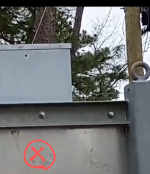
Thanks everyone, I got one more dilemma that I would really appreciate some good advice on. The enclosure is mounted on a metal plate so if I tap it, the screw will have to be exactly the right length so it doesn't bottom out on the plate. I want to run a bolt all the way through, but I don't like going through the metal plate.
I can see three options.
1. Tap it and install short screws that won't push into the plate
2. Go all the way through the plate and use a washer and nut
3. Since there is extra material to go through, maybe a self tapping screw?
I appreciate you guys.
 

Attachments

  • Screenshot_20260129-182710_Photos~3.png
    Screenshot_20260129-182710_Photos~3.png
    121.8 KB · Views: 7
  • Screenshot_20260129-192557_Photos~2.png
    Screenshot_20260129-192557_Photos~2.png
    345.1 KB · Views: 7
Drill and tap through the metal plate. You will not get a better connection. A little cutting oil and a sharp drill bit will do just fine.
 
Top