
Size the junction box for SER Cable Splicing

zemingduan

Senior Member
Location
Philadelphia,PA
Occupation
Electrical Designer
This is a multifamily building project with modular apt units. Each apt unit is delivered to the site from the factory as a module. It has a 4#2/0 & 1#1G AL SER Cable whip. We need to make connections between the SER cable from the modular unit to the 4#2/0 & 1#1G AL MC Cable from the building electrical panel.

As an engineer I am not very familiar with junction box sizing which is usually done by electricians. I sized the junction box as below, could you let us know your thoughts on the required junction box dimensions.


A. If the cable enters from the sides, and not leaving the box from opposite wall (i.e. angle pull or U-pull), according to NEC 314.28:

1. Transposing the 4#2/0 AL & 1#1 AL GND SER cable size into raceway size, the minimum required trade size raceway for the conductors in the cable is 2".

2. For angle pull or U-pull that cable entering from sides (not entering the box opposite the removable cover), it doesn't fall under the exception in 314.28 (2). So you can not use table 312.6(A). The box shall not be less than 6 x 2" = 12" as per 314.28 (2).

The minimum required junction box is 12" x 12" according to NEC 314.28.

B. If the cable enters from the back (entering the box opposite the removable cover) and leaves from the sides, you can apply NEC table 312.6(A). The minimum required bending space for 2/0 AL SER cable is 3" (from end of connector to the wall). Adding the connector dimensions, a 10" x 10" x 6" box maybe enough.

But I can not source a 10" x 10" x 6" box with factory installed knockouts on the back. All products I search online only have knockouts on the sides. Is this an adaptive that the manufacture typical can make for you?

Or can you make the hole at the back by yourself? Is it an easy work for example to the junction box attached? They need 300+ of these boxes.
 

Attachments

  • grainger-32FG76_v1.pdf
    69.9 KB · Views: 7
1. Transposing the 4#2/0 AL & 1#1 AL GND SER cable size into raceway size, the minimum required trade size raceway for the conductors in the cable is 2".
If you're trying to get this box as small as allowed, 314.28 is silent on what type of conduit to use when make this transposition, and IMC appears to be the most advantageous. Using the compact conductor XHHW sizes from Table 5A, the area of conductors I get is 573.63 mm^2, while the allowable 40% fill on 1-1/2" IMC is 573 mm^2. This is close enough that you may wish to get the actual OD of the wires supplied, or recheck the computation using sq in to see if a 1-1/2" transposition can be justified.
 
B. If the cable enters from the back (entering the box opposite the removable cover) and leaves from the sides, you can apply NEC table 312.6(A). The minimum required bending space for 2/0 AL SER cable is 3" (from end of connector to the wall). Adding the connector dimensions, a 10" x 10" x 6" box maybe enough.
The exception refers to the distance from the wall to the cover and does not require adding connector dimensions. So the minimum depth is 3". The 12" minimum dimension still applies from the side wall entry (the language in 314.28 does not differentiate between exits and entries). The other horizontal dimension is not constrained. Choosing to make it no less than the minimum other dimensions, I get a 12x3x3 as the minimum size.

Cheers, Wayne
 
If you have 300 of these boxes and you know ahead of time where the holes are needed, then you can order them customized with the holes made in the right places.
 
314.28 is silent on what type of conduit to use when make this transposition,
Is using a conduit for transposing the size of the box even required? I know that the wording in 314.28 is horrible but I'm not seeing where you have to transpose the cable size to a raceway first. Why can't you just use the trade size of the KO based on the size of the SE cable connectors?
 
Why can't you just use the trade size of the KO based on the size of the SE cable connectors?
Because a cable connector is not a raceway? The wording seems pretty clear to me:

"the minimum metric designator (trade size) raceway required for the number and size of conductors in the cable shall be used."

So you look at the number and size of conductors in the cable, and then you figure out the minimum size raceway you would need to run those conductors in a raceway method, rather than a cable method.

Cheers, Wayne
 
Pardon if this has been covered, but I don't see it in your original calculations. The entering and exiting conduits containing the same set of conductors (even if spliced they are the same ones) have to be the same 6x the diameter apart from each other whether entering and exiting from a side or the front or back.
 
If you're trying to get this box as small as allowed, 314.28 is silent on what type of conduit to use when make this transposition, and IMC appears to be the most advantageous. Using the compact conductor XHHW sizes from Table 5A, the area of conductors I get is 573.63 mm^2, while the allowable 40% fill on 1-1/2" IMC is 573 mm^2. This is close enough that you may wish to get the actual OD of the wires supplied, or recheck the computation using sq in to see if a 1-1/2" transposition can be justified.
You are right. And I did check the 1-1/2" IMC which has a 39.93% conduit fill for 4#2/0 AL & 1#1 AL THNN or XHHW :D. 1.5 " x 6= 9". The 1.5" IMC almost touches the conduit fill limit. So I used 2". But I guess 10" width minimum required can be justified code wise? Is 10" width tight practically?
The exception refers to the distance from the wall to the cover and does not require adding connector dimensions. So the minimum depth is 3". The 12" minimum dimension still applies from the side wall entry (the language in 314.28 does not differentiate between exits and entries). The other horizontal dimension is not constrained. Choosing to make it no less than the minimum other dimensions, I get a 12x3x3 as the minimum size.

Cheers, Wayne
Yes thanks for the correction. The distance permitted in exception is the distance between the wall to the cover. The width shall be still constrained by the 314.28 6 times the conduit trade size.

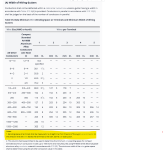
But the exception says that distance shall comply with table 312.(6)A. Table 312.(6)A note 1 states the distance in this table is the minimum bending space required between the end of connector to the wall. So I think the connector dimension shall be added to the distance you got from the table to get the minimum distance between the wall to the cover.

1770062886236.png
 
Table 312.(6)A note 1 states the distance in this table is the minimum bending space required between the end of connector to the wall.
Well, the applicability of Note 1 to this reference from 314.28 is I think debatable [if you have RMC connected to a splice box with two locknuts, and the computation comes out to 12", I've never seen anybody say "well the RMC sticks into the box a little, so you need to go one size up from 12".] But say it does apply, what connector sticks into the box more than 1"? 4" deep would be plenty.

Cheers, Wayne
 
Well, the applicability of Note 1 to this reference from 314.28 is I think debatable [if you have RMC connected to a splice box with two locknuts, and the computation comes out to 12", I've never seen anybody say "well the RMC sticks into the box a little, so you need to go one size up from 12".] But say it does apply, what connector sticks into the box more than 1"? 4" deep would be plenty.

Cheers, Wayne
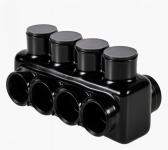
I think we are talking about different connectors. The connector I refer to is the 4-port connector inside the box used to connect/join the incoming and outgoing #2/0 conductors. I make connection in this box not just pull the conductors through the box.

1770064558689.png
 
I think we are talking about different connectors. The connector I refer to is the 4-port connector inside the box used to connect/join the incoming and outgoing #2/0 conductors.
Presumably you mean the (4) 2 port connectors, not the (1) 4 port connector you show, as all 4 ports are connected together. [The version you show is double ended, so you can enter each port from either side, but not both simultaneously.]

Anyway, 314.28(A)(2) Exception is referring to the distance between the wall and the opposite cover. The size of the connector used to splice the wires does not enter into it. If you think about it, the sizing requirements in 314.28 are about wire bending space, you need enough room to bend the wire before it hits the opposite obstruction (and physically do this bending as you make up the connection, which is why the opposite removable cover matters).

If you are coming into the box through the back opposite a removeable cover, your wire is likely going to make roughly a full 90 degree turn and then enter your wire connector roughly parallel to the back of the box. So the wire connector dimensions don't take away from the wire bending space.

Cheers, Wayne
 
Presumably you mean the (4) 2 port connectors, not the (1) 4 port connector you show, as all 4 ports are connected together. [The version you show is double ended, so you can enter each port from either side, but not both simultaneously.]

Anyway, 314.28(A)(2) Exception is referring to the distance between the wall and the opposite cover. The size of the connector used to splice the wires does not enter into it. If you think about it, the sizing requirements in 314.28 are about wire bending space, you need enough room to bend the wire before it hits the opposite obstruction (and physically do this bending as you make up the connection, which is why the opposite removable cover matters).

If you are coming into the box through the back opposite a removeable cover, your wire is likely going to make roughly a full 90 degree turn and then enter your wire connector roughly parallel to the back of the box. So the wire connector dimensions don't take away from the wire bending space.

Cheers, Wayne

You are right, 2 port connector. I understand what you are saying. Thanks for the detailed explanation! I obtained more knowledge about the installation.
 
Top