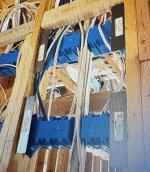
300.4. Protection against physical damage.

I guess I always look for the path of least resistance in things and keep it simple. If I were still wiring houses, and if this was a problem for the inspector, I would scab a short piece of 2 x 4 everywhere an outlet box needed to be. The width of a 2 x 4 is 1 1/2". That's more than 1 1/4" away from the framing member that the drywall guys are aiming to hit. I don't know of an inspector that could argue that point.
 
I guess I always look for the path of least resistance in things and keep it simple. If I were still wiring houses, and if this was a problem for the inspector, I would scab a short piece of 2 x 4 everywhere an outlet box needed to be. The width of a 2 x 4 is 1 1/2". That's more than 1 1/4" away from the framing member that the drywall guys are aiming to hit. I don't know of an inspector that could argue that point.
Hey Rick... That came up while back and of course, it would be an extra cost to do the work, and who would do it, the framer or electrician....we have scabbed on 2x material, but that is to get boxes away from door areas where trim will be installed, if needed, and other locations. But its always who will do the work and of course it can get expensive. But it would work though
 
Hey Rick... That came up while back and of course, it would be an extra cost to do the work, and who would do it, the framer or electrician....we have scabbed on 2x material, but that is to get boxes away from door areas where trim will be installed, if needed, and other locations. But its always who will do the work and of course it can get expensive. But it would work though
It has been many years since I did houses, but there were always pieces of scrap wood lying around. probably not the case today. So I would understand the discussion on who would incur the cost. As far as who would do the work, I can still drive two nails through a short piece of 2x4 in seconds, so I wouldn't worry about that too much. Besides, the framer doesn't know where your boxes are going, so the electrician would be required to nail them up.
 
With most of today's deep switch boxes a 2X4 on the flat would be too deep.
Not following what you mean. The extra bit of 2x4 is presumably not a "framing member", so all that could matter is the box location relative to the stud. Which doesn't actually matter as long as you route your cable between the stud and the box in a manner that avoids segments parallel to the framing member.

Cheers, Wayne
 
Not following what you mean. The extra bit of 2x4 is presumably not a "framing member", so all that could matter is the box location relative to the stud. Which doesn't actually matter as long as you route your cable between the stud and the box in a manner that avoids segments parallel to the framing member.

Cheers, Wayne
Oh I get it I now thanks I was picturing a 2X4 horizontal behind the box, Rick is talking about a spacer flat on the framing member.
 
It's all just not the code. The code is all about not being able to drive something into NM (or MC) when passing through a stud. That's it. If it was about 1-1/4" from the face of anything else, then what about NM cable that's moved around by the insulation team? It is also not about plastic boxes being closer than 1-1/4". If it was, I could get "lucky" and put a nail though one of the open pre-punched holes in a metal box.
 
It's all just not the code. The code is all about not being able to drive something into NM (or MC) when passing through a stud. That's it. If it was about 1-1/4" from the face of anything else, then what about NM cable that's moved around by the insulation team? It is also not about plastic boxes being closer than 1-1/4". If it was, I could get "lucky" and put a nail though one of the open pre-punched holes in a metal box.
See post #40, its largely a AHJ call as there many terms an AHJ could interpret, especially in 300.4 (F) the pic in post 36 NM passing behind switch boxes. Do the switch boxes create a shallow groove? What is a groove?
This is from my 2017 PDF: (I dont think its changed much)
300.4 (F) Cables and Raceways Installed in Shallow Grooves.
Cable- or raceway-type wiring methods installed in a groove, to
be covered by wallboard, siding, paneling, carpeting, or similar
finish, shall be protected by 1.6 mm (1⁄16 in.) thick steel plate,
sleeve, or equivalent or by not less than 32-mm (1 1⁄4-in.) free
space for the full length of the groove in which the cable or
raceway is installed.
...
 
Last edited:
It appears this area requires protection just like other areas specifically identified in the Code. While it may not have been explicitly called out in the past, the Code requirements are clear, and the absence of a specific callout does not mean the requirement is not enforceable. This seems to have been an oversight rather than an exemption.

Code requirements do evolve, and after reviewing the applicable standards, including the requirement for a metal protection plate, we will be installing this protection on all of our work moving forward, whether or not it is specifically called out. This protection is required by NFPA.

It appears this issue has now been identified and addressed.
 
It's all just not the code. The code is all about not being able to drive something into NM (or MC) when passing through a stud. That's it. If it was about 1-1/4" from the face of anything else, then what about NM cable that's moved around by the insulation team? It is also not about plastic boxes being closer than 1-1/4". If it was, I could get "lucky" and put a nail though one of the open pre-punched holes in a metal box.
Especially if they use spray insulation, that moves everything around....
 
It appears this area requires protection just like other areas specifically identified in the Code. While it may not have been explicitly called out in the past,
Reminds me of 312.5(C), its been the code long time, but lots of places it was never called out. It was very common to see these resi exterior mounted narrow style combo meter / loadcenter pannels that just had a 2" PVC adapter out the back and all the romexes pulled thru into a stud bay.
Then one day after a IAEI meeting they started enforcing 312.5(C).
 
Reminds me of 312.5(C), its been the code long time, but lots of places it was never called out. It was very common to see these resi exterior mounted narrow style combo meter / loadcenter pannels that just had a 2" PVC adapter out the back and all the romexes pulled thru into a stud bay.
Then one day after a IAEI meeting they started enforcing 312.5(C).
Totally agree ! Its like going to continuing education training, and the instructor shows some slides and codes and asks what Jurisdictions are enforcing this and some hands go up and some don't. He emphasizes what ever the topic is that's needs to be enforced. We then all go back to our cities/Counties and start informing and calling it out, working it into the trades. That is why I enjoyed and networking with other jurisdictions on codes.. I was with guys from my own City that raised their hands and I know firsthand they did not enforce it. They and including myself were to embarrassed to acknowledge they missed something that should be called...But it was a great learning and always striving to be better was our goal, or at least mine... Codes and updates are always changing and we all strive to be better...
 
To post # 36..I have many places like this location. We build high end custom homes, in the 5 to 10 million and more range. We have so many locations with so much wiring for wiring centers. This is what I use, similar to what you have. This is just a sample.
 

Attachments

  • IMG_5805.jpeg
    IMG_5805.jpeg
    1.5 MB · Views: 18
To post # 36..I have many places like this location. We build high end custom homes, in the 5 to 10 million and more range. We have so many locations with so much wiring for wiring centers. This is what I use, similar to what you have. This is just a sample.
I have banks of walls with all this going on....I protect the 1 1/4" from stud edge, because of so much going on in these areas. I only protect out to what the code states.
 
This is not what the code is trying to address. If you are asking if these need to be protected, and you feel the answer may be YES, then the entire length of cable needs to be protected anywhere is is closer to the wall surface than 1-1/4" and there is no way that can be accomplished using NM or MC. That means you need to use EMT.
 
This is not what the code is trying to address. If you are asking if these need to be protected, and you feel the answer may be YES, then the entire length of cable needs to be protected anywhere is is closer to the wall surface than 1-1/4" and there is no way that can be accomplished using NM or MC. That means you need to use EMT.
Totally agree. I have protected the conductor and box that are closer then an 1 1/4" from framing member edge, and moved conductors and secured away to meet my required distance. This photo is hard to see, and not too clear and not all the way done securing away and plate protection. I just make sure I am protected or not within 1 1/4" Could you please explain what the code is trying to do ? I don't think it matters further out away from the stud if it's closer, it just says 1 1/4" from edge of framing member. Am I missing something when you say "closer to the wall surface ". If it is out and closer to the backwall surface , say in the middle of the stud bay and secured, it would not matter, I believe. It just says 1 1/4" from Edge of Framing Member. Thank you for jumping on here...
 
Could you please explain what the code is trying to do ?
It's trying to prevent the most common sources of cable damage from wallboard fasteners, not all sources. So it has rules on cables through holes in framing members (300.4(A)) and rules on cables installed parallel to framing members (300.4(D)). It does not have any rules on cables running diagonally within a stud bay, or rules on cables within boxes.

So if the additional protection near boxes described in this thread is useful to you because it saves you callbacks or gives you peace of mind, that's great. But this protection is optional, not mandatory.

Cheers, Wayne

 
It's trying to prevent the most common sources of cable damage from wallboard fasteners, not all sources. So it has rules on cables through holes in framing members (300.4(A)) and rules on cables installed parallel to framing members (300.4(D)). It does not have any rules on cables running diagonally within a stud bay, or rules on cables within boxes.

So if the additional protection near boxes described in this thread is useful to you because it saves you callbacks or gives you peace of mind, that's great. But this protection is optional, not mandatory.

Cheers, Wayne
It's trying to prevent the most common sources of cable damage from wallboard fasteners, not all sources. So it has rules on cables through holes in framing members (300.4(A)) and rules on cables installed parallel to framing members (300.4(D)). It does not have any rules on cables running diagonally within a stud bay, or rules on cables within boxes.

So if the additional protection near boxes described in this thread is useful to you because it saves you callbacks or gives you peace of mind, that's great. But this protection is optional, not mandatory.

Cheers, Wayne
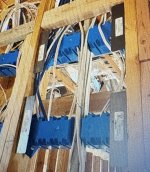
I agree on diagonally inside a stud bay, or even vertical in stud bay, like above our mains or subpanels, they install blocking and secure wiring, but at the box for the receptacle (switch or plug) where it enters, within an 1 1/4" from face of studs, two directions is required. There is a misconception on what is required to be protected. I do not see how protection is optional when wiring is so close and does not meet the distance. So if the conductor is fastened down the stud vertical. (Middle of stud and 1 1/4 " from both edge's), then looped into the box well in violation of the 1 1/4" from framing member edge, at the box. I do not see how this protection can be optional. Have you read the IAEI magazine article commentary from Vincent LaPorta ? Great commentary on this protection. Thanks Wayne....and appreciate your time and expertise.
 
Last edited by a moderator:
Top