Ethernet Through 4 Twisted Pairs of Phone Wire?

Joethemechanic

Senior Member
Location
Hazleton Pa
Occupation
Electro-Mechanical Technician. Industrial machinery
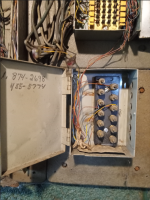
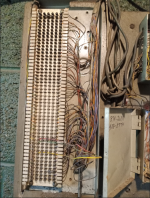
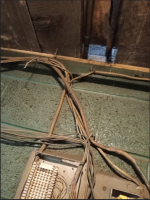
I'm talking about this stuff. It's already there and going exactly where I want to go. It's a lot of work saved and I'd have to get a scissor lift in here to run modern CAT cable.

Screenshot 2025-09-22 124710.pngScreenshot 2025-09-22 124643.pngScreenshot 2025-09-22 124627.png
 
Interesting, but the closest this cable ever came to CAT anything is when a stray had kittens in that old telephone closet. It's probably 1960's.
I wonder how much different the construction of the cable is.

Basically I want to add a couple of wireless access points
 
Interesting, but the closest this cable ever came to CAT anything is when a stray had kittens in that old telephone closet. It's probably 1960's.
I wonder how much different the construction of the cable is.

Basically I want to add a couple of wireless access points
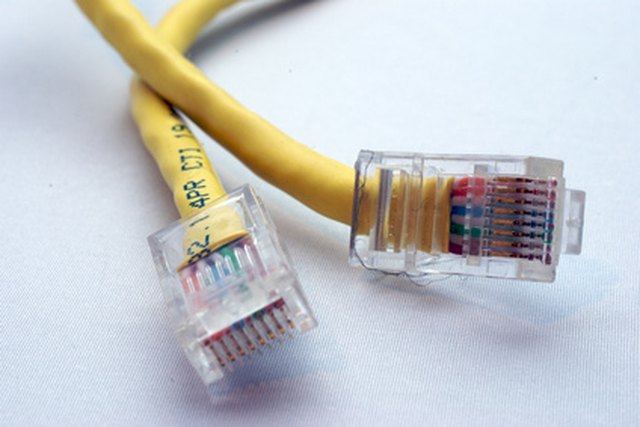
So you want Ethernet and PoE over non twisted pair cables? Good luck with that. New CAT5E or better cable will be needed.
 
I thought most phone cable was cat3 and it has a twist, but its slow. Maybe more of a convenience to keep the pairs together. It may work at 100BaseT, but gigabit is probably going to be a problem.
 
I thought those were twisted pairs.
They are. The problem is that the number of twists per inch is related to the frequency that the cables can reliably carry, which is based on common-mode noise rejection at the receiving end.

The tighter the twists, the higher the frequency of interference that both conductors will pick up equally, and then be ignored by the differential inputs, allowing only the difference signal to pass.
 
Maybe but doubtful. You don't show much except for an ancient mess, though I do see some 25 pair. So, if you can follow the 25 pr color code (it doesn't look like anything else is usable besides the 25 pr) and if you can somehow press plugs on the pairs you are using you could try. That cable may predate CAT3 and is only twisted pair. CAT3 is actually good for 10 BASE T. Twisted pair is good for voice, that's it.

That said, keep in mind that most all phone systems today are VOIP, they connect to the internet like computers using the same network and CAT5e or 6 cables. When a business buys a new phone system, always the place has to be rewired for the extra phones. If the techs could use the existing that would be like winning the lottery. And VOIP phone isn't much bandwidth. An access point will be.

Good luck but don't get your hopes up.

From a former AVAYA phone system dealer.

-Hal
 
Basically I want to add a couple of wireless access points
Don't know your situation or layout requirements, but you might consider replacing the cable with wireless radios.

Then you can also add extensions, from them with cables if needed.

I started with them years ago, linking between buildings and then adding access points inside when needed. for extended coverage.

You can start the learning process here. If interested. They have made great products that I have used outdoors and indoors for decades. ps://www.ui.com/us/en/how-it-works

the new products store for perusing. https://store.ui.com/us/en?s=us&l=en

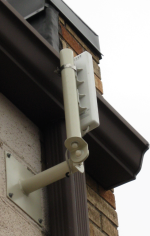
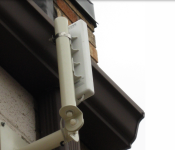
Here is one of the older obsolete models I started with, for cheap never had one fail with years of outdoor use.

You might get away with one inside depending on your requirements and layout

 
Don't know your situation or layout requirements, but you might consider replacing the cable with wireless radios.

Then you can also add extensions, from them with cables if needed.

I started with them years ago, linking between buildings and then adding access points inside when needed. for extended coverage.

You can start the learning process here. If interested. They have made great products that I have used outdoors and indoors for decades. ps://www.ui.com/us/en/how-it-works

the new products store for perusing. https://store.ui.com/us/en?s=us&l=en

Here is one of the older obsolete models I started with, for cheap never had one fail with years of outdoor use.

You might get away with one inside depending on your requirements and layout

Use a lot of those, there is a company that also pre sets them for plug and play. 10 mile range. Just upgraded a switch at a customers building. Got about 30 cameras too. Domes, PTZ and bullets.
 
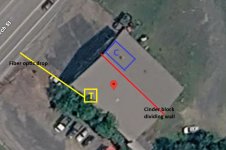
Actually my problem is cinder block walls and brick walls between parts of the building. From what I've heard I'm going to have dead areas if I just put a WAP up on the wall above that telephone closet. I more or less have to bring the fiber optic in that room because I can't have the drop where there is truck and heavy equipment traffic.

I need wifi propagation through the interior walls
 
I have used them through block walls many times when selected and positioned properly, they need basically line of sight between two radios without large metal obstructions in the path, brick and block is not so bad, a big metal truck body is not so good. looks like your distance is not that far and indoors. You might look to see if you have an experienced installer in your area to make a site visit.

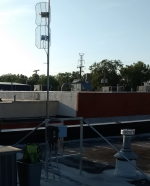
I'm using one on the building roof, to reach across the parking lot about the size of your building, then penetrate a block wall of a neighboring building and go across it's shop to a standard DSL wireless router. It's been working fine rain,snow or shine for years.

One block wall inside the building shouldn't be a deal breaker with the right radios and placement. One on each end of the link should be bullet proof. Like I said I'm using one and the standard DSL provided wireless router and have good success with it See if you can find an experienced installer in your area or study up. I don't even know if the models I'm using are still available new, but I'm sure they have something in their line compatible with your needs.
 
1770650067247.png

The original plan was to put a WAP like that up on the inside wall above that telephone closet at about 18 feet elevation above the floor right above that telephone closet. But then I'm hearing that the cinder block wall is going to slow down the speed a lot. Distance is about 75 feet
 
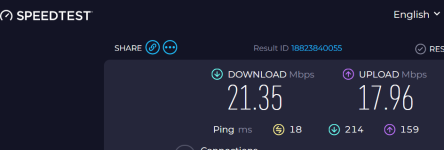
Here is a speed test across the lot, thru a block wall and another shop, to the older DSL wireless router, plenty fast enough for my needs. I'm sure it would be faster if the basic router on the other end was a faster unit and line in. Don't know how much throughput you need, but for older gear this is not bad. I'm not sure even what the DSL line and router is rated at.

1770651721807.png
 
Here is a speed test across the lot, thru a block wall and another shop, to the older DSL wireless router, plenty fast enough for my needs. I'm sure it would be faster if the basic router on the other end was a faster unit and line in. Don't know how much throughput you need, but for older gear this is not bad. I'm not sure even what the DSL line and router is rated at.
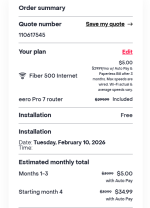
Right now I have about 10 Mbps in the office on a good day. 15 tops. But I'm having Frontier 500 Mbps installed, and I want to get as much speed as I can

1770652553083.png

1770652300212.png
 
Last edited:
Right now I have about 10 Mbps in the office on a good day. 15 tops. But I'm having Frontier 500 Mbps installed, and I want to get as much speed as I can

View attachment 2581905
Well, I have no experience with a fiber front end. But it advises that advertised speeds are wired, actual speeds vary. Maybe you should have them run the fiber across the building if you want full throughput. cat3 certainly is not what your looking for.
 
Top