
Run SER cable to junction box, the installation correct?

zemingduan

Senior Member
Location
Philadelphia,PA
Occupation
Electrical Designer
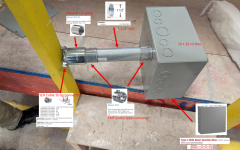
The electrician plan to run the 4#2/0 & #1GND AL SER cable to the 10 x 10 x 6 junction box through the SER cable strap connector and a short section of 1-1/2"C RGC conduit. See the picture below. I think the installation is not code compliance. What do you think?
1773246265984.png


1. Are you allowed to strip the SER cable and only run the individual insulated conductors after the SER strap connector in the short section of IMC? Do you need a box to transit the SER cable to conduit?

2. 1-1/2" RGC doesn't meet the conduit fill for 4#2/0 & #1GND THHN AL. 1-1/2" IMC does meet the conduit fill though.

3. If he pulls the SER cable in the conduit, the conduit fill shall be met since the RGC conduit is part of the raceway according to the picture in my opinion. The 1-1/2" RGC conduit fill exceed 53% for the SER cable.
 
I believe it is fully compliant if the SER jacket is not stripped off inside the conduit and protrudes into the box. If it's still a cable as it passes through the RGC or IMC, the pipe is not actually a raceway/wiring method, so conduit fill and listing of individual conductors does not apply.

I would approve it either way all day long. There are no legitimate safety concerns.
 
Last edited:
3. If he pulls the SER cable in the conduit, the conduit fill shall be met since the RGC conduit is part of the raceway according to the picture in my opinion. The 1-1/2" RGC conduit fill exceed 53% for the SER cable.
I suppose you could debate it both ways, If you omit the two screw connector its a protective sleeve then
I don't think conduit fill applies to protective sleeves, NEC chapter 9 Table 1 note 2, the cable needs to be intact, you cant have open conductors in a protective sleeve, the sleeve is to protect a cable.

I suppose if the two screw connector makes it a change in wiring methods and if the conductors in the SER meet 300.3 then its unquestionably allowed and fill would apply only to the conductors.
I personally go the sleeve route often, the one caution with the sleeve route is its generally allowed on a pull box but if 312.5(C) applies say at a load-center its a bit more complicated.
 
What happens to the conductor once they enter the box ?
My concern would be making sure proper bending radius was maintained and grounding was addressed.
I would have no problem with either cable or conductors entering the box via the nipple,.
 
I believe it is fully compliant if the SER jacket is not stripped off inside the conduit and protrudes into the box. If it's still a cable as it passes through the RGC or IMC, the pipe is not actually a raceway/wiring method, so conduit fill and listing of individual conductors does not apply.

I would approve it either way all day long. There are no legitimate safety concerns.
What makes a section of conduit as a protective sleeve or raceway/wiring method? I can not find a definition in NEC. I am not clear about this.
 
The cable will enter into the box, make the splice, transit to MC cable and exit the box from the side. The OD of the SER cable is 1.421" = 36.0934 mm. The inner diameter of the RGC is 40.89 mm. 36.0934/40.89 = 88.27% fill.

I am wondering why not just connect the SER cable to the box using the SER strap connector through the knock out.
 
Where does it say that? It just says a raceway 24" or less.
Where conduit or tubing nipples, not including connectors, having a maximum length not to exceed 600 mm (24 in.) are installed between boxes, cabinets, and similar enclosures, the nipples shall be permitted to be filled to 60 percent of their total cross-sectional area, and 310.15(C)(1) adjustment factors need not apply to this condition.

Is this what you are talking about
 
The photo shows a SE cable connector threading into a rigid coupling which not permitted. It also shows RMC with EMT connectors which won't work on 1.5 RMC.
 
Can someone also give me some education on this question? " Are you allowed to strip the SER cable and only run the individual insulated conductors after the SER strap connector in the short section of IMC? Do you need a box to transit the SER cable to conduit?"

Similar to transit the MC cable to conductors in the conduits. Can you just strip off the metal armor and pull the conductors in the conduit? Does code require a box and require splice for the transition and why?

Thanks!
 
The photo shows a SE cable connector threading into a rigid coupling which not permitted. It also shows RMC with EMT connectors which won't work on 1.5 RMC.

There is quite a bit going on.

Building a transition fitting from 2 connectors and a rigid coupling is one of those things that has been debated ad nauseum. I'm pretty sure that this is technically a violation but a large portion of the trade will accept it if implemented well. In this installation (where the connection is not needed for EGC integrity) I wouldn't have a problem with it at all.

The photo calls the raceway 'rigid conduit' but it looks like EMT to me, and is held in EMT connectors. So I'm pretty sure that this is EMT in properly sized connectors. 1.5 RGC would not fit in those connectors and any RGC that did fit in those connectors would be way too small.

The cable will enter into the box, make the splice, transit to MC cable and exit the box from the side. The OD of the SER cable is 1.421" = 36.0934 mm. The inner diameter of the RGC is 40.89 mm. 36.0934/40.89 = 88.27% fill.

The diameter ratio is not the same as the area ratio. You need to use (<cable OD>/<raceway ID>)^2 to get the area ratio. Even so, IMHO you are correct that the raceway selected is too small for the cable.

I am wondering why not just connect the SER cable to the box using the SER strap connector through the knock out.

It looks to me as though things are being set up to penetrate a wall or similar, and they want to extend the SER connector away from the box.

I would be comfortable with this installation if they used a larger conduit, and if the cable isn't being inappropriately stressed where it gets clamped by the connector.
 
Can someone also give me some education on this question? " Are you allowed to strip the SER cable and only run the individual insulated conductors after the SER strap connector in the short section of IMC? Do you need a box to transit the SER cable to conduit?
The usual issue with stripping off the jacket is that the conductors within the raceway are not marked. If the conductors are individually marked then I don't see an issue with stripping off the outer jacket.
 
Can someone also give me some education on this question? " Are you allowed to strip the SER cable and only run the individual insulated conductors after the SER strap connector in the short section of IMC? Do you need a box to transit the SER cable to conduit?"

This is a point of debate, but IMHO the general consensus is that if the individual insulated conductors are labeled with an appropriate conductor type, then you can do this. So if you strip the SER cable and see wires labeled (for example) "THHN" then there is no issue. Some SER has labeled conductors, some doesn't. The debate is about what you are allowed to do if the individual conductors are not labeled.

Similar to transit the MC cable to conductors in the conduits. Can you just strip off the metal armor and pull the conductors in the conduit? Does code require a box and require splice for the transition and why?

A separate debate is the transition. Making up a 'transition fitting' with a rigid coupler has recently been identified as a violation, but without evidence of a real problem. Arguably it is just a lack of testing. I personally would have no problem with a field built transition fitting if it is in a dry environment and not part of the EGC. I would worry more it were an EGC (say a conduit transition where the conduit was the EGC) or if it were an environment that might corrode the threads.

-Jonathan
 
Top
