Help, need advice please 400 amp house

If I did my math right, that’s only 32 amps usage. But that’s just an average over a whole month, right? So it could be days using a lot more than that obviously, we had a cold spell in February, I believe here..
Your math may be fine. But your method is invalid, you can't learn what you need from that.


I’m thinking on going head with a 400 service, enlarging the 2 inch riser to 2 1/2 inch and enlarging the 4/0 to 350.
I'd give it a 2% chance that you need more than 200A.
Do the load calc per the optional method,. get the utility data, get the CT meter described above.
Only a tiny fraction of homes need 400A after you do the numbers right.
 
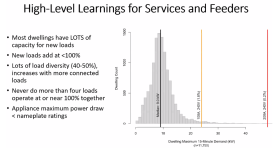
The POWER working group and Lawrence Berkeley National Lab have instrumented tens of thousands of homes, and analyzed large volumes of utility data. The number of homes that require 400A service is tiny.
5254.png

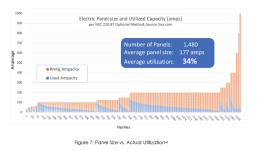
This is a very weird chart. I'm not sure why I need to see the total quantity of panels on the X axis. It would however be interesting to see quantity of each panel size, or quantity of each utilization percentage.

Regardless, it is making me question some 400 amp services on recent and future project. 🤔

Rob G
Seattle
 
This is a very weird chart. I'm not sure why I need to see the total quantity of panels on the X axis. It would however be interesting to see quantity of each panel size, or quantity of each utilization percentage.
Regardless, it is making me question some 400 amp services on recent and future project. 🤔
The chart is odd, but well founded. It shows the distribution of homes by peak load.
You an see at the 100 amp size there are some homes that peak out that 100A panel. But get up to 200, and basically none do.
And at 400 the peak homes are using a fraction of the service. Even more so at 600/8000/1000.

92% of the homes with 200A and above had over 50% in spare reserve capacity.

This dude did some of the work:
The graph above was from
R.19-01-011 Phase 4a Staff Proposal, citing Home Energy Analytics public data:
See also
Avoiding and streamlining electric panel and service upsizing Policy Brief / May 14, 2024


1775803771349.png
 
It is needed to create the data point. It appears they sorted the houses by service size and usage, then assigned an identifier so they could be plotted individually.
I had assumed it was simply the quantity based on the total panel count of 1,480. It could be one in the same as what you're describing. Either way it seems useful to the researchers, less so for others hoping to glean useful information from the chart.

Rob G
Seattle
 
I had assumed it was simply the quantity based on the total panel count of 1,480. It could be one in the same as what you're describing. Either way it seems useful to the researchers, less so for others hoping to glean useful information from the chart.
As various commenters noted: its a way of visualizing the distribution of homes.
If you want PM me an email address and I'll introduce you to the researcher, you're welcome to help shape the next gen research.

I'm not that interested in the distribution myself, being more concerned with the peaks and edge cases that code
decisions need to be made on.
 
This is a very weird chart. I'm not sure why I need to see the total quantity of panels on the X axis. It would however be interesting to see quantity of each panel size, or quantity of each utilization percentage.
The quantity of 100 amp panels is 407 (482 minus 75). Over half of them (200 of roughly 400) never saw a peak over 50% utilization on a 15 minute basis, during the sample period.
 
If you want PM me an email address and I'll introduce you to the researcher, you're welcome to help shape the next gen research.
I can't imagine I would have anything of use to add, way over my pay grade. I was merely commenting on what I thought was a poor choice on the layout of the chart. I'm guessing that chart is but one of many in an otherwise well researched and informative study.

I'm not that interested in the distribution myself, being more concerned with the peaks and edge cases that code decisions need to be made on.
Both seem relevant, useful and interesting.

Rob G
Seattle
 
Top