

1000 volt single phase inverters

Status
Not open for further replies.

electrofelon

Senior Member
Location
Cherry Valley NY, Seattle, WA
Occupation
Electrician
Are there any 1000V single phase inverters besides the Fronius Primo line? Seems the manufacturers are kinda behind on this?

(Note all the datasheets out there, even the ones on the Fronius website show the primo as 600V, but they are in fact 1000V, confirmed by data plate and tech support, and have been since at least middle of last year. I installed 2 on a 1000v system and the inverters were ordered in early summer '16 = very odd)
 
Since the NEC still limits one and two family dwellings to 600V, I'd imagine were talking about a pretty small segment of the US market.
 
Since the NEC still limits one and two family dwellings to 600V, I'd imagine were talking about a pretty small segment of the US market.

Around here I see many inverters located outdoors on a ground or pole mount array structure, or on an accessory structure like a shed or detached garage. I could see if you are in a more urban area, you will see mostly roof mounts with the inverters inside.
 
I see. Yes, I didn't have that segment in mind, that would enlarge it significantly. (Are most of those ground-mounts 'behind the fence' or is that issue mostly ignored?)

Another thing that could be going against it (so I've been told by SolarEdge) it is that those higher voltages aren't ideal for inverting to single phase.
 
I see. Yes, I didn't have that segment in mind, that would enlarge it significantly. (Are most of those ground-mounts 'behind the fence' or is that issue mostly ignored?)

Another thing that could be going against it (so I've been told by SolarEdge) it is that those higher voltages aren't ideal for inverting to single phase.
They aren't ideal for inverting to lower voltages (e.g. 240 delta or 208Y/120) even at three phase.
Probably they do not see a big market for higher voltage single phase either.

mobile
 
I see. Yes, I didn't have that segment in mind, that would enlarge it significantly. (Are most of those ground-mounts 'behind the fence' or is that issue mostly ignored?)

I recall some recent discussions on the fence issue. I admit I dont recall the relevant code sections and specific wording. I dont have my codebook with me and I am away. Is this only an issue with > 600 Volt or both? I have only seen 1 non - 480V 3 phase system that was 1kv, and that was the one I did which was a roof mount on a residential detached structure. Around here resi ground mounts are not fenced (I have actually done very little Resi grid tie Pv, most is commercial or off grid).

Another thing that could be going against it (so I've been told by SolarEdge) it is that those higher voltages aren't ideal for inverting to single phase.
They aren't ideal for inverting to lower voltages (e.g. 240 delta or 208Y/120) even at three phase.

I wondered about this. Clearly with 1KV strings and 208 or 240 Ac we are looking at having to buck the DC down 400 volts easy even at the peak of the AC wave. Has anyone heard any figures on efficiency losses with this or know enough about inverter buck topologies to comment? Fronius does not make any comments or disclaimers in their efficiency figures. I do know that many off gridders report higher running temps when running string voltages at the higher end of their charge controllers (most are 150-200V max for 12-48 battery banks. There are two 600 volt charge controllers available but I am quite certain those have a transformer).

Obviously Fronius hasnt really felt the need to advertise and rave about their 1kv capability, but I still say its a no brainer (clearly I am right and all the inverter manufacturers are wrong ;)). Besides the systems I mentioned, we have single phase inverters frequently used in commercial applications with 120/208 services and 1kv strings would be of great benefit. Finally, with 1.5KV coming and the presumed acceptance of higher string voltages in other than industrial situations, 600V will lag still further behind.
 
Around here resi ground mounts are not fenced

Has anyone heard any figures on efficiency losses

I agree with the 1st part, and at first glance, there isn't a lot of difference efficiency wise.
There only diff. here is the brand of inverter. (From Helioscope)

SMA 6000tl
Module DC Nameplate7.68 kW
Inverter AC Nameplate6.00 kW
Load Ratio: 1.28
Annual Production10.87 MWh
Performance Ratio85.4%
kWh/kWp1,415.8

----
Ingeteam 6tl M
Module DC Nameplate7.68 kW
Inverter AC Nameplate6.00 kW
Load Ratio: 1.28
Annual Production10.99 MWh
Performance Ratio86.3%
kWh/kWp1,430.6
 
single phase inverters frequently used in commercial applications with 120/208 services and 1kv strings

I know your tagline says "can't generalize", but...
I'd say the benefit of 1000VDC increases the closer you get to 50kVA, and the longer the run from panels to interconnection point is. (those examples in my previous post were only 200 ft. runs)
It is directly proportional to those two things in some way. At least around here.

NatGrid ESB 756
5.3.1 Single Phase
Single phase DG system connections to the Company’s Distribution EPS circuits under 600 volts (AC) present power quality and phase balance challenges. Single phase connections shall have these minimum characteristics:
•Nameplate rating of a single generator or group of generators equal to or less than 50 kVA...
 
Around here I see many inverters located outdoors on a ground or pole mount array structure, or on an accessory structure like a shed or detached garage. I could see if you are in a more urban area, you will see mostly roof mounts with the inverters inside.

Our AHJ says that the 1000V limit permitted in 2014 NEC 690.7(C) applies to the load being served rather than the structure the array is attached to. Also, Hren and Mehalic in SolarPro April/May 2014 and Ball, Brearly and Hamon in SolarPro April/May 2013 wrote that the 600V limit still applies to PV systems "for" one- and two- family dwellings, although 690.7(C) says it applies to PV source and output circuits "in" one- and two- family dwellings. I think the most common interpretation is that the 600V limit still applies to ground or pole mount residential systems.
 
Our AHJ says that the 1000V limit permitted in 2014 NEC 690.7(C) applies to the load being served rather than the structure the array is attached to. Also, Hren and Mehalic in SolarPro April/May 2014 and Ball, Brearly and Hamon in SolarPro April/May 2013 wrote that the 600V limit still applies to PV systems "for" one- and two- family dwellings, although 690.7(C) says it applies to PV source and output circuits "in" one- and two- family dwellings. I think the most common interpretation is that the 600V limit still applies to ground or pole mount residential systems.
If there is a ground mounted PV system at a residence and the inverter(s) is/are at the array, what difference does it make to the residence what the DC voltage is? It's probably a moot point, though, seeing as most residences have 240V single phase services and I don't know of any single phase inverters which will take 1000V DC.
 
Our AHJ says that the 1000V limit permitted in 2014 NEC 690.7(C) applies to the load being served rather than the structure the array is attached to. Also, Hren and Mehalic in SolarPro April/May 2014 and Ball, Brearly and Hamon in SolarPro April/May 2013 wrote that the 600V limit still applies to PV systems "for" one- and two- family dwellings, although 690.7(C) says it applies to PV source and output circuits "in" one- and two- family dwellings. I think the most common interpretation is that the 600V limit still applies to ground or pole mount residential systems.

2014 NEC
690.8(C) In one and two-family dwellings, PV source circuits and PV output circuits that do not include lampholders, fixtures, or
receptacles shall be permitted to have a maximum PV system voltage up to 600 volts.


2017 NEC
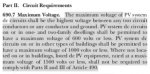
690.7 PV system dc circuits on or in one- and two-family dwellings shall be permitted to have a maximum voltage of 600 volts or less.


Neither of these say anything about the AC circuits so I see no code based reason why a 1,000Vdc PV array and inverter on a non-residential structure could not be connected to the AC system of a residence. An AHJ can just say no though.
 
This language in 2017 NEC does make it clear that a residential ground mount with inverter at the array should be permitted to run at 1000V. I didn't find a rationale for the interpretation of the 2014 language limiting these residential ground mounts to 600V, but that interpretation is out there and may have to be dealt with. Showing the AHJ the 2017 NEC might help.
The issue of the 600V rating on the Fronius Primo data sheet may still be a problem that needs to be solved, though.
 
Status
Not open for further replies.
Top