120v 277v insame 3ph box

Status
Not open for further replies.
Re: 120v 277v insame 3ph box

Originally posted by hardworkingstiff:
Originally posted by charlie b:
By recognizing that the voltages are all 120 degrees apart. That is an easy set of phasors to draw.
Looking at jb's drawing, and thinking of how a "high leg" service is connected at the pole (the 120/240-volt part on one transformer), aren't a-phase and b-phase 180 degrees out from each other, not 120 degrees?
I was replying to a question about a 120/208 volt system. You are right, in that a 120/240 volt system will have phases A and B 180 degrees apart from each other.
 
Re: 120v 277v insame 3ph box

You are right, in that a 120/240 volt system will have phases A and B 180 degrees apart from each other.
Wouldn't that be true any time you put a load across two phases in either a delta or wye system? You only have 120 degrees when you are working with all three phases.
Don
 
Re: 120v 277v insame 3ph box

Originally posted by don_resqcapt19: You only have 120 degrees when you are working with all three phases.
True.

But a center-tapped 240 volt secondary gives you two distinct phases, and they have different phase angles (180 degrees apart from each other). That is different from connecting one load to two (of the three available) phases. In that case, you have only one phase, and not two, to consider. So you can't say that anything is any amount of degrees offset from another thing.
 
Re: 120v 277v insame 3ph box

Thanks for the complement about the drawing.

Originally posted by charlie b:
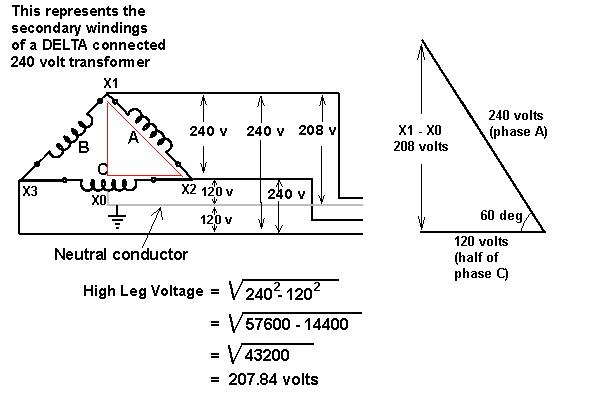
What I am trying to get is an easy way to explain to the non-engineer why 240 plus 120 is not 360, and why it is indeed not even as high as 240.
If you find one, please let this non-engineer know.

In an effort to try to use one of my last remaining brain cells, can someone tell me what the formula is for the vectors before it is simplified because this one case happened to create a right triangle. Also, if i created a second mid point tap between A and C what formula would I need to find the voltage between n, in my drawing, and the new point. I will call the new point m for lack of a better letter.

I know I cant buy one of these goofie transformers, but inquiring minds wanna know. :confused:
 
Re: 120v 277v insame 3ph box

Charlie,
But a center-tapped 240 volt secondary gives you two distinct phases, and they have different phase angles (180 degrees apart from each other).
Isn't that really a single phase system at that point, and as such does not have phases? You only have a single sine wave and therefore only a single phase.
Don
 
Re: 120v 277v insame 3ph box

Originally posted by jbwhite: Also, if i created a second mid point tap between A and C what formula would I need to find the voltage between n, in my drawing, and the new point. I will call the new point m for lack of a better letter.
The voltage would be zero, the current would be (briefly) very high, and you would need to call the fire department. Or did you not mean a second center tap to ground? :D

If I were to use the vector additions that others have told me I need to use (without explaining why they are the right ones), my answer would be that the voltage from "n" to "m" would be 120 volts. Look at the picture. The three points "n, c, and m" form an equilateral triangle.
 
Re: 120v 277v insame 3ph box

Originally posted by don_resqcapt19: Charlie, Isn't that really a single phase system at that point, and as such does not have phases? You only have a single sine wave and therefore only a single phase.
Yes it is a single phase system. But it comprises two separate single phase signals that happen to add up to form a single sine wave.

If you used an oscilloscope to display voltages, and connected wires to show both the voltage between "C" and "N" and the voltage between "A" and "N," you would see two different pictures. They would be opposites: One would be reaching its positive peak at the same moment the other would reach its negative peak. They would hit zero voltage at the same times.

The "single sine wave" you mentioned comes into play when you measure from "C" to "A." That voltage is the sum of the other two. Well, that's not quite true; it's the difference between the two. Please note that we measured the first two from an ungrounded point to the grounded, neutral point. So to get the voltage from "C" to "A," we have to subtract, not add, Vna from Vnc. When you subtract two sine waves that have the same magnitude and are 180 degrees apart, what you get is double the magnitude, with the same angle as Vnc. That is why it can be called single phase: there is no change in angle between Vnc and Vac.
 
Re: 120v 277v insame 3ph box

For simplicity I think we need one of Ed MacLaren's drawings to accompany Jb's so I'm going to post one. ;)

EDs4Wdelta2.JPG


Thanks to ED MacLaren


Roger
 
Re: 120v 277v insame 3ph box

Now that the high leg delta is solved could someone explain just how a grounded (neutral) could be utilized from a 480/277 panel in a 240/120 panel or vise versa.

First and foremost how would it be installed?

Second would it be a return path for the 120 volt circuit?

I have put so much though into this situation that my ears are 2? inches closer together. If the 240/120 is derived from a step down transformer then there would be no physical connection of the neutral from one to the other unless the bond between the grounding electrodes was carrying current.
:)
 
Re: 120v 277v insame 3ph box

Originally posted by jwelectric:
...unless the bond between the grounding electrodes was carrying current.
Without drawing it out, I would venture a "bingo" to that statement. ;)

Edit to add: I think the common grounding electrode would be conveying the 277's neutral current back to the 480/277 service.

Transformers use three ungrounded conductors to create three ungrounded and a "grounded" conductor, isn't that right? There isn't a neutral present on the primary side, is there? (Never seen one.)

[ December 30, 2005, 08:41 PM: Message edited by: georgestolz ]
 
Re: 120v 277v insame 3ph box

Mike,
Now that the high leg delta is solved could someone explain just how a grounded (neutral) could be utilized from a 480/277 panel in a 240/120 panel or vise versa.
In this case I am assuming that the neutrals from both systems are landed on the panel neutral bar. Even if they are not, and assuming the required system bonding jumpers are in place, it will still work.
Don
 
Re: 120v 277v insame 3ph box

Originally posted by don_resqcapt19:
In this case I am assuming that the neutrals from both systems are landed on the panel neutral bar. Even if they are not, and assuming the required system bonding jumpers are in place, it will still work.
Don
Originally posted by terrytc
can you put 120v 2 poles and 1 pole of 277v in the same breaker box 3-ph
Here in lies my question, how is this installed?
Is the 240 volt circuit installed without a neutral and the 277 volt leg and neutral installed?

Should the three ungrounded conductors be connected to the same piece of three phase equipment would it operate?

Should the 277 volt leg and one 120 volt leg be connected to a single phase piece of equipment would it operate?

Should the 277 volt leg and one 120 volt leg get connected to a piece of equipment that also utilized the neutral would it operate?

Should the neutral be energized by the 277 volt leg what effect would it have on the remaining 120 volt circuits?

If the neutral is brought in with the 240 volt circuit and one is not brought in with the 277 volt circuit then there would be a raceway with only one conductor.

I just can?t get this setup pictured in my mind.

I have tried to visualize this setup but I can?t see anything working as it should therefore I summarize that this panel is a delta high leg panel.
:confused: :confused: :confused:
 
Re: 120v 277v insame 3ph box

Mike,
Note, none of these solutions are code compliant.

Is the 240 volt circuit installed without a neutral and the 277 volt leg and neutral installed?
That would work, as long as both systems have bonding jumpers

Should the three ungrounded conductors be connected to the same piece of three phase equipment would it operate?
Not likely. The voltage between the 120 volt system and the 277 volt system would be either too high or too low.

Should the 277 volt leg and one 120 volt leg be connected to a single phase piece of equipment would it operate?
The voltage would not be correct for the equipment

Should the 277 volt leg and one 120 volt leg get connected to a piece of equipment that also utilized the neutral would it operate?
No. The voltages would not be correct

Should the neutral be energized by the 277 volt leg what effect would it have on the remaining 120 volt circuits?
Can't happen if the system bonding jumpers are in place. It would be a short.

If the neutral is brought in with the 240 volt circuit and one is not brought in with the 277 volt circuit then there would be a raceway with only one conductor.
Correct, there would be excessive votlage drop as a result of the inductive reactance caused by the seperation of the supply and return conductors. On low current loads(under 100A or so) this will not cause operational problems.

Don
 
Re: 120v 277v insame 3ph box

Thank you Don, this is what I was thinking.

This is also the reason that I?m thinking that the panel described in the original post is a high leg panel.
:)
 
Re: 120v 277v insame 3ph box

We each have our own ideas. :)

I was picturing two phases of 208Y/120 and one phase of 480Y/277 along with a neutral from both sharing one neutral bar.

Not legal but it would work.
 
Re: 120v 277v insame 3ph box

Originally posted by iwire:
We each have our own ideas. :)

I was picturing two phases of 208Y/120 and one phase of 480Y/277 along with a neutral from both sharing one neutral bar.

Not legal but it would work.
But, would it work on anything other than 120 volt and 277 volt circuits such as lighting and receptacles?

I believe there would be a problem with the 120 volt circuits unless the two neutrals were kept separate in the panel.
:confused:
 
Re: 120v 277v insame 3ph box

Mike,
I believe there would be a problem with the 120 volt circuits unless the two neutrals were kept separate in the panel.
Having the neutrals tied together in the panel will not cause any problems. It happens on every code compliant installation where there are two or more systems with grounded conductors in a building. All of the grounded conductors are tied together by the system bonding jumpers and the grounding electrodes.
Don
 
Status
Not open for further replies.
Top