2 prong metal drills

Merry Christmas
Status
Not open for further replies.
Lots of different designs could have been better.
The German Shuko ("Schutzen Kontakt" ... protective) has a recessed earth conductor -- there isn't anything that can be removed, nor any reason to. It's also completely finger safe - the plug is completely recessed inside the receptacle before the pins make contact.

View attachment 2555936
That is a bit like the shell ground on some twist lock plugs. First make, last break.
 
Lots of different designs could have been better.
The German Shuko ("Schutzen Kontakt" ... protective) has a recessed earth conductor -- there isn't anything that can be removed, nor any reason to. It's also completely finger safe - the plug is completely recessed inside the receptacle before the pins make contact.

View attachment 2555936


I have those throughout my home, they are great (y)


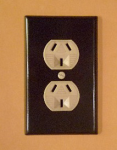
However, this was supposed to be the dominant plug in the US, ahead of its time with grounding:


https://patentimages.storage.googleapis.com/48/f8/94/7639ad56b7c68d/US1179728.pdf


1616870548517.png

1616870568183.png


These existed for some time, even appearing in prints/older buildings, than for some reason vanished without explanation.
 
I have seen a very few of these or similar. Can’t recall where.


Were they the actual non nema type (smaller) or NEMA 10-20r (larger)?


Were they the actual non nema type (smaller) or NEMA 10-20r (larger)?


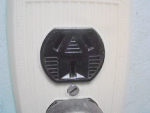
Checking back to a pic I posted sometime before. It was a combo device, 120 & 250. The 250 may have been close.
 
If I'm correct the 15 amp version was dual rated 15 amps 125volts 10 amps 250 volts.
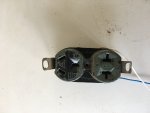
Can’t find my post but here is the pic. Yes, 15A, 125. I can’t see other but I think it was 10A, 250. Sadly, I lost the device.
 

Attachments

  • ADDF95B5-CE3B-4058-ADE2-D35BEC8D52AB.jpeg
    ADDF95B5-CE3B-4058-ADE2-D35BEC8D52AB.jpeg
    1.4 MB · Views: 14
Can’t find my post but here is the pic. Yes, 15A, 125. I can’t see other but I think it was 10A, 250. Sadly, I lost the device.


Bro! Thats just pure awesome!

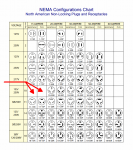
Yes, the plug on the top is as common as NEMA 5-15 in most alternate realities. Its whats missing in most NEMA charts:


1616899785966.png

Ideally the "W" slot becomes the ground and rows #10 and #18 are dominant in number.
 
I inherited some of those from my grandfather, with matching plugs. I installed one in the bed of my '86 pickup behind a weatherproof cover; used it to power the lights on the cap and a 12-volt trouble light; assuring that the trouble light could never be plugged into a 120-volt receptacle. I probably still have the rest of them.

And now, decades later, I learn what they are.
 
I inherited some of those from my grandfather, with matching plugs. I installed one in the bed of my '86 pickup behind a weatherproof cover; used it to power the lights on the cap and a 12-volt trouble light; assuring that the trouble light could never be plugged into a 120-volt receptacle. I probably still have the rest of them.

And now, decades later, I learn what they are.

Do you still have them?

They existed, and were used in a variety of odd locations before becoming totally uncommon. Its a shame, the ground should be like the phases in construction, grip and continuity.
 
I inherited some of those from my grandfather, with matching plugs. I installed one in the bed of my '86 pickup behind a weatherproof cover; used it to power the lights on the cap and a 12-volt trouble light; assuring that the trouble light could never be plugged into a 120-volt receptacle. I probably still have the rest of them.

And now, decades later, I learn what they are.


Spotted today on Reddit, was used for 120 volts:

 
So how were all those drills livening up?
One way is drilling into a live conductor. Even had that happen to me before while drilling with a cordless drill in recent years. Most of drill case is insulated but the bit and at least some parts of the chuck are not.
 
One way is drilling into a live conductor. Even had that happen to me before while drilling with a cordless drill in recent years. Most of drill case is insulated but the bit and at least some parts of the chuck are not.


Right, but I don't think that is behind most of the statistics.
 
In an electrocution situation wouldn't they have investigated what actually failed most the time? You maybe not reading the right reports to find that information?


My understanding is the insulation failed internally energizing the metal case.
 
Status
Not open for further replies.
Top