
You are using an out of date browser. It may not display this or other websites correctly.
You should upgrade or use an alternative browser.
You should upgrade or use an alternative browser.
2 Transformers with series connection to fed one MV drive
- Thread starter Joao
- Start date
- Location
- Wisconsin
- Occupation
- PE (Retired) - Power Systems
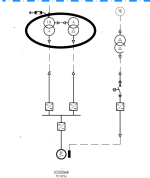
It looks like a drive front end that has two 'out of phase' inputs. This is a not uncommon method for reducing harmonics especially at MV.
winnie
Senior Member
- Location
- Springfield, MA, USA
- Occupation
- Electric motor research
I agree with @jim dungar that this is a VFD front end with different transformer phasing. The square blocks with ~/= are pretty common for AC/DC conversion (rectification) and =/~ for DC to AC conversion (inversion). The diagram is pretty clear about two _different_ transformers feeding two different AC/DC blocks feeding a common DC bus.
What I am not familiar with is the transformer symbol with three parallel lines. A typical '12 pulse' rectifier starts with a delta-wye and a delta-delta transformer prior to the two rectifier blocks. But the right transformer symbol in the original post is a wye-delta transformer, but the left symbol has "|||-wye", and I have no clue what that is.
I _think_ the triangles/arrows on the single lines are cable connections, but also not sure on that.
-Jonathan
What I am not familiar with is the transformer symbol with three parallel lines. A typical '12 pulse' rectifier starts with a delta-wye and a delta-delta transformer prior to the two rectifier blocks. But the right transformer symbol in the original post is a wye-delta transformer, but the left symbol has "|||-wye", and I have no clue what that is.
I _think_ the triangles/arrows on the single lines are cable connections, but also not sure on that.
-Jonathan

OldBroadcastTech
Senior Member
- Location
- Western IL
- Occupation
- Retired Broadcast Technician
Looks like what high-powered broadcast transmitters used for the high-voltage rectifier input and was called a 12-phase system.
It gave 12 output pulses per input cycle and required much less filtering to produce a steady DC output.
It gave 12 output pulses per input cycle and required much less filtering to produce a steady DC output.
- Location
- Wisconsin
- Occupation
- PE (Retired) - Power Systems
But the right transformer symbol in the original post is a wye-delta transformer, but the left symbol has "|||-wye", and I have no clue what that is.
Typically both transformers would have the same primary side winding configuration. There would be one Wye secondary and the other Delta to provide a 30° phase shift.It gave 12 output pulses per input cycle and required much less filtering to produce a steady DC output.
winnie
Senior Member
- Location
- Springfield, MA, USA
- Occupation
- Electric motor research
Typically both transformers would have the same primary side winding configuration. There would be one Wye secondary and the other Delta to provide a 30° phase shift.
Yes, I'd expect that the first transformer to be a wye-wye and wye-delta.
Maybe @Jraef will chime in, if the '|||-wye' transformer is a weird but real thing, or if it looks like a typo.
- Location
- Wisconsin
- Occupation
- PE (Retired) - Power Systems
If it is wired wierd then you wont have a clean phase shift between them.Yes, I'd expect that the first transformer to be a wye-wye and wye-delta.
Maybe @Jraef will chime in, if the '|||-wye' transformer is a weird but real thing, or if it looks like a typo.
I have never seen a 3 phase transformer primary other than Wye, Delta, or T.
IEC 60076-1:I agree with @jim dungar that this is a VFD front end with different transformer phasing. The square blocks with ~/= are pretty common for AC/DC conversion (rectification) and =/~ for DC to AC conversion (inversion). The diagram is pretty clear about two _different_ transformers feeding two different AC/DC blocks feeding a common DC bus.
What I am not familiar with is the transformer symbol with three parallel lines. A typical '12 pulse' rectifier starts with a delta-wye and a delta-delta transformer prior to the two rectifier blocks. But the right transformer symbol in the original post is a wye-delta transformer, but the left symbol has "|||-wye", and I have no clue what that is.
I _think_ the triangles/arrows on the single lines are cable connections, but also not sure on that.
-Jonathan
Open windings in a three-phase transformer (that are not connected together in the transformer but have both ends of each phase winding brought out to terminals, for examplethe line windings of series and phase-shifting transformers) are indicated as III (HV), or iii(intermediate or low-voltage windings).
Yes arrows are cable interconnection between both primaries.
EC 60076-1:If it is wired wierd then you wont have a clean phase shift between them.
I have never seen a 3 phase transformer primary other than Wye, Delta, or T.
Open windings in a three-phase transformer (that are not connected together in the transformer but have both ends of each phase winding brought out to terminals, for examplethe line windings of series and phase-shifting transformers) are indicated as III (HV), or iii(intermediate or low-voltage windings).

Joethemechanic
Senior Member
- Location
- Hazleton Pa
- Occupation
- Electro-Mechanical Technician. Industrial machinery
Yeah that is what I thought too. to try and kill the 5th and 7th harmonics, in trade for some lesser 11th and 13th. But some of the symbols are a bit unfamiliar to me.
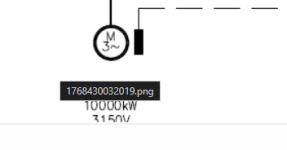
That's like 13,500 horsepower if that KW figure is mechanical. What's the black box on the side with the dashed line? Is this some kind of synchronous AC machine?
That's like 13,500 horsepower if that KW figure is mechanical. What's the black box on the side with the dashed line? Is this some kind of synchronous AC machine?
winnie
Senior Member
- Location
- Springfield, MA, USA
- Occupation
- Electric motor research
IEC 60076-1:
Open windings in a three-phase transformer (that are not connected together in the transformer but have both ends of each phase winding brought out to terminals, for example the line windings of series and phase-shifting transformers) are indicated as III (HV), or iii(intermediate or low-voltage windings).
That makes sense. So you essentially have the two primary windings electrically in series. The left primary is a '6 bushing' transformer and each of the three phase coils is connected _in series_ to the respective right primary phase. In terms of phase angle relations the left transformer is the equivalent of wye-wye, and the right transformer is wye-delta, you get the 30 degree phase shift.
I need to think more about how the different phase angles of the rectification pulses play with the phase shift of these _series_ primary coils. You can't have current flowing in a 'left' phase without current flowing at the same time in corresponding 'right' phase, and vice-versa.
-Jonathan
winnie
Senior Member
- Location
- Springfield, MA, USA
- Occupation
- Electric motor research
That's like 13,500 horsepower if that KW figure is mechanical. What's the black box on the side with the dashed line? Is this some kind of synchronous AC machine?
My guess was an exciter for some sort of synchronous machine. It's fed from circuit T5 via AC/DC conversion. Synchronous generator in some sort of variable speed service, with a DC link to supply grid frequency?
@Joao can you give us any more information about the context of this drawing, and expand on your questions?
Joethemechanic
Senior Member
- Location
- Hazleton Pa
- Occupation
- Electro-Mechanical Technician. Industrial machinery
Yeah, it's got to be, or maybe something like a synchronous condenser for stabilization?My guess was an exciter for some sort of synchronous machine. It's fed from circuit T5 via AC/DC conversion. Synchronous generator in some sort of variable speed service, with a DC link to supply grid frequency?
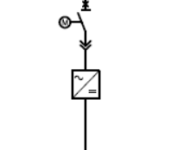
Not sure how I missed the rectification here. I think that I I I transformer symbol at the head threw me off and had me thinking maybe it was all in Greek
Joethemechanic
Senior Member
- Location
- Hazleton Pa
- Occupation
- Electro-Mechanical Technician. Industrial machinery
I cheated
winnie
Senior Member
- Location
- Springfield, MA, USA
- Occupation
- Electric motor research
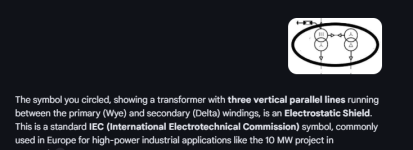
IMHO 'AI' got that one very wrong. The three lines shown are not _between_ the primary and secondary. They represent the primary.
An electrostatic shield might show up as 3 lines if it is paired with the symbol for the core, eg:

OP described the meaning of the 3 lines in post #8. The 3 parallel lines are the symbol for a primary that is neither wye or delta, but instead has all 6 terminations brought out. The primary could be connected wye or delta with suitable external jumpers, or it could be used in some other fashion.
-Jonathan
Attachments


Why would that be on the primary side? I would think it would be on the secondary side.IEC 60076-1:
Open windings in a three-phase transformer (that are not connected together in the transformer but have both ends of each phase winding brought out to terminals, for examplethe line windings of series and phase-shifting transformers) are indicated as III (HV), or iii(intermediate or low-voltage windings).
Yes arrows are cable interconnection between both primaries.
I dont get how that works on the primary side, do you mean like a zig-zag configuration? I could see it on the secondary side.The left primary is a '6 bushing' transformer and each of the three phase coils is connected _in series_ to the respective right primary phase.

- Location
- Wisconsin
- Occupation
- PE (Retired) - Power Systems
A zig-zag would not provide the two isolated outputs shown in the OP.I dont get how that works on the primary side, do you mean like a zig-zag configuration? I could see it on the secondary side.
Connecting two sets of coils in series would mean you have voltage drops across each one. Each winding would never see the full L-N voltages.So you essentially have the two primary windings electrically in series.
I wonder if this is simply a reconnectable transformer that would allow the installer to create additive or subtractive connections resulting in a positive or negative 30° phase shift on the output compared to the delta output on the other transformer?
Joethemechanic
Senior Member
- Location
- Hazleton Pa
- Occupation
- Electro-Mechanical Technician. Industrial machinery
IMHO 'AI' got that one very wrong. The three lines shown are not _between_ the primary and secondary. They represent the primary.
An electrostatic shield might show up as 3 lines if it is paired with the symbol for the core, eg:
View attachment 2581477
OP described the meaning of the 3 lines in post #8. The 3 parallel lines are the symbol for a primary that is neither wye or delta, but instead has all 6 terminations brought out. The primary could be connected wye or delta with suitable external jumpers, or it could be used in some other fashion.
-Jonathan
Yeah I was kind of wondering why no delta or wye above it. And why only one shielded
Joethemechanic
Senior Member
- Location
- Hazleton Pa
- Occupation
- Electro-Mechanical Technician. Industrial machinery
I thought about zig zag also, but why?zig-zag configuration?
winnie
Senior Member
- Location
- Springfield, MA, USA
- Occupation
- Electric motor research
Connecting two sets of coils in series would mean you have voltage drops across each one. Each winding would never see the full L-N voltages.
Yes. If both secondaries were the same, with the same load, then each series primary would see half of the typical L-N voltage.
But the two secondaries are _not_ the same; they are presumably rectifier loads with different supply phase angles. If you have the two _primaries_ in series you need to have the same current flow in each secondary coil.
I think I'd need to build a SPICE model to see what was going on here, and that isn't on my dance card today

I wonder if this is simply a reconnectable transformer that would allow the installer to create additive or subtractive connections resulting in a positive or negative 30° phase shift on the output compared to the delta output on the other transformer?
Maybe. The two transformers would be parallel on the primary, not series, and one can be reconnected as needed...but then I think there would be a parallel connection to the supply bus, not supply bus to xformer 1 then xformer 1 to 2.
-Jonathan