300.4. Protection against physical damage.

I also heard and looked up that the next NEC code cycle "may" be requiring and it's for bored wires through studs and they may require protection at the face of stud and out a 1 1/4" from each side of the stud, where the wire is located through the stud. The code verbiage now requires protection in two directions. Why some codes are written are beyond me. Thanks guys !!
There is no change in these rules in the 2026 code, and there is no way to know what may be in the 2029 code as they are accepting public inputs to make changes in the 2029 code through April 9, 2026.
 
What's not a good look is using your opinion of proper work to go outside of what the code states and forcing contractors to use additional labor and materials because of your pride. You stated that "For kitchen and garages I made them protect all locations regardless if they were an 1 1/4" back per code....Because of the use of longer screws.....". This was based solely on your opinion yet you chastise guys on here for stating theirs.

I am curious, do you have any stock / ownership in the product that you are trying to push so hard?
The protection at those areas, is what my electrician did because of longer attachment fasteners that may be installed later. It was my electrical contractor's opinion, and their own requirement because of damage they saw when called out for repairs.... Cabinets, Hooks, hangers, etc...We looked at it and agreed that it may reduce an issue later. we would actually recommend it and the contractors were on board with it. Who knows what homeowners will do later. I learned from them. Just tried to get ahead of a possible problem later...Yes and I took pride in everything I did.
 
The protection at those areas, is what my electrician did because of longer attachment fasteners that may be installed later. It was my electrical contractor's opinion, and their own requirement because of damage they saw when called out for repairs.... Cabinets, Hooks, hangers, etc...We looked at it and agreed that it may reduce an issue later. we would actually recommend it and the contractors were on board with it. Who knows what homeowners will do later. I learned from them. Just tried to get ahead of a possible problem later...Yes and I took pride in everything I did.
But your pride does not trump the opinions of others nor does it make your opinions correct. Your interpretation of the code does not make you superior to the opinions of others nor is it accepted by 99% of other inspectors considering most of us here have never experienced the issue.

I'll ask again, do you have stock / ownership in the product you are trying to push so hard?
 
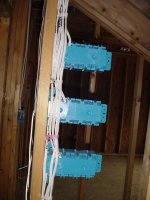
The specific requirements in 300.4 all deal with wiring methods outside boxes, as does Article 300 in general. The code does not specifically require protection for conductors in plastic boxes based on any distance to anything. A really broad reading of the first, general sentence of 300.4 could be used to require protection based on the AHJs interpretation of a safe distance, but that's really stretching it. Certainly one could provide additonal protection if desired. But no, it is not the case that everyone using plastic boxes is ignoring a clear or explicit code requirement.

Boxes are required to be accessible and visible and in my opinion for this reason do not need the same protection requirements as wiring methods that might be completely hidden behind finished surfaces.
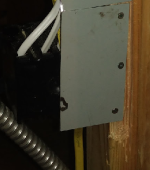
And I always looked at the small plate for bored holes through members. They put that little protector plate on the stud face. But the wire was not protected to the left or right of the stud. The requirement is also an 1 1/4" back from that face of stud or protected ? I always looked at that and wondered if that would need protection and per the code it does, but never really addressed, or nothing made for that location. Handbooks and depictions show one thing and the verbiage states it's required. That plate was removed many times, by the sheet rock crew and planers. You could see the locations it was removed from on Insulation inspection. Once removed they never put back on. It just gets a little frustrating sometimes when you actually look at the codes and requirement's and always hoped for some kind of clarification or it was addressed better. As an inspector, I tried to learn as much as possible, and make the right calls, but the code gets confusing sometimes. What's very confusing for me, is that you have these code requirements for protection locations and exceptions listed. You have a plastic box within 1/2" of stud face, (backside of interior wall), and sometimes closer with a deeper junction box. The plastic box is not a ' listed exception' and this distance is not the required 1 1/4' needed from framing member face...Now what ? I have always looked at that and wondered if I am missing it. It would be great if this was addressed more. How can this not be explained or addressed better in the code ?? Am I missing something ?

 
Am I missing something ?
Is the conductor touching the side of the stud when it enters the box? Every install I have seen has the conductor moved away from the stud. I see no NEC requirement for protecting a conductor that is not touching the stud (parallel) nor passing through a stud (perpendicular). There is definitely no NEC requirement for box protection.
 
And I always looked at the small plate for bored holes through members. They put that little protector plate on the stud face. But the wire was not protected to the left or right of the stud. The requirement is also an 1 1/4" back from that face of stud or protected ? I always looked at that and wondered if that would need protection and per the code it does, but never really addressed, or nothing made for that location. Handbooks and depictions show one thing and the verbiage states it's required. That plate was removed many times, by the sheet rock crew and planers. You could see the locations it was removed from on Insulation inspection. Once removed they never put back on. It just gets a little frustrating sometimes when you actually look at the codes and requirement's and always hoped for some kind of clarification or it was addressed better. As an inspector, I tried to learn as much as possible, and make the right calls, but the code gets confusing sometimes. What's very confusing for me, is that you have these code requirements for protection locations and exceptions listed. You have a plastic box within 1/2" of stud face, (backside of interior wall), and sometimes closer with a deeper junction box. The plastic box is not a ' listed exception' and this distance is not the required 1 1/4' needed from framing member face...Now what ? I have always looked at that and wondered if I am missing it. It would be great if this was addressed more. How can this not be explained or addressed better in the code ?? Am I missing something ?
It sounds to me, that YOU want to just have us install a complete wall of 3/16" sheet metal before the sheet rock is installed.

Plus you sound butt hurt.
 
I hate to jump in on this but....... Once upon a time I got an emergency call on a Friday afternoon about 4:30..... The house main on a newly installed panel was tripping. Remember this was a new install done by me a month or so earlier.

Arrived onsite and found the house was being remodeled, and the siding being replaced. Anyone want to guess what was causing a 200 Amp main to trip?????

Siding guys missed the stud by 6 " + and shot right through the back of the panel, the bus insulator and the COPPER bus !!!! Spent more time waiting for the homeowner and siding contractor to show up than I did pushing the nail out ( fortunately it hit a major part of the bus and we were able to save replacing the panel)

Point of this being even a metal plate is no guarantee that a fastener wont find the building wiring!


Howard
Totally agree
 
Is the conductor touching the side of the stud when it enters the box? Every install I have seen has the conductor moved away from the stud.
In most cases, the first KO in the box is less than 1.25" from the stud.
"cable or raceway shall be installed and supported so that the nearest outside surface of the cable or raceway is not less than 32 mm (11⁄4 in.) from the nearest edge of the framing member"
If you use the first KO, you are likely in violation, but that is rarely enforced.
 
In most cases, the first KO in the box is less than 1.25" from the stud.
"cable or raceway shall be installed and supported so that the nearest outside surface of the cable or raceway is not less than 32 mm (11⁄4 in.) from the nearest edge of the framing member"
If you use the first KO, you are likely in violation, but that is rarely enforced.
Hey Don...that is exactly it. That is the issue and at times the conductor entering into or out of the box is so close. Sometimes the conductor going in is less then a half inch from framing member edge and the plastic box is right there also. Thank you for your input.
 
Hey Don...that is exactly it. That is the issue and at times the conductor entering into or out of the box is so close. Sometimes the conductor going in is less then a half inch from framing member edge and the plastic box is right there also. Thank you for your input.
We are using more 2x6 framing , thank God. It takes all this away. but still have 2x4 interior walls...
 
It isn't even about plastic boxes.

What if you use a metal devise box that is 3 1/2" deep in a 2x4 stud wall? The wires enter the box at the far back placing the wires less than 1 1/4" from the face of the opposite wall where they could easily be hit by a nail. no difference.
 
Top