
480v grounded 3 phase serving an oil well pump jack

IMHO the question of 'where can the grounded conductor serve as the fault current path' is a side discussion from the OP's issue.

The utility grounded conductor functions as part of the fault current path. The NEC splits this function to a separate EGC. This combined function is still permitted for the emergency disconnect. We can debate it endlessly.

The OP's issue is either the lack of proper bonding between grounded conductor and EGC, or proper ground fault detection.

Jonathan
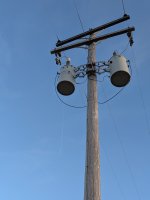
 
Ok finally got a look at the source (power pole disconnect) I only have two line fuses so is that corner grounded 480 transformer and if I have three line fuses is that 480 grounded phase? First time I ve seen just two line fuses.
 
Ok finally got a look at the source (power pole disconnect) I only have two line fuses so is that corner grounded 480 transformer and if I have three line fuses is that 480 grounded phase? First time I ve seen just two line fuses.
The configuration of the utility has little to do with the grounding or ungrounding. At the best you can tell is it is an open delta.
 
The op is describing what I suggest we call a TT system, the NEC obviously does not permit a TT system, in places where TT systems are legal they use RCD's or GF relays extensively.
The term 'TT system' is a easy way to refer to systems like this where the earth is the only fault path back to the utility;
View attachment 2582325
What I’m describing would have a second OCPD/disconnect at the load end.
 
Ok finally got a look at the source (power pole disconnect) I only have two line fuses so is that corner grounded 480 transformer and if I have three line fuses is that 480 grounded phase? First time I ve seen just two line fuses.
Those are the primary fuses and have nothing to do with the configuration of the secondary. Might be able to tell if we could see all of the secondary conductors. Given the white conductor and its connection to the case of the transformers, I would guess it is a corner grounded system, but can't tell for sure without seeing the opposite side of the transformers.
 
Well is this the problem the difference between open delta, also called v phase and corner grounded phase?
If so then is the EGC bonded to the grounded phase at the service disconnect and then to grounding rods? Then in open delta you have a fourth wire that is your low impedance connection back to the source which also goes to ground rods?
 
Well is this the problem the difference between open delta, also called v phase and corner grounded phase?
An open-delta only affects the imbalanced loading ability of the system. It has no impact at all on the secondary being corner grounded or ungrounded.

Not all open delta configurations are made using a center tapped secondary transformer, so they do not all have the 4th wire you mention.

The NEC rules for a GEC and EGC do not change regardless if the grounded conductor is a 'phase' or a 'neutral'.
 
I'd add to the excellent post above:

The OP needs to determine if the service is supposed to be ungrounded or corner grounded. (As @don_resqcapt19 says.)

Based on this information the system either needs a bonding jumper added or ground detection added
and an equipment grounding conductor beyond service equipment in either case
 
You have an open delta system. That just means you have two secondary coils and a "ghost coil" on the third side of the delta and overall kVA capacity is about 58% of what it would be for full delta assuming all secondary coils are same capacity. both full and open delta would have same voltage options, three wire ungrounded, three wire with one line grounded or mid point ground on one coil (assuming the unit has a center tap available) which would result in a high leg to that center tap from the opposite corner of the delta.

Since you have mentioned you have 480 between each conductor but one of them is zero to ground, and looks like from your picture that there is only three secondary conductors kind of am assuming you do have a corner ground delta.
 
Well is this the problem the difference between open delta, also called v phase and corner grounded phase?
No. That's a distraction.
If so then is the EGC bonded to the grounded phase at the service disconnect and then to grounding rods? Then in open delta you have a fourth wire that is your low impedance connection back to the source which also goes to ground rods?
As far as the NEC is concerned and as far as you should be concerned the number of wires coming from the power company and how the transformers are configured doesn't matter.

Power comes in from the power company through a magic pipe and fills up the wires you provide at the Service Disconnect.

Two of those wires are fused and ungrounded.

One of those wires should be unfused and grounded - connected to the earth with ground rods and bonded to the metal enclosure with a Main Bonding Jumper.

All three of those wires go out to your equipment, plus a fourth wire that is the Equipment Grounding Conductor. The EGC carries the fault current back to the Main Bond Jumper at the Service Disconnect. That's it. Nothing up the power pole matters. If you have motors burning up and breakers or fuses not blowing then you need to look at the integrity of your EGC and how the motors are protected. If you don't have the right thermal and overload protection on a motor it can burn up and not trip a breaker. A pump jack motor sitting out in the heat and sun, cold and snow, surrounded by weeds and rats, running 24/7 might just say the hell with all of you and decide to die.
 
One of those wires should be unfused and grounded - connected to the earth with ground rods and bonded to the metal enclosure with a Main Bonding Jumper.
In the picture, you can see each transformer has a wire connected to its tank. This wire is spliced to the utility grounded conductor and to what looks like a white conductor. It then looks like 2 black and 1 white conductor go down the pole as service entrance conductors. We don't see the service entrance equipment, which is where the GEC is likely located.
 
In the picture, you can see each transformer has a wire connected to its tank. This wire is spliced to the utility grounded conductor and to what looks like a white conductor. It then looks like 2 black and 1 white conductor go down the pole as service entrance conductors. We don't see the service entrance equipment, which is where the GEC is likely located.
Even if GEC is missing this is still a grounded secondary system since it is bonded to the primary grounded conductor. You wouldn't want to intentionally or accidentally bond anything but the grounded conductor as it would result in objectionable current flow.

We need to see other side view of pole but with this picture plus based on information already given this has to be three wire delta with one lead grounded.
 
That's what we need to see.
I seen enough that I'm convinced this is corner ground delta. Only thing we may do if we see the service equipment is critique what is or is not done right with it. It should have either three pole common trip breaker or only fuses in two ungrounded poles and the grounded conductor should be bonded to the enclosure. GEC can connect there but is permitted to connect anywhere up to service drop/lateral so doesn't absolutely have to connect in the service disconnect. Should also have an EGC leaving with any branch circuits or feeder conductors.
 
Top