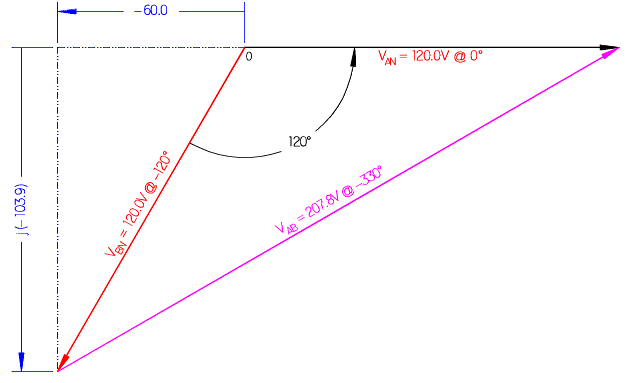
A little more fun:

Status
Not open for further replies.
Smart $ said:
Regardless, I've got $1000 bucks that says my CAD drawing is more accurate and precise than yours :grin:
I own about a dozen CADD systems, including the TurboCad and AutoCad that you have.....sorry, but when it comes to accuracy, they are a wee bit lacking. :rolleyes: As for the display accuracy, you know enough about CADD to know that all I did was set the display to 4 decimal digits, not changed the accuracy. :smile: They can all be just as accurate as the underlying computer system, but some systems interject errors without ever letting you know that they have. That's why both TurboCad and AutoCad are toward the bottom of my list of favorites. :grin:
 
Smart $ said:
What... no resultant figure? :D
I can not get the version of Mathmatica that I have to run on Windows XP Pro...something about trying to run in 386 protected mode. I was creating a DOS 6.22 virtual machine to re-install Mathmatica when I found the sqrt(3) on-line to 14,929 places and figured I would just cheat :grin:
 
Rick Christopherson said:
I own about a dozen CADD systems, including the TurboCad and AutoCad that you have.....sorry, but when it comes to accuracy, they are a wee bit lacking.
Rick Christopherson said:
Oh by the way, my drawing looks prettier than yours anyway, so there! :rolleyes:
Actually I also own several other professional level CAD programs, too. I just used TurboCAD and AutoCAD because I don't have the others loaded to run on Vista and would have ahd to reboot to use any of the others.

As you say, accuracy can only be as good as the underlying system. TurboCAD is accurate to 10 decimal places, and AutoCAD is accurate to 16. I am uncertain of the accuracy built in to Windows Vista's Calculator, but I am fairly certain it is greater than 16 decimal places. Yet accuracy is always subject to user error too!

Regardless, I did not claim the CAD program to be more accurate, only the drawing... and prettiness has nothing to do with it :grin:
 
mivey said:
I can not get the version of Mathmatica that I have to run on Windows XP Pro...something about trying to run in 386 protected mode. I was creating a DOS 6.22 virtual machine to re-install Mathmatica when I found the sqrt(3) on-line to 14,929 places and figured I would just cheat :grin:
I assumed you had done something like that :smile:
 
interesting posts on accuracy
So, if one measured 120V on a fluke 87:
What is resolution?
What is the accuracy?

If such a thing as "120V exactly" were available on this earth, and if it were measured by in-cal fluke 87, what upper and lower readings could the fluke have?

What are the upper and lower bounds on the accuracy?

carl
 
Last edited:
coulter said:
interesting posts on accuracy
So, if one measured 120V on a fluke 87:
What is resolution?
What is the accuracy?

If such a thing as "120V exactly" were available on this earth, and if it were measured by in-cal fluke 87, what upper and lower readings could the fluke have?

What are the upper and lower bounds on the accuracy?

carl
In discussing values, the terms are accuracy and precision. Accuracy is how close several measurements are to the true value. Precision is how close the measurements are to each other.

For example, readings of 120.5, 119.7, 120.1, and 119.9 could be considered accurate for a 120V reading, yet they would not be considered precise. Readings of 119.0, 119.3, 118.9, and 119.2 would be considered more precise but less accurate. For several measurements of the same value to be valid, they must be both precise and accurate. The valid bounds of both are set in predetermined parameters of the measurement.

Generally speaking, DMM's have a high degree of precision inherent in the design. However, they have to be calibrated to ensure accuracy. Typically accuracy is stated in decimal places, while precision is stated as the tolerance.

Rick sidetracked me in discussion accuracy. When I mentioned my drawing was more accurate, I was referring to its depiction, not the values. Both objects in Rick's drawing have the long leg in the wrong quadrant. Both solutions need to be rotated 180?.
 
Last edited:
Smart $ said:
Both objects in Rick's drawing have the long leg in the wrong quadrant. Both solutions need to be rotated 180?.
No. You are confusing a circuit representation with vector analysis. The diagram I drew is the proper vector analysis solution to the problem. Each of the vectors in my drawing have a 1:1 correlation to the equations of the system.

You are making the same mistake that Rattus did in the previous discussion, in that you are mis-applying true vector analysis with your interpretation of a circuit. Vector analysis doesn't care about quadrants.
 
Please note:

Please note:

Neither Rick nor Smart has posted a phasor diagram--vector diagram either, because there are no arrowheads in the diagrams. Could we please see some arrowheads in these diagrams??
 
rattus said:
Neither Rick nor Smart has posted a phasor diagram--vector diagram either, because there are no arrowheads in the diagrams. Could we please see some arrowheads in these diagrams??
partwye3.gif
 
Rick Christopherson said:
No. You are confusing a circuit representation with vector analysis. The diagram I drew is the proper vector analysis solution to the problem. Each of the vectors in my drawing have a 1:1 correlation to the equations of the system.

You are making the same mistake that Rattus did in the previous discussion, in that you are mis-applying true vector analysis with your interpretation of a circuit. Vector analysis doesn't care about quadrants.
Before telling me I'm confused and mistaken again, please review Section 2: Brief review of vector mathematics, Subsections 2.1 through 2.3 of

Cahier technique no. 18

Analysis of three-phase networks
in disturbed operating conditions
using symmetrical components


...one of a series of Schneider Electric Publications (Mike H. even hosts three of the series on his website)
 
rattus said:
Neither Rick nor Smart has posted a phasor diagram--vector diagram either, because there are no arrowheads in the diagrams. Could we please see some arrowheads in these diagrams??
Well of course not. :confused: We started out with a phasor diagram, so what would be the point in simply redrawing the diagram. The drawings represent the graphical solution to the original problem, and the fully dimensioned lines are providing the answers that the phasor diagram does not provide on its own.
 
Rick Christopherson said:
Well of course not. :confused: We started out with a phasor diagram, so what would be the point in simply redrawing the diagram. The drawings represent the graphical solution to the original problem, and the fully dimensioned lines are providing the answers that the phasor diagram does not provide on its own.

Smart didn't redraw the diagram, he ended up with the original sketch.

And, how do you know the phase angle of Vab without any arrowheads? Maybe it is really 210 degrees?
 
rattus said:
Smart didn't redraw the diagram, he ended up with the original sketch.
Ya, so what. Both answers are correct and no one is disputing that--except maybe you. If you think that our two answers are different, then you need to bone-up on your vector analysis. The only difference between our two drawings is that mine is prettier than his. :)

rattus said:
And, how do you know the phase angle of Vab without any arrowheads? Maybe it is really 210 degrees?
If I was not too lazy to place the labels "A" and "B" on the diagram, that is all it takes to properly identify the phase angle. This is the same mistake you made that started this whole discussion two weeks ago. You are assigning arrow heads according to your interpretation of the circuit, and that is not how phasor diagrams work.

I have repeated this so many times that I am growing tired of saying the same thing without you acknowledging it. I have not contested how you choose to identify your voltages in your circuit diagrams, but when you create a phasor diagram, it is a solution to the problem, and the phasor directions are independent of the original assumptions.

A phasor diagram is a graphical solution to a mathematical problem. As I said before, when solving a scientific or mathematical problem, it doesn't matter where someone starts or how they get to the final answer, ALL final answers must be the same. If your answer differs from the norm, then it means you have made a mistake in your methodology.

 
Rick Christopherson said:
Ya, so what. Both answers are correct and no one is disputing that--except maybe you. If you think that our two answers are different, then you need to bone-up on your vector analysis. The only difference between our two drawings is that mine is prettier than his. :)

If I was not too lazy to place the labels "A" and "B" on the diagram, that is all it takes to properly identify the phase angle. This is the same mistake you made that started this whole discussion two weeks ago. You are assigning arrow heads according to your interpretation of the circuit, and that is not how phasor diagrams work.

I have repeated this so many times that I am growing tired of saying the same thing without you acknowledging it. I have not contested how you choose to identify your voltages in your circuit diagrams, but when you create a phasor diagram, it is a solution to the problem, and the phasor directions are independent of the original assumptions.

A phasor diagram is a graphical solution to a mathematical problem. As I said before, when solving a scientific or mathematical problem, it doesn't matter where someone starts or how they get to the final answer, ALL final answers must be the same. If your answer differs from the norm, then it means you have made a mistake in your methodology.

I would think that a "proper vector analysis" would retain the arrowheads and node IDs. Perhaps that would explain the reason for rearranging the diagram which I see as not wrong but as unneeded.

Of course, one would not ordinarily use a CAD system for such a problem. The idea is to draw the diagram accurately on paper and then measure the magnitude and phase manually.
 
rattus said:
I would think that a "proper vector analysis" would retain the arrowheads and node IDs. Perhaps that would explain the reason for rearranging the diagram which I see as not wrong but as unneeded.
Why is it that I need to repeat something 2 or 3 times before it sinks in? What I drew was just a graphical solution to a problem. It wasn't intended to be a phasor diagram. It was simply using the computational power of a CADD system to find an answer. It is no different than using a calculator, except this calculator is graphic-based.

The difference between the two drawings is that Smart$ used vector subtraction, and I used vector addition. It is simply personal preference. I prefer to always use vector addition. It doesn't matter when there are only two vectors, but when you get into a more complicated problem with multiple vectors, then addition is more straight forward.

rattus said:
Of course, one would not ordinarily use a CAD system for such a problem. The idea is to draw the diagram accurately on paper and then measure the magnitude and phase manually.
Your age is showing. :D A CADD system is just electronic paper. And while you would need to scale your drawing so that 1 volt was equal to some small fraction of an inch, I can draw it in full scale where 1 volt is equal to 1 inch (or any unit I set the system to use). Why wouldn't one use the tools they have at their disposal?
 
Status
Not open for further replies.
Top