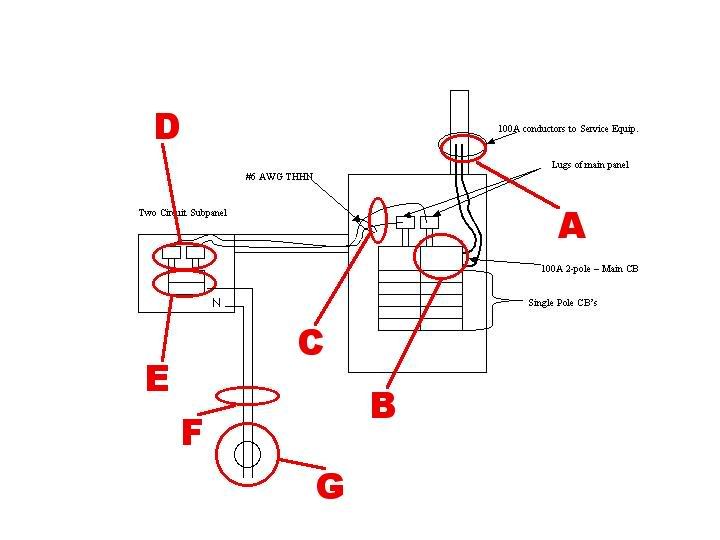
Any issues with this installation?

Status
Not open for further replies.
jwelectric said:
Well I don?t guess there is much need to say much more.
Well for not saying much more you sure covered a good bit of space ;)

Well I sure do appreciate you running around helping me find my way but I think that I will jerk free for a while and let someone help me with this one, mightily feared that you might be headed the wrong way.
You're quite welcome, FWIW. I'm just sorry we cannot reach a mutual understanding.

I would like to ask why you see a need to compare Busways to Panels? Surely you are not trying to use the rules for Busways for panels are you?
Well, no. Not explicitly. Either one see's the connection or they don't. Apparently you don't. Sometimes one has to visualize beyond the written word, and even go as far as to integrate concepts to obtain a better understanding of it all. Some say its all in the details. But in complex mechanics, if the details don't coalesce, they are proven to be meaningless.

I stand my ground. I just can?t agree with what you are saying because of how it reads.
First you refer to a section of the code that allows 240.21 in an exception. No such exception exists in 408 and 408.36(A) is clear about the feeders in the first exception.
Per my last response, consider the jaunt retracted. As for 408 and 408.36(A), I in no way said the wording is unclear. I did say in effect though that the means of overcurrent protection required in the exception is not specific. Unclear, not specific... unclear, not specific... not the same meaning in my book.

Now let's expand a little on the scope of that exception, specifically "if the panelboard feeder has overcurrent protection not greater than the rating of the panelboard." Can we agree the #6 conductors are the panelboard feeder? Assuming a yes, we follow them to their supply end to find they are connected to busbars having greater ampacity and overcurrent protection. The panelboard feeder seems to meet the definition of tap conductors. We look up tap conductors and find their are defined in what article? Oh... that would be Article 240 ? Overcurrent Protection. The first occurence therein is under 240.2 Definitions and we confirm the panelboard feeder is in fact tap conductors. The next occurence is in 240.4 Protection of Conductors, (E) Tap Conductors, which states, "Tap conductors shall be permitted to be protected against overcurrent in accordance with the following:" and lists six items. Since we are dealing with a panelboard feeder we find it in "(5) 368.17(C) Feeder or Branch Circuits (busway taps)"...

Now you should be able to make the connection I mentioned earlier. That connection leads us back to 240.21(B) and the rest is current history :D
 
Last edited:
Smart,
Can we agree the #6 conductors are the panelboard feeder?
Yes the #6s are the feeder to the sub-panel.
Assuming a yes, we follow them to their supply end to find they are connected to busbars having greater ampacity and overcurrent protection.
What does this have to do with anything?
Definitions and we confirm the panelboard feeder are in fact tap conductors. The next occurence is in 240.4 Protection of Conductors, (E) Tap Conductors, which states, "Tap conductors shall be permitted to be protected against overcurrent in accordance with the following:" and lists six items.
While the conductors between the two panles are protected per the tap rules in 240.21(B), this fact has nothing to do with the required overcurrent protection of the sub-panel. The conductor protection rules in 240 do not change or modify the requirement in 408.36(A). The panel protection rule requires protection at a rating eqaul to or less than that of the panel. We do not have such protection in this case, even though the feeder is protected as permitted in the tap rules.
Since we are dealing with a panelboard feeder we find it in "(5) 368.17(C) Feeder or Branch Circuits (busway taps)"..
There is nothing in Article 368 that can be applied to this installation as there is no busway involved. Read 368.1 and 368.2. The bus in a panel is not a busway.
Now you should be able to make the connection I mentioned earlier. That connection leads us back to 240.21(B) and the rest is current history
There is no conneciton back to 240. The rules in 240 and 408 must both be applied. This just like when we are dealing with transformers, we must apply the overcurrent protection rules in both 240 and 450. If you don't comply with both sets of rules you have a code violation.
Don
 
don_resqcapt19 said:
Assuming a yes, we follow them to their supply end to find they are connected to busbars having greater ampacity and overcurrent protection.
What does this have to do with anything?
Establishing the fact that the panelboard feeder conforms to the defintion of tap conductors. Are you really so "blind" you have to ask?

While the conductors between the two panles are protected per the tap rules in 240.21(B), this fact has nothing to do with the required overcurrent protection of the sub-panel.
Ahh, but it has everything to do with the required overcurrent protection of the sub-panel... (cont'd after next quote)

The conductor protection rules in 240 do not change or modify the requirement in 408.36(A). The panel protection rule requires protection at a rating eqaul to or less than that of the panel. We do not have such protection in this case, even though the feeder is protected as permitted in the tap rules.
408.36(A) Exception No. 1: Individual protection for a lighting and appliance panelboard shall not be required if the panelboard feeder has overcurrent protection not greater than the rating of the panelboard.

We've established the #6 conductors are the feeder and they are tap conductors. As tap conductors the method of determining overcurrent protection is laid out, and in that are not permitted to have an ampacity less than the device supplied and the loads served. The device supplied is the panelboard and the loads both it and the feeder serves cannot exceed the rating of the panelboard. This is the overcurrent protection of the feeder and the panelboard. This is load side overcurrent protection. Nowhere in 408.36(A) Exception No. 1 does it say overcurrent protection cannot be on the load side!

This is where my participation in this particular branch of the discussion ends. I will not continue to rehash the same concept in alternate ways to assist in understanding. You either see it or you don't, and I could care less which way that may be. It has very little bearing on the purpose of this discussion and the resolution as I see it, so let's move on...

It comes down to making the AHJ happy through its interpretation of the code. The options having reduced, and in the order of least conjecture would be to 1) replace both the main and the subpanel with a service rated load center having an appropriately sized main ocpd plus an appropriate number of bc ocpd slots, 2) replace the subpanel with an adequately rated MLO panel with an appropriate number of bc ocpd slots plus 2, and feed off a two-pole ocpd from the existing main panel and re-land the bc's displaced in the new panel, or 3) replace the subpanel with an MLO panel rated 100A or greater and feed with 100A capacity or greater "buss jumpers". End of story.
 
Smart,
Are you really so "blind" you have to ask?
This is where my participation in this particular branch of the discussion ends. I will not continue to rehash the same concept in alternate ways to assist in understanding. You either see it or you don't, and I could care less which way that may be.
First you can get off your high horse, and in my opinion, you are that one who can't see it.
Establishing the fact that the panelboard feeder conforms to the defintion of tap conductors.
The fact that the feeder is or is not a tap conductor has nothing to do with the requirement that the panel be protected on its supply side by two or less breakers.
This is load side overcurrent protection. Nowhere in 408.36(A) Exception No. 1 does it say overcurrent protection cannot be on the load side!
If the panel only had two breakers, then I could agree with you, but if it has more, it is not protected in compliance with the code rule.
408.36 Overcurrent Protection
(A) Lighting and Appliance Branch-Circuit Panelboard Individually Protected Each lighting and appliance branch-circuit panelboard shall be individually protected on the supply side by not more than two main circuit breakers or two sets of fuses having a combined rating not greater than that of the panelboard.
Exception No. 1: Individual protection for a lighting and appliance panelboard shall not be required if the panelboard feeder has overcurrent protection not greater than the rating of the panelboard.
The exception does not change the requirement that the panel be protected by two or less OCPDs.
Don
 
Last edited:
don_resqcapt19 said:
The fact that the feeder is or is not a tap conductor has nothing to do with the requirement that the panel be protected on its supply side by two or less breakers.
...
The exception does not change the requirement that the panel be protected by two or less OCPDs.
408.36(A) Exception No. 1 clearly places the requirement of individual panelboard overcurrent protection on the overcurrent protection of its feeder. 408.36(A) says not more than two ocpds. This statement may very well be a stretch in some circles, but the fact is... zero is not more than two! Perhaps you can explain to me the purpose of 408.36(A) Exception No. 1 if there has to be an ocpd at either end of the feeder? If there has to be an ocpd at either end of the feeder, would that not make the exception moot? So why is it there? Please describe a situation where a feeder has overcurrent protection without an ocpd at either end?

If the panel only had two breakers, then I could agree with you, but if it has more, it is not protected in compliance with the code rule.
Ahh! but the panel does only have two breakers. But why does that make a difference? The code does not mention BC circuit breakers as overcurrent protection for a panel or its feeder... or does it? Protection for tap conductors comes from the load side device rating or ocpd and "calculated" load, amongst other things. For a panel, is the "calculated" load permitted to exceed its rating?

Anyway, I'm not on a high horse. Out of courtesy I am responding to your post, even in violation of my own words to the effect of discontinued participation on this topic. As I wrote yesterday in post #30...
Smart $ said:
I must say this is stretching tap rules to the limit, but the code is "black and white" :D
 
Last edited:
Smart,
but the fact is... zero is not more than two!
Yes zero is not more than two, but zero overcurrent protective devices provides zero overcurrent protection and the code words require overcurrent protection.
Perhaps you can explain to me the purpose of 408.36(A) Exception No. 1 if there has to be an ocpd at either end of the feeder?
Acutually the only reason for the exception is to permit the required panel over current protective device to be at the supply end of the feeder.
Anyway, I'm not on a high horse.
That is how your posts read to me.
Out of courtesy I am responding to your post
I don't care if you respond to my posts, but I am not going to let your statements stand without a response.
Don
 
Smart $

I have come to the conclusion that you are using hand picked sections of the NEC to try and make an installation look compliant.

When using a section of the NEC everything in that Article leading up to that section will apply to that section.
Here you are trying your best to take 240.21(B)(1) and 368.17(C) to plea your case concerning the protection of feeders supplying a panel. This is not the correct way to use the NEC.

For this post I will only address the use of tap conductors between two panels.

As I read 240 I find in 240.4 that the conductors shall be protected from overcurrent except where required or permitted in A through G. When I come down to ?E? I find the places where I can use a ?tap conductor? they are as follows; (1) 210.19(A)(3) and (A)(4) Household Ranges and Cooking Appliances and Other Loads - (2) 240.5(B)(2) Fixture Wire - (3) 240.21 Location in Circuit - (4) 368.17(B) Reduction in Ampacity Size of Busway - (5) 368.17(C) Feeder or Branch Circuits (busway taps) - (6) 430.53(D) Single Motor Taps
I do see your Busway taps being allowed but I can?t find your panel taps.

Read on a little future and I see that conductors must have overcurrent at the point they receive power, 240.21.
This is the Mother rule that you are quoting which has seven subsections. None of these subsections mention a panel although ?D? does catch my eye.
Based on section 240.21 I can easily see that the only two conductors that don?t require overcurrent at the point they receive their power are service and tap conductors.
All feeders and branch circuits must have overcurrent protection at the point they receive their power.

This brings us to the tap off a panel to supply another panel and the rule for panels in 408.36. This rule clearly states that a lighting and appliance panel shall have no more than two mains.
The exception allows the overcurrent device for the feeders to meet the requirements for these mains as long as the feeder overcurrent device is not larger than the panel they supply.

In the original post the second panel is being protected with a 100 amp overcurrent device which mandates that the second panel would be required to be at least 100 amp rating. If the second panel is rated at 100 amps and protected at 100 amps then the tap conductors would be required to be sized at 100 amps.

To add a little humor to this post I do believe that based on one of your post this is a classic case of the blind leading the blind. What you say we chip in together and buy us a seeing eye dog.
 
Smart $ said:
Protection for tap conductors comes from the load side device rating or ocpd and "calculated" load, amongst other things.

This is a very untrue statement and one that I can not understand.

Let me ask this question about conductors. If I drive a nail through my service entrance conductors on the riser, the main breaker will trip when the current draw is more than what the main breaker is rated, is this true?

Then how can any overcurrent on the load side of a conductor protect that conductor from short circuit and ground fault?

The tap conductor is protected from short circuit and ground fault by the overcurrent device that protects the feeder not the overcurrent device at the load end of the tap.
Shucks why put breakers in a panel to start with? Why not just put them at the piece of equipment that they supply?
 
bjp_ne_elec said:
Here's my attempt of graphically displaying the situation, and also my first attempt at uploading. I drew it up in Power Point and saved as a jpeg file.

Please note that I didn't include the Neutral and Grounding Electrode Conductor and EGC in my sketch, as I figured it get too busy. The neutral is isolated from the ground in the subpanel, but is bonded together in the main panel. The ground between the subpanel in the original installation is the rigid metal nipple between the two panels - there is not seperate EGC installed.

Thanks,

Brett

IMO
The Tap to the sub-panel shown in the drawing is illegal because of the (grounded) neutral in the feeder conductors (as the OP posted).
This is a Lighting and Appliance panelboard.

In order to use this same set-up to supply a larger panel that will have over 10% of it's circuits supplying line to neutral loads you must:
(1) Change the feeder conductors to 100 Amp capacity.
I would also add a grounding conductor from panel to panel unless the existing conduit was rated for grounding.
This is not a Tap.
It's that simple to me.
steve
 
don_resqcapt19 said:
Smart $ said:
Not the bccb's but the load they serve, as specified in 240.21(B)(1)(a).
If the calculated load is less than the ampacity of the conductors and the ampacity of the conductors are equal to or greater than the rating of the sub-panel you are correct. Note that all of the provisions of this section must be complied with and it appears that this could be the case.
I don't understand. The tap conductors do not terminate in an overcurrent device as required by 240.21(B)(1)(1)(b). It seems like everybody's reading (a) and then going, "Well, the feeder conductors are protected," and moving on to the panelboard violation.

Subsection (b) seems to clearly require terminating the feeder tap conductors in a singular OCPD; not allowing 42 OCPDs to cumulatively protect the feeder.

Brettsdilemma.jpg

Looking again at Brett's picture, I say this:
A: Is a feeder (assuming OCPD at the service equipment).
B: Backfed circuit breaker.
C: Would be feeder tap conductors, except there is no OCPD at it's termination. If it did have OCPD at the end, then it would be a feeder tap, because it is supplying a panelboard.
D: Main Lugs (where the "tap" terminates - no OCPD)
E: Branch Circuit Circuit Breakers (protecting BC conductors)
F: Branch Circuit
G: Outlet or Load (Does not protect anything)
 
jwelectric said:
Smart $ said:
Protection for tap conductors comes from the load side device rating or ocpd and "calculated" load, amongst other things.
This is a very untrue statement and one that I can not understand.
No, Mike, I agree with the statement.

Feeder tap conductors are protected against overcurrent by the load side OCPD. Obviously, the load-side OCPD cannot protect against ground-fault and short-circuit on the line-side of the OCPD.

I think you inadvertently put words in Smart's mouth.

jwelectric said:
The tap conductor is protected from short circuit and ground fault by the overcurrent device that protects the feeder not the overcurrent device at the load end of the tap.
I sort of agree. But I would say that in fact, feeder tap conductors are not protected against ground faults and short circuits at all.

However, the circuit breaker in the supplying panel ((B) in the diagram above) would in fact offer some protection, but not officially, IMO.
 
georgestolz said:
I sort of agree. But I would say that in fact, feeder tap conductors are not protected against ground faults and short circuits at all..

Here I have to disagree.

In fact the OCPD on the supply side does directly protect the tapped conductors from short circuits and ground faults.

Just like on a 'normal' say 100 amp feeder the 8 AWG cu EGC is protected by the 100 amp breaker.

Just like the conductors supplying a motor load are protected against short circuits and ground faults by OCPDs often above the conductors rating.

Think about this in conjunction with the link Don provided you about conductor damage as it relates to cycles and load.

A conductor is not necessarily damaged when it is overloaded (even substantially overloaded) if the time is short.
 
The problem I have with the statement is that there isn't any consideration for the size of that supplying OCPD. In this particular installation, conductor sizes and OCPDs are "pretty close" in terms of SC and GF.

Increase the size of the originating panel, and keep the small feeder tap. That protection gets more and more inadequate, as things change.

I don't see any codes taking this into consideration, which is why I think there's "officially no protection at all." Realistically, yes, there is some protection - but it doesn't seem to be called out by the NEC.

Thanks for reminding me about that link, I need to look at that. I keep meaning to and getting distracted. :)
 
georgestolz said:
The problem I have with the statement is that there isn't any consideration for the size of that supplying OCPD.

No?

Your correct for taps not over 3' which is pretty a short distance when trying to honestly apply that rule They also have to have more physical protection than average conductors.

In general three foot tapes are used for control circuits inside MCCs and switchgear.

Now look at 200.21(B)(2)(1) for taps not over 25'

The ampacity of the tap must be at least 1/3 of the feeder.

Once we get to 200.21(B)(5) I start to see your side. The protection there is the fact if it burns it won't hurt anything. ;)

Also keep in mind section IV of 430 tells us in no uncertain terms that 'normal' breakers up to 250% +240.6 above the conductors ratings will provide the short circuit and ground fault protection off those conductors.

I don't see any codes taking this into consideration, which is why I think there's "officially no protection at all." Realistically, yes, there is some protection - but it doesn't seem to be called out by the NEC.

I would say they have taken it into consideration and it is spelled out how in the tap rules.
 
George,
I don't understand. The tap conductors do not terminate in an overcurrent device as required by 240.21(B)(1)(1)(b).
There is no requirement that the tap conductors terminate on an overcurrent device, just that they terminate on a device with a rating not greater than the ampacity of the tap conductors.
240.21(b)(1)(1)b. Not less than the rating of the device supplied by the tap conductors or not less than the rating of the overcurrent-protective device at the termination of the tap conductors.
As long at the tap conductors have a rating equal or greater than that of the panel, they can terminate on a MLO panel and not on an OCPD.
Don
 
George;
I see a light bulb fixing to come on and this always warms my heart like candy to a baby.

As far as ground fault and short circuit, (phase to ground or phase to phase), in the properly installed system will open the Overcurrent Device rather quickly.
Conductors that are allowed to be installed in a building must have ground fault and short circuit protection. The only exception to this rule is for service conductors.

The GF/SC (ground fault short circuit) protection for tap conductors is provided by the OCPD on the feeders. This is why a 10 foot or less tap can be no smaller than the feeder OCPD divided by 10 (shall not exceed 10 times the ampacity of the tap conductor) and one 25 feet or less would be 1/3 the size of the feeder OCPD.

To put this in prospective let?s look at the Equipment Grounding Conductor that would be carrying enough current back to the main to open a 200 amp breaker.
Table 250.122 allows a #6 Copper conductor to carry this current.

Well what if this conductor was carrying the current from the equipment grounding terminal to the grounded (neutral) on the inside of the main panel. (main bonding jumper)?
We have to look in 250.66 to find this one. It went up two sizes to a #2 copper, almost twice the amount of current carrying ability, why?
Are they saying, should one of the SE conductors short to the panel that the #2 would carry enough current to open the primary of the supply transformer?

These grounding conductors are like tap conductors. They are big enough to open the OCPD on the feeders in the event of a ground fault or short circuit and any overcurrent due to a load would be covered by the OCPD at the load end of the tap conductors.

Have you ever cut a circuit and burned your tool. Left a neat little hole didn?t it. Brunt the insulation off the conductors too, didn?t it?
No, wonder why?

In the class room I use a trough supplied by a 200 amp feeder feeding three 100 amp MLO panels to demonstrate the 10 foot rule and point out that any thing longer is required to land in an OCPD. See (A)(2), (4) & (5)
 
iwire said:
I would say they have taken it into consideration and it is spelled out how in the tap rules.
Thanks for taking the time to clear that up for me. I can see what you're saying and it makes sense. :cool:

don_resqcapt19 said:
240.21(b)(1)(1)b. Not less than the rating of the device supplied by the tap conductors or not less than the rating of the overcurrent-protective device at the termination of the tap conductors.

As long at the tap conductors have a rating equal or greater than that of the panel, they can terminate on a MLO panel and not on an OCPD.
Thank you for pointing out the or. I think "or" is a word that should be deleted from the code, I can never see it anyway. That clears up why everybody had moved on. I'm slow - I can accept that. :D

jwelectric said:
(Lots and lots and lots of words)
Good analogies. Thanks. :D
 
Status
Not open for further replies.
Top