arcing sounds in receptacle

Status
Not open for further replies.
You'd be lucky. . .

You'd be lucky. . .

Yes; it's too bad. Proprietary info, lawsuits, and all that.
And getting patent info isn't of much help.
You may get a schematic if you autopsy one of these things but who has the time for that?

If you have a specific troubleshooting question they might help, since it is not in their interest for their products not to work. And they do have to watch for failure trends.

If I send out three e-mails I might get one reply, maybe better if I put my MHIC #.
And once you have a specific company-person's e-mail address you can bug the daylights out of him/her. They don't want to say "they don't know" and they don't want to say "don't bother me" because you could be or are, a customer.
 
Install a hospital grade receptacle. They're very quiet.

1645394.jpg
 
langjahr@comcast.net said:
So, the best you can do is have some likelihood of being right about an AFCI with one of these testers, I hope more than 50%.
And to even know the likelihood you need to know the specificity and sensitivity of the test/check. We're getting' into some math, here.

What are the consequences of failing a good AFCI? Customer pays!
How 'bout passing a bad AFCI? You get called back!

Use the test button on the unit.

That is what it is there for, I will let UL and NEMA worry about how accurate that method is. :smile:
 
langjahr@comcast.net said:
Yes; it's too bad. Proprietary info, lawsuits, and all that.
And getting patent info isn't of much help.
You may get a schematic if you autopsy one of these things but who has the time for that?

If you have a specific troubleshooting question they might help, since it is not in their interest for their products not to work. And they do have to watch for failure trends.

If I send out three e-mails I might get one reply, maybe better if I put my MHIC #.
And once you have a specific company-person's e-mail address you can bug the daylights out of him/her. They don't want to say "they don't know" and they don't want to say "don't bother me" because you could be or are, a customer.
When I listed one company's specs for a GFCI and a question, their only response was to provide a link to those same specs!!
 
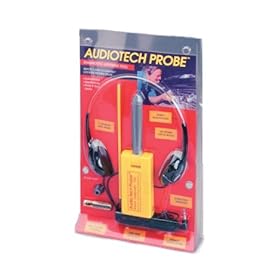
I use an 'electronic stethoscope' for issues like these. I got mine from the tool guy that visited a car dealership I used to work at. It is a steel rod connected to an audio amp with a pair of headsets. Powered by a 9v battery and has a volume control. They work very well but obviously care must be taken when poking the metal probe around. They are designed to locate noise sources in running automobile engines.

Here is one almost identical to mine:

http://www.amazon.com/dp/B0000YQNSY?smid=A1Y0Z9WRN44SR1&tag=yahoo-tools-mp-20&linkCode=asn

416RKAZCF1L._AA280_.jpg
 
'electronic stethoscope'

'electronic stethoscope'

This reminds me that, back in the dark ages of my youth, there used to be a gadget called The Honeywell Probe. When you had trouble, people would say in a deep and solemn voice, "USE THE PROBE!" It was like calling in an Exorcist.
It listened in on 27 mHz, which was the frequency of radio noise emitted by an energized, defective solder joint.
I don't know if it would work for bad wire nut connections.
 
care must be taken

care must be taken

Since the rod transmits only sound, it should work as well with a wooden or plastic dowel. Sound attenuation through these things should be minimal.
 
ceb58 said:
Yes, Watson we now have a clue! Was this recp. on a outside wall? What is the siding on house? Was the sun directly on this wall when you heard the noise

Are you sure she doesn't have an infestation of these?

Image:Harmonia_axyridis01.jpg
 
Status
Not open for further replies.
Top