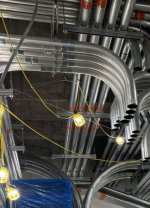
Back to back strut

Merry Christmas

Alwayslearningelec

Senior Member
Location
NJ
Occupation
Estimator
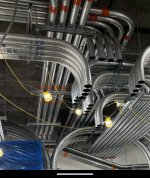
Not sure I've seen this much but why woild one use back to back strut for trapeze racks ..some with only 4 conduits. I understand added support but I believe I've seen conduit runs like this with just 1-5/8 strut .
 

Attachments

  • Screenshot_20251224-171031~2.jpg
    Screenshot_20251224-171031~2.jpg
    299.2 KB · Views: 29
  • Screenshot_20251224-171045~2.jpg
    Screenshot_20251224-171045~2.jpg
    208.8 KB · Views: 29
The strut manufacturer publishes information on how much weigh the strut can support along with how close together the supports need to be etc.
 
If there is nothing run on the bottom strut the it's likely that they used back to back strut for physical strength.
I agree and if you end up with left over from another project you use it where it's not actually needed.
 
I assume it's more practical to buy it back to back then assemble....should it's welded together or something similar so assembling wouldn't even in be an option.
 
They also make strut deeper than the standard 1 5/8" tall strut. I think you can buy 3" deep strut and maybe 2 1/2" I forgot.

The back-to-back double 1 5/8" is riveted together, I think.
 
I would think no longer than it is a 1-5/8" strut would be sufficient. Size of suspending rods and what might they hanging from possibly can be more questionable than using 1-5/8" strut there?

As others mentioned it may be back to back assembly that is factory welded or riveted, though I think isn't necessary here.
 
I can't look at racks of strut and all thread without thinking about the the Hyatt Regency in KC. I know the applications are way different, but those stress flows. And to make matters worse people were dancing on it to a beat
 
I would think no longer than it is a 1-5/8" strut would be sufficient. Size of suspending rods and what might they hanging from possibly can be more questionable than using 1-5/8" strut there?
Looks like 1/2" rod which can support thousands of pounds depending on the type of anchor used.
 
Right but what determines that? Some sort of calcs or judgement call? Barring spec requirements.
Lots of calcs, especially if there are seismic requirements. I don't see any diagonal bracing on those strut trapezes, so must not be a seismic area.

The back-to-back strut also give you some room for expansion if they happen to plan for that. We did lots of strut trapezes with cable try on top of the strut and conduits on the underside. Those were single channel though, with the channel facing down and the tray on the flat back of the strut.
 
Top