

crossman
Senior Member
- Location
- Southeast Texas
This is from another thread but I believe it deserves its own thread. I want to know if I am thinking correctly.
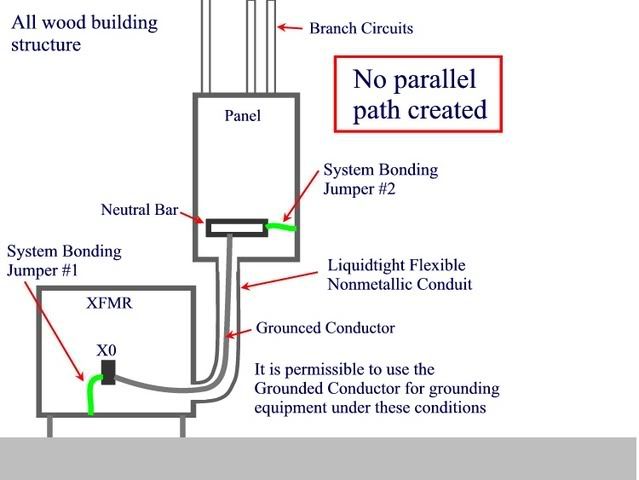
Given: A wood structure building, no waterpipe or structural steel. 480 3-phase service with ground rod as electrode. We are feeding a 480 to 208Y/120 xfmr. The transformer secondary feeds a panel with a main. All electrical equipment is mounted on the wood structure of the building.
250.30(A)(1) Ex 2 says we can put a system bonding jumper at the xfmr AND at the panel = bonding the neutral in 2 places if no parallel path is created.
250.142(A)(3) follows up and says we can use the grounded conductor (in this case, the neutral) for bonding between the source of the seperately derived system and the main disconnect.
So from that, I have the following diagram.
Do you see this as being what the NEC is saying, or am I missing something?
Given: A wood structure building, no waterpipe or structural steel. 480 3-phase service with ground rod as electrode. We are feeding a 480 to 208Y/120 xfmr. The transformer secondary feeds a panel with a main. All electrical equipment is mounted on the wood structure of the building.
250.30(A)(1) Ex 2 says we can put a system bonding jumper at the xfmr AND at the panel = bonding the neutral in 2 places if no parallel path is created.
250.142(A)(3) follows up and says we can use the grounded conductor (in this case, the neutral) for bonding between the source of the seperately derived system and the main disconnect.
So from that, I have the following diagram.
Do you see this as being what the NEC is saying, or am I missing something?
Last edited:


