If you have more than 30 current carring conductors bundled (ty-wrapped in lengths over 24") in a panel board, do you have to derate? As near I as I can tell in 312.8 you can use a panel board as a raceway, but that doesn't mean that it is classified as one. In article 366.22 (B), and article 376.22 reference 30 current carring conductors as a cut off to where you have to start derating, and article 310.15(B)(2) refrences the 24". I think it boils down to what a panel board is classified as. Dose any one have any thoughts?

You are using an out of date browser. It may not display this or other websites correctly.
You should upgrade or use an alternative browser.
You should upgrade or use an alternative browser.
Bundling in a panel board
- Thread starter RSW
- Start date
- Status
- Not open for further replies.
bphgravity
Senior Member
- Location
- Florida
I say no.... 310.15(A)(2) Exception.
McDowellb
Banned
- Location
- Beverly Hills, CA
I also say no. The derating only applies to raceways and cable.RSW said:If you have more than 30 current carring conductors bundled (ty-wrapped in lengths over 24") in a panel board, do you have to derate? As near I as I can tell in 312.8 you can use a panel board as a raceway, but that doesn't mean that it is classified as one. In article 366.22 (B), and article 376.22 reference 30 current carring conductors as a cut off to where you have to start derating, and article 310.15(B)(2) refrences the 24". I think it boils down to what a panel board is classified as. Dose any one have any thoughts?

- Location
- Illinois
- Occupation
- retired electrician
mcdowellb,
Don
Really???The derating only applies to raceways and cable
That being said, the exception cited by Bryan, eliminates the requirement to use the reducded conductor ampacity that is the result of the application of 310.15(B)(2).(a) More Than Three Current-Carrying Conductors in a Raceway or Cable. Where the number of current-carrying conductors in a raceway or cable exceeds three, or where single conductors or multiconductor cables are stacked or bundled longer than 600 mm (24 in.) without maintaining spacing and are not installed in raceways, the allowable ampacity of each conductor shall be reduced as shown in Table 310.15(B)(2)(a). Each current-carrying conductor of a paralleled set of conductors shall be counted as a current-carrying conductor.
Don


LarryFine
Master Electrician Electric Contractor Richmond VA
- Location
- Henrico County, VA
- Occupation
- Electrical Contractor
I can't help but wonder why wires need to be tie-wrapped in panels to begin with. I have no trouble keeping them neat without wraps. If they're really needed (for stranded wire, say) nobody says they have to be so tight.
Who says they "need to be"?LarryFine said:I can't help but wonder why wires need to be tie-wrapped in panels to begin with.
LarryFine
Master Electrician Electric Contractor Richmond VA
- Location
- Henrico County, VA
- Occupation
- Electrical Contractor
You couldn't see my tongue in my cheek?celtic said:Who says they "need to be"?
It's just something I never do. When I dress a panel, the wires seem to stay in place without help.
Feeder first, EGC's second, neutrals third, hots last. Why tie?
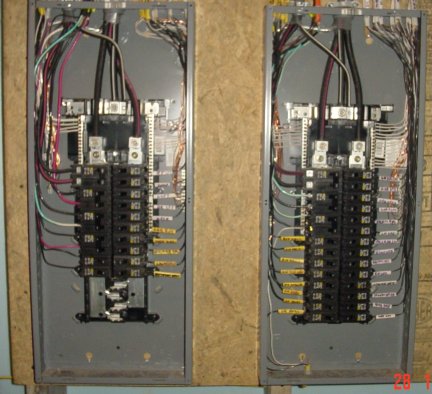
Last edited:
McDowellb
Banned
- Location
- Beverly Hills, CA
Wow Larry, that's excellent work. Time well spent.LarryFine said:You couldn't see my tongue in my cheek?
It's just something I never do. When I dress a panel, the wires seem to stay in place without help.
Feeder first, EGC's second, neutrals third, hots last. Why tie?
LarryFine
Master Electrician Electric Contractor Richmond VA
- Location
- Henrico County, VA
- Occupation
- Electrical Contractor
Thanx!McDowellb said:Wow Larry, that's excellent work. Time well spent.
For what it's worth, I did not take extra care or time in these panels for the pictures.
It takes no more time to dress them neatly than sloppily; in fact, maybe less.
McDowellb
Banned
- Location
- Beverly Hills, CA
I especially like the order you said you terminate the conductors. I've always done hots, neutral then eq. grounds.LarryFine said:Thanx!
For what it's worth, I did not take extra care or time in these panels for the pictures.
It takes no more time to dress them neatly than sloppily; in fact, maybe less.
LarryFine
Master Electrician Electric Contractor Richmond VA
- Location
- Henrico County, VA
- Occupation
- Electrical Contractor
You are kidding, aren't you?McDowellb said:I've always done hots, neutral then eq. grounds.
McDowellb
Banned
- Location
- Beverly Hills, CA
No I'm not. Just a bad habbit I've had. I do the same on service entrances and feeders. Just never thought about it. I told my guys about it and they all say they do it your way.LarryFine said:You are kidding, aren't you?
This conductor order is important for safety reasons. You should allways be grounded before being energized with no ground hooked up. Larry do you always use ser cable for your services? Not trying to critisize but dont forget to tape them white conductors on your ocp black.LarryFine said:You couldn't see my tongue in my cheek?
It's just something I never do. When I dress a panel, the wires seem to stay in place without help.
Feeder first, EGC's second, neutrals third, hots last. Why tie?
- Location
- Illinois
- Occupation
- retired electrician
Nick,
Don
Not really as you should never be hooking up conductors to an energized point.This conductor order is important for safety reasons.
Don
LarryFine
Master Electrician Electric Contractor Richmond VA
- Location
- Henrico County, VA
- Occupation
- Electrical Contractor
True. Now that I think about it, I hook up everything that way, even light fixtures: green, white, black.NICK D said:This conductor order is important for safety reasons. You should allways be grounded before being energized with no ground hooked up.
Yes, when the main disconnect isn't in the panel. Look again.Larry do you always use ser cable for your services?
If you look more carefully, you can see that they have been colored blue. They're faded a bit at the ends from handling, but they're nowhere as pale as they appear in the pic.Not trying to critisize but dont forget to tape them white conductors on your ocp black.
By the way, I dislike using tape for recoloring entire conductors (except phase marking). I do it when I must, but I prefer ink or paint.
Last edited:
LarryFine
Master Electrician Electric Contractor Richmond VA
- Location
- Henrico County, VA
- Occupation
- Electrical Contractor
While that's true, it's still one of the best habits for electricians to develop.don_resqcapt19 said:Nick,Not really as you should never be hooking up conductors to an energized point.NICK D said:This conductor order is important for safety reasons.

resistance
Senior Member
- Location
- WA
LOL
I can see the homeowner dashing out of the house yelling, "FIRE"! Not to say you'll hook up an energized overhead service (temp power to occupied home) this way: Hot-Hot-N
I can see the homeowner dashing out of the house yelling, "FIRE"! Not to say you'll hook up an energized overhead service (temp power to occupied home) this way: Hot-Hot-N

Dave58er
Senior Member
- Location
- Dearborn, MI
I hate to bring this show and tell back towards the OP but...
Wink
I'm curious about the application of 376.22. My first question is how often is this enforced? I don't think I've seen it on a job. Secondly, and more importantly, how would you go about applying 310.15(B)(2)(a)? Is 376.22 saying that if I have 30 current carrying conductors no problem but if I have 31 I must use 40% ampacity? That seems a little crazy. Do you start from the top of the table instead? Maybe 31-33 are @ 80% 34-36 @ 70% and so on?
Sorry. tried the wink icon... didn't work.
Wink
I'm curious about the application of 376.22. My first question is how often is this enforced? I don't think I've seen it on a job. Secondly, and more importantly, how would you go about applying 310.15(B)(2)(a)? Is 376.22 saying that if I have 30 current carrying conductors no problem but if I have 31 I must use 40% ampacity? That seems a little crazy. Do you start from the top of the table instead? Maybe 31-33 are @ 80% 34-36 @ 70% and so on?
Sorry. tried the wink icon... didn't work.
- Status
- Not open for further replies.