Can a 200A Breaker Be a Service Disconnect

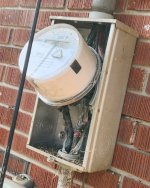
I pop meters all the time.
You must not be in PG&E territory. They know when meters get pulled and will threaten legal action and sometimes cut service off to the customer.

Firefighters in my area have never pulled meters. In my opinion its a pretty stupid way to de-energize a service that is under load or could potentially fault during a fire.
 
Our POCOs won't allow us to pull meters anymore either. One of them cites a case of an electrician pulling a meter and the jaws came out with the meter. Can't recall if their was any shocking or other damage but do remember the lineman had to come and take it loose at the transformer. That stopped the meter pulling with them. I imagine the others just followed suit.
 
Wo

Wonder why that is? Maybe liability or fussy POCOs that don’t want “their” stuff touched?
CT metering possibly enters the picture some. Though not too common for residential applications, at least for 400 amp and less, it maybe has been an issue a time or two when they pulled a meter then later found out that doesn't always disconnect power from the structure?
 
Firefighters in my area have never pulled meters. In my opinion its a pretty stupid way to de-energize a service that is under load or could potentially fault during a fire.
In the average dwelling with self contained metering, I don't see it as being too big of an issue. Firemen are already wearing sufficient PPE for arc flash, it may be shock hazard that possibly isn't going to be covered by their gear to OSHA standards anyway, what they have is still going to be pretty effective. Not very often is there any extreme high available fault current at single family dwellings. Multifamily maybe, but you likely have a main on those instead of turning off multiple main breakers or pulling multiple meters in an emergency situation. 320 amp sockets - usually have bypass and the bypass handle also opens the jaws - actually somewhat safer to pull those - if you use the bypass lever to release jaws and then flip handle again after pulling meter. But unless they know what they are doing is possible they don't throw the handle afterwards - which ultimately still leaves power inside the building. So it kind of still comes down to having qualified persons assure them there is no power. Maybe wouldn't be a bad idea to have some qualified on staff? Volunteer fire departments possibly do already have qualified individuals within their members at times?
 
Not much of an advantage. If the EM disconnect is not service equipment then you only need 3 conductors between it and the panel. Also if the panel is on the inside then the GEC's can land there instead of in the disconnect on the outside. This is convenient for service upgrades where all of the GEC's are already on the inside and therefore would not need to be extended by irreversible means to the outside.
Good explanation. I would not call this "not much" though; seems like a big advantage, in some houses, where the water meter's a long, difficult, or impossible run.
 
You must not be in PG&E territory. They know when meters get pulled and will threaten legal action and sometimes cut service off to the customer.

Firefighters in my area have never pulled meters. In my opinion it’s a pretty stupid way to de-energize a service that is under load or could potentially fault during a fire.
Depends on who you talk to at the poco’s too. I’ve pulled meters in one Georgia Power jurisdiction, and get cussed out. Another jurisdiction, I would call to have them pull it, and they would say “can’t you pull it? “ We will come out and re-seal it. You just can’t win!
 
The local fire departments in my area will pull a meter if it's a working house fire if the electrical utility is too far out (time-wise). They radio the county fire dispatch for eta and priority level, with level 1 being the worst. The fire scene officer in charge takes possession of the meter until poco arrives or takes the meter to their firehouse to meet up with poco rep. In my county, there are 4 local municipality companies and 2 regional companies.
 
Many fire departments banned pulling meters 15+ years ago...fire firefighters are not qualified persons to do that type of electrical work.
I mostly understand, yet they typically already wearing more appropriate gear for the task than many electricians would be wearing.

IMO a bigger concern would be firefighters pulling a meter that is only a CT meter and not realizing it did not disconnect power to the structure.

They will shut off a gas valve as well if deemed necessary.

They also are at high risk in many other aspects when they get called to many different scenes and receive training on how do deal with many different hazards. I been up close a couple times when firefighters (volunteer firefighters) are at an incident and was rather impressed with how they handled certain situations even if they were something they maybe don't encounter on a regular basis. My most recent was I was still doing some finish up work in a new home I was part of. I had left for lunch, the husband called me asking questions about the CO alarm, as his wife called him saying it was making sounds. I told him I was going back and would check it out. when I got back she had called fire department and they were there. She went outside before she called. Turns out it was a valid alarm, they had monitors and determined it was too high concentration to safely go in. They masked up with breathing apparatus and went in to check out a few things and then open doors and get some fresh air into the place. turned out to be a wood burning stove that was back drafting, they did want his wife to go the ER and get checked out, they did have her on oxygen for a while before releasing her. CO alarm probably saved her life, had she decided to lay down because of unknown oxygen deprivation she probably would been found dead. Another time a car crashed into town substation, I heard it happen, and noticed power went out where we was at. We walked the few blocks to where this occurred and that car was sitting up against the transformer, occupant still alert. I was ready if needed to tell them to wait until POCO says it is safe, but they kept the occupant calm and stayed away until POCO disconnected the feed to it and informed them it was now ok to enter.

They have to learn a lot about many things just to be able to safely do what they need to do and occasionally still need to take some risks to save a life.
 
Many fire departments banned pulling meters 15+ years ago...fire firefighters are not qualified persons to do that type of electrical work.
I have never understood this. So they can go into burning buildings, saw through roofs, be around potential BLEVE's, but cant take a 45 min class on pulling a meter? The POCO people i see installing meters are not not linemen and probably have minimal training, and far less PPE than I see firefighters with.
 
I have never understood this. So they can go into burning buildings, saw through roofs, be around potential BLEVE's, but cant take a 45 min class on pulling a meter? The POCO people i see installing meters are not not linemen and probably have minimal training, and far less PPE than I see firefighters with.
It’s not that they don’t know how to pull a meter, it’s the potential arc flash that comes with it. Safer for the poco too. Ever notice they turn their head when they plug a meter in? I’ve talked to several linemen that had them blow up on them.
 
I mostly understand, yet they typically already wearing more appropriate gear for the task than many electricians would be wearing.
It becomes an issue of qualified persons and citations by OSHA or the department of labor if something bad happens. If is very unlikely that a fire fighter is a qualified person for the purpose of pulling a meter to kill the power.

A department in my area was cited by the department of labor for inadequate training after a firefighter fatality and the following civil suit resulted in a judgement of over $30 million against the fire department.
Sure that is different than pulling a meter, but safety citations by OSHA or the Department of Labor are a big deal for fire departments.
 
One of the POCOs here said an electrician pulled a meter and something broke and the jaws and live conductors came out with the meter. He threw the meter down and started a fire. That was the reason they said we couldn't pull meters any more.
 
Was your inspection by L&I? Their inspectors are usually right on, and they give you the code section.
But for state amendments, check WAC 296-46 B part 230. And there was an Electrical Currents artical on this when the EM disconnect rules were first added to NEC
 
One of the POCOs here said an electrician pulled a meter and something broke and the jaws and live conductors came out with the meter. He threw the meter down and started a fire. That was the reason they said we couldn't pull meters any more.
And I seen bad connections at top of poles dropping molten metal down to the ground, which could also start a fire. And this happens with nobody there to see it allowing fire to spread even faster. In the case you mentioned it most likely more about potential liablility
 
Top