Can i install a 14-50 with no neutral?

Merry Christmas

WD40

Senior Member
Location
Philly
Occupation
Electrician
My boss used a estimating service to bid a 33 unit HOA to do some electrical upgrades I am looking it over on a Sunday before its due in. There is one odd thing to me, these 50A receptacles for EV's going in garages that call for a 6/2 cable, 50A breaker and a 14-50 receptacle. Apparently that is what some other EC's did recently in another section and it passes inspection.
You cant pigtail a EGC to the neutral pin I know the code says that,
but you can leave the neutral open is that correct ? Did this other EC somehow slip this by the inspection agency?
The way inspections work here we may get a different inspection agency than the one the approved the other section so even if we do what they want I doubt it will pass, and frankly it seems just wrong.
Before you all say it I already emailed them back and asked they do a RFI and see if NEMA 6-50's can be installed. I see there is 6-50 - 14-50 adapter on amazon for under $20 designed for EV's and some EVSE do come with a 6-50, offer one or allow you to choose. And honestly they may not even notice RFI or not so I'll probably just use 6-50's.
Do any of you install 14-50's with no neutral?
 
As I've said before, in my opinion it's dangerous and irresponsible to leave a neutral terminal floating.

There is nothing to prevent a matching plug, with a load expecting the neutral, from being inserted.

Either connect the neutral or use a receptacle configuration that does not provide a neutral terminal.
 
This topic has received extensive coverage here on on the excellent resource Reddit r/evcharging
In short the 14-50 is a poor choice for EV charging, in part because of the absolute waste of money and copper on the neutral.
Hard wiring EVSE avoids all that nonsense.

The problem with using a 6-50 is that Amazon is not required to patrol for safety standards. The adapters on Amazon are largely fake certified, from companies with random letter names. But even the name brand 6-50 to 14-50 adapters introduce additional failure points and defeat any plug level temperature sensor shutoff. It's really only safe if the EVSE are native NEMA 6-50. That's possible, but hard to patrol.

The NEC prohibits the use of better safer connectors for EVSE installs in 625.44. See also CAM 70-181.
Until the NEC changes, your only code compliant bet may in fact be slipping in the NEMA 6-50's.
 
Guess who would get sued when someone plugs something in that requires a neutral, and it fries what they plugged in, or starts a fire? The logical answer would be the engineer, but the lawyer answer would be the electrician because he knew better.
 
As I've said before, in my opinion it's dangerous and irresponsible to leave a neutral terminal floating..
Yeah thanks we all have our opinions, since you guys are not posting code references does than mean the other 33 units with floating neutrals are code legal?
Guess who would get sued when someone plugs something in that requires a neutral,
If it meets minimum NEC standards and got inspected would they have a case?
 
Yeah thanks we all have our opinions, since you guys are not posting code references does than mean the other 33 units with floating neutrals are code legal?

If it meets minimum NEC standards and got inspected would they have a case?
How does it meet NEC standards if the installation is not complete? Seen plenty of installations that were inspected, but did not meet code. I had one state inspector that wanted the neutral bond on the LOAD side of a groundfault protected transferswitch.
 
Sorry I should have been more clear, I am referring to a complete installation;
Just like if you have say a 240V only feeder panel and did not pull a neutral in the feeder.
The neutral bar would have nothing connected to it, same thing but a receptacle.
I know a neutral is required to a service but thats all I know of code wise.
This is whats done by another EC,they wire a 14-50 receptacle to a 6/2 and float the neutral as in they don't land anything on the neutral pin. I am being told this is 'code'.
If I could cite a code section that violates it would help.
Thanks
 
If the instructions for the receptacle call for a neutral to be connected, there's 110.3(B).

If there are any 120/240V 14-50 receptacles installed on the premises (e.g. for a range), then there's 406.4(F).

Cheers, Wayne

IMHO those are the relevant code requirements.

My understanding is that NEMA patterns are not code requirements, and sometimes it makes sense to use them in non standard ways. (I once used L17 or L20 plugs and receptacled for some 120V control circuits. No 600V anywhere in the facility, no pattern conflict.)

But my opinion is that using a common residential receptacle pattern in a non standard fashion is a bad design choice.
 
IMHO those are the relevant code requirements.

My understanding is that NEMA patterns are not code requirements, and sometimes it makes sense to use them in non standard ways. (I once used L17 or L20 plugs and receptacled for some 120V control circuits. No 600V anywhere in the facility, no pattern conflict.)

But my opinion is that using a common residential receptacle pattern in a non standard fashion is a bad design choice.
My shop has L14-50 with a wild leg where the neutral should be.

Don't plug anything in that that is expecting a neutral.

Previous occupant wired it that way, don't blame me. I should probably get around to fixing it but then I would need to buy new cords for my 3 phase stuff.
 
Maybe if the EVSE vendors start making 14-50's with the neutral pin left off..... that they do without a code violation probably.
How would that help? The issue is not the unused neutral pin on the plug. The issue is having a receptacle that anything can get plugged into that needs a neutral.

Many EV's chargers can be purchased with 6-50 plugs. Many of the basic cord that come with cars have the option of 6-50 adapters. When my previous neighbor orders his Tesla the sales person recommended he purchase a 6-50 adapter if they didn't have an existing 14-50 receptacle that they were going to use.
 
Yeah thanks we all have our opinions, since you guys are not posting code references does than mean the other 33 units with floating neutrals are code legal?

If it meets minimum NEC standards and got inspected would they have a case?
hard wire them EVSE. Way better.
How would that help? The issue is not the unused neutral pin on the plug. The issue is having a receptacle that anything can get plugged into that needs a neutral.
Many EV's chargers can be purchased with 6-50 plugs. Many of the basic cord that come with cars have the option of 6-50 adapters. When my previous neighbor orders his Tesla the sales person recommended he purchase a 6-50 adapter if they didn't have an existing 14-50 receptacle that they were going to use.
What would help is if all automakers were required to sell plug adapters, or use a connector comparable with the one from Tesla.
Cars from Rivian, Ford, etc come with only NEMA 14-50 and NEMA 5-15 and that's it.

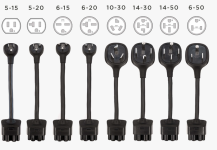
Telsa equipment owners have it easy:

Tesla NEMA Modular Plug EVSE.png
California's CARB has it messed up. California's Clean Cars II regulation more or less forced the vehicle vendors into the NEMA 5-15 14-50 solution, yet for new buildings NEMA 6-20 will be more common. CARB's answer is that drivers can buy adapters on Amazon -- despite the obvious reality that the typical Amazon adapter is crap, and none of them (even good ones) can replicate the thermal sensor in the plug.
 
How would that help? The issue is not the unused neutral pin on the plug. The issue is having a receptacle that anything can get plugged into that needs a neutral.
Right, but if the plug had no neutral pin, then you could put a non-conductive dummy in the neutral slot on the receptacle to prevent anyone from plugging in a normal 14-50. Effectively creating a new pattern that duplicates the functionality of 6-50 but whose plug can interoperate with normal 14-50.

Which raises the question, why weren't the NEMA 6 and 14 designed so that a 6-50 plug could fit in a 14-50 receptacle?

Cheers, Wayne
 
Top