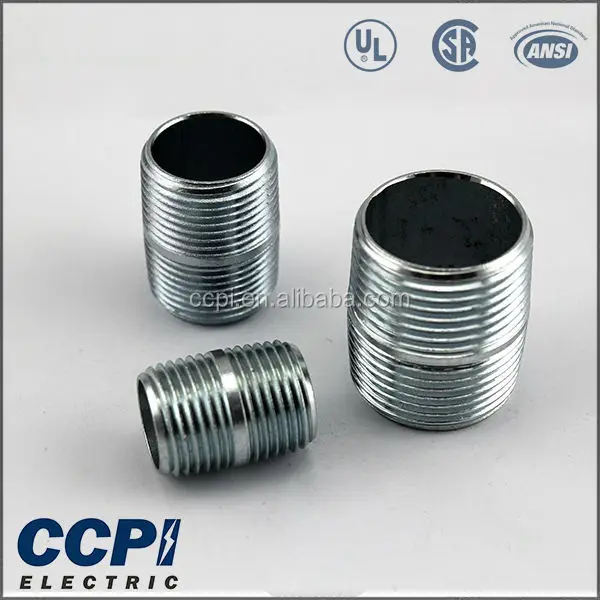
chase nipples, close nipples, bond bushing

Status
Not open for further replies.

rayertz

Member
Location
USA
I have a 1600 amp busway to a tap box that changes over to EMT from the tap box to the equipment. Where it changes over to EMT at the tap box a mogul LB is used by connecting it to the tap box with a chase nipple without locknuts.
I think a chase nipple should used with lock nuts on both sides and a bond bushing that is grounded.

I can't find it in the code. I need some wisdom please.
 
Does this help

250.97 Bonding for Over 250 Volts. For circuits of over
250 volts to ground, the electrical continuity of metal raceways
and cables with metal sheaths that contain any conductor
other than service conductors shall be ensured by
one or more of the methods specified for services in
250.92(B), except for (B)(1).
Exception: Where oversized, concentric, or eccentric knockouts
are not encountered, or where a box or enclosure with
concentric or eccentric knockouts is listed to provide a
reliable bonding connection, the following methods shall
be permitted:
(1)
Threadless couplings and connectors for cables with
metal sheaths
(2) Two locknuts, on rigid metal conduit or intermediate
metal conduit, one inside and one outside of boxes and
cabinets
(3) Fittings with shoulders that seat firmly against the box or
cabinet, such as electrical metallic tubing connectors,
flexible metal conduit connectors, and cable connectors,
with one locknut on the inside of boxes and cabinets
(4) Listed fittings
 
I have a 1600 amp busway to a tap box that changes over to EMT from the tap box to the equipment. Where it changes over to EMT at the tap box a mogul LB is used by connecting it to the tap box with a chase nipple without locknuts.
I think a chase nipple should used with lock nuts on both sides and a bond bushing that is grounded.

I can't find it in the code. I need some wisdom please.

Umm, not trying to be a wisea$$ don't chase nipples only use a locknut on one side of it?
 
Umm, not trying to be a wisea$$ don't chase nipples only use a locknut on one side of it?

I got lost also.
Not sure how you'd use a bonding bushing on a chase nipple that was threaded into an LB.

I'm thinking the OP meant to say use a "Close" nipple with 2 locknuts (one on each side) and a bonding bushing.

JAP>
 
I got lost also.
Not sure how you'd use a bonding bushing on a chase nipple that was threaded into an LB.

I'm thinking the OP meant to say use a "Close" nipple with 2 locknuts (one on each side) and a bonding bushing.

JAP>

A "Chase Nipple" has a shoulder on it but as far as getting a bite into the enclosure from a chase nipple a locknut would need to be used as was posted by infinity.

JAP>
 
I see chase nipples threaded into conduit bodies all of the time. With or without a locknut it's a technical violation due to the straight threads on the chase nipple. I always use a close nipple, two locknuts and a bushing. If there are concentric or eccentric KO's and over 250 volts to ground then often a bonding bushing is used.
 
I see chase nipples threaded into conduit bodies all of the time. With or without a locknut it's a technical violation due to the straight threads on the chase nipple. I always use a close nipple, two locknuts and a bushing. If there are concentric or eccentric KO's and over 250 volts to ground then often a bonding bushing is used.

That's good practice.

JAP>
 
A "Chase Nipple" has a shoulder on it but as far as getting a bite into the enclosure from a chase nipple a locknut would need to be used as was posted by infinity.

JAP>

If all you care about is mechanical continuity, and don't require electrical continuity in that particular application, does a chase nipple still need a pair of locknuts?

Also, on a similar note, can a chase nipple be threaded in to a coupling or conduit body with no locknut, and still establish sufficient mechanical continuity?
 
If all you care about is mechanical continuity, and don't require electrical continuity in that particular application, does a chase nipple still need a pair of locknuts?

Also, on a similar note, can a chase nipple be threaded in to a coupling or conduit body with no locknut, and still establish sufficient mechanical continuity?

Don't tell anyone but I don't generally use a chase nipple / Locknut combination and I've used a chase nipple into a coupling and a conduit body several times wthout a locknut. There,,, I've confessed.


JAP>
 
On a side note, the chase nipples I've been getting lately are too long to begin with and tend to bind up in the threads before the get to where I want it to go so sometimes I have to use the Locknut scenario and in that case an I feel like I'm killing 2 birds with one stone. :)
JAP>
 
I've seen enough installs where the chase nipple does not make up tight against the enclosure that I would definitely, at a minimum, add a grounding locknut, probably on the interior of the enclosure.
 
In this article at the bottom Mark mentions EMT fitting but they have the same straight threads as chase nipples.

http://www.ecmag.com/section/codes-standards/fittings-hubs

I think it is hog wash:

1. There is no code that states anything about tapered mating with non tapered
2. RGS couplings are not tapered
3. I think the bonding and water entry concerns are hogwash. See#2


I do not dispute what the listing and/or instructions say on some of these things, but I find the tapered/non thing baseless.
 
I think it is hog wash:

1. There is no code that states anything about tapered mating with non tapered
2. RGS couplings are not tapered
3. I think the bonding and water entry concerns are hogwash. See#2


I do not dispute what the listing and/or instructions say on some of these things, but I find the tapered/non thing baseless.

How can you say it is baseless?

It may be dumb but it has a legitimate paper trail.
 
Where is it stated that mating tapered with non tapered threads is not allowed?

110.3(B) and ULs position that they can't say untested combinations meet the listing requirements.

Certainly an AHJ can choose to accept it, they can just as easily fail you for it.

So if you had an AHJ fail your job based on this issue what would your response be?
 
OK. The ignorant Brit strikes again............
What is a chase nipple? And what is it chasing?

109879-326-2-electrical-conduit-chase-nipple-rigid-imc-non-insulated-lot-of-37-2.jpg


Often used to run conductors between enclosures that are tightly positioned.

The issue under discussion has to do with the grounding continuity this fitting may have compared to using a 'close nipple' with locknuts on all sides of each enclosure.

Electrical-Rigid-Conduit-Nipple-close-nipple-long.jpg
 
Status
Not open for further replies.
Top