Designing poorman's busway using tap rules

fastline

Senior Member
Location
midwest usa
Occupation
Engineer
There is a budget! lol However, a real busway is NOT in that budget, or really needed, but working on a new building layout and would like some thoughts. Service entrance will be 400A, 480/277. Machinery will be along 2 walls of building and most machines are 208-230V but there are some 480V. I'm only sharing voltages as I have to decide where to set transformers, size, and generally make a guess on expansion needs. I'm usually pretty adamant about setting transformers, even smaller ones, outdoors to both save space, and reduce that annoying 60hz noise.

With that said, I am currently pondering after 480 entrance, landing that from a trough, to a 480 panel, then shooting 200A of 480V through the under slab conduit across the building, and landing that in some other smaller 480 panel just so 480 is established on both sides of building. Then do outdoor concrete pads for 208/120 transformers on both sides. I just know I have to have both 480 and 208/120 covered on both sides.

Main reason for the post was I want to get creative in reducing circuits, wire, conduit, and clutter by doing mostly a single EMT on each side of building as like a busway, and add some sort of tap boxes along the feeder. It is fine to feed say a couple machines with one tap, but I need to think carefully on that. Machines to serve typically have up to 50hp of induction motors, but usually 30hp. However, they are rarely at full ballz.

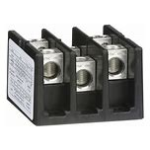
What I am trying to find is these feeder tap boxes I have in my head but can't find. I envision either a clamp style where the feeder conductors are never actually cut, or at least lugs looking left and right so the feeder passes through the boxes simple. I'd prefer breakers over fuses, but all machines have their own main breakers anyway. I had also considered running the feeder conduits higher on the wall but would have to navigate a "tee" and drop down into tap boxes.

Basically I'm horsing with ways to design a clean and easy install. Feeder distance will not exceed 100ft. What is COMMON, and may just have to return is the 'ol dedicated circuits. This is our standard go-to. Was just trying to optimize.
 
There is a budget! lol However, a real busway is NOT in that budget, or really needed, but working on a new building layout and would like some thoughts. Service entrance will be 400A, 480/277. Machinery will be along 2 walls of building and most machines are 208-230V but there are some 480V. I'm only sharing voltages as I have to decide where to set transformers, size, and generally make a guess on expansion needs. I'm usually pretty adamant about setting transformers, even smaller ones, outdoors to both save space, and reduce that annoying 60hz noise.

With that said, I am currently pondering after 480 entrance, landing that from a trough, to a 480 panel, then shooting 200A of 480V through the under slab conduit across the building, and landing that in some other smaller 480 panel just so 480 is established on both sides of building. Then do outdoor concrete pads for 208/120 transformers on both sides. I just know I have to have both 480 and 208/120 covered on both sides.

Main reason for the post was I want to get creative in reducing circuits, wire, conduit, and clutter by doing mostly a single EMT on each side of building as like a busway, and add some sort of tap boxes along the feeder. It is fine to feed say a couple machines with one tap, but I need to think carefully on that. Machines to serve typically have up to 50hp of induction motors, but usually 30hp. However, they are rarely at full ballz.

What I am trying to find is these feeder tap boxes I have in my head but can't find. I envision either a clamp style where the feeder conductors are never actually cut, or at least lugs looking left and right so the feeder passes through the boxes simple. I'd prefer breakers over fuses, but all machines have their own main breakers anyway. I had also considered running the feeder conduits higher on the wall but would have to navigate a "tee" and drop down into tap boxes.

Basically I'm horsing with ways to design a clean and easy install. Feeder distance will not exceed 100ft. What is COMMON, and may just have to return is the 'ol dedicated circuits. This is our standard go-to. Was just trying to optimize.
Why not properly sized boxes and some term blocks or Polaris lugs?
 
I once designed a small machine shop where we ran a 100A feeder, in 6" square wireway, down each side of the building. At each machine location a power distribution block was mounted in the trough and a tap was made to a local disconnect, per 240.21(B).
 
I once designed a small machine shop where we ran a 100A feeder, in 6" square wireway, down each side of the building. At each machine location a power distribution block was mounted in the trough and a tap was made to a local disconnect, per 240.21(B).

I pondered something similar. How big was that building though? I'm starting to think I'm making this more complicated than it really needs to be. Electrofelon does have a point. Maybe just landing a few sub panels to tap out of is the right strategy.
 
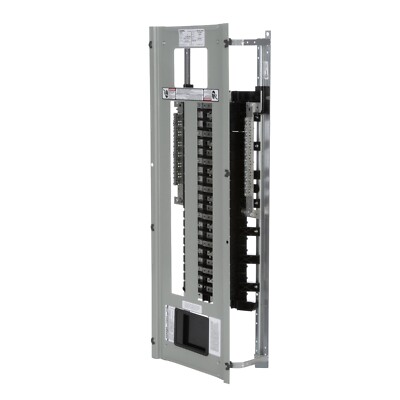
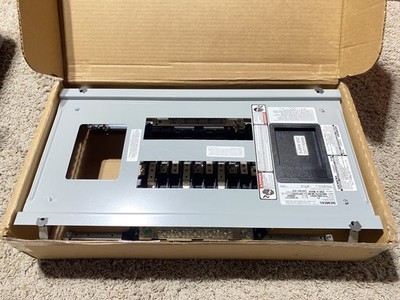
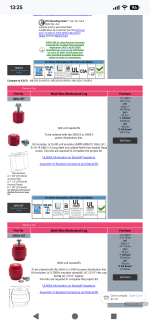
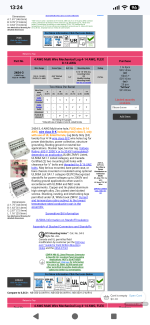
Just some examples:


It's a good and practical thought! However, those breakers do get pricey! I know we have run a couple 480v panels on 208v simply because the panels were used and loaded up.
 
I pondered something similar. How big was that building though? I'm starting to think I'm making this more complicated than it really needs to be. Electrofelon does have a point. Maybe just landing a few sub panels to tap out of is the right strategy.
We didn't need/want power panels. Each tap point was at max 2 loads in order to keep the tap <25'. There were panels for the miscellaneous receptacles and non-machine loads. I think the building was about 160' long.
 
As a point if interest OP, how big is your building? You say the feeder distance is no more than 100ft. I take that to mean each side of the building is only 100 ft, and if that's the case then this is a pretty small building.

And if the goal is to minimize budget, remember the effect skin effect has on your ampacity. It takes more than double the copper to move 200A on one 3/0 circuit than it does to move 200A on (10) 12awg circuits. And breakers are not free, but neither are tap blocks and tap connectors.

I think the most cost effective way to do the feeder trick is to just plant an appropriately sized junction box on the wall at each machine location and use some tap connectors in there. Let the breaker on the machine act as the tap conductor protection. That's not very complicated. Don't worry about the tap blocks you have in your head. Tap connectors are cheaper and easier for circuits this small, and they will hook up nice and clean in the box like you are hoping for.

On a matter of saving money though, I don't think putting the transformers outside is the right way to do that. Sounds like a great way to reduce the life of your equipment and pay more later. Based on the size of the service and the panels you are talking about, these are probably 45 or maybe 75kva transformers. That isn't very big. Wall mount them if you need the space that bad, but keep them out of the weather and you will be able to use them for a good long time. That's how you save money.

Also, regarding the panel on the other side of the building for the service: You can sneak 4/0 conductors in the same 2" conduit that you would be installing the 3/0 conductors in for the 200A panel. But with 4/0 conductors you can make that panel on the other side a 250A panel instead of a 200A panel. Easy way to get 25% more ampacity over there, especially since that panel bus is probably already rated for 250A as it is, and it is being fed from a breaker that is already a 250A frame size.
 
And if the goal is to minimize budget, remember the effect skin effect has on your ampacity. It takes more than double the copper to move 200A on one 3/0 circuit than it does to move 200A on (10) 12awg circuits. And breakers are not free, but neither are tap blocks and tap connectors.
Skin effect has very very little effect on conductors smaller than 250kcmil at 60HZ.
The NEC ampacity tables pretty much include normally expected skin effect.
 
You might find it simpler to just use a few smaller panel boards. By the time you get a tap box, connectors, a fused disco, maybe just a panel board with subfeed lugs would be a better cleaner easier option.
Sub feed lugs is the key here. So long as the entire cable run from box to box is whatever size the main feed is, you’re golden. I’ve done exactly that for a long production line with multiple process machinery and conveyor stations. Same issue, their engineer felt that bus duct was overkill. I’m not so sure, but whatever… it was a T&M project for me so no skin off my nose. It was significantly faster though because bus duct had a long lead time at that time.
 
Top