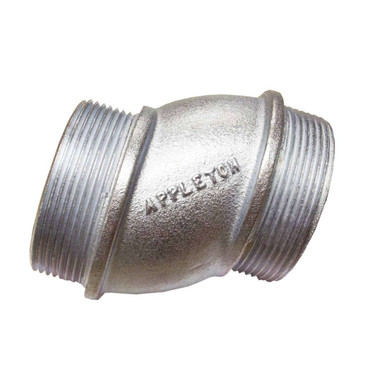
Die cast zinc offset

nizak

Senior Member
Can a die cast zinc offset be used with a RMC service riser?

It would be placed coming out of the meter socket. I need to get about 1 1/2” away from the siding due to a step in the surface finish of the wall.

Due to the way the existing mast is going through the soffit and roof assembly it would be a lot of work to change the entire pipe to bring it out that distance.

I’m not sure if the thread type would allow for being able to screw it into a 2” Rigid coupling.

I’ve just always known them as offset nipples and used them between enclosures for instance.
 
It will work, threads are same other than there likely is no taper to the thread on the die cast offset which can be a listing issue to use that combination together. For most part the rigid coupling is only listed to use threaded rigid conduit with proper thread taper into it, but this is not always something that you see enforced either.
 
It will work, threads are same other than there likely is no taper to the thread on the die cast offset which can be a listing issue to use that combination together. For most part the rigid coupling is only listed to use threaded rigid conduit with proper thread taper into it, but this is not always something that you see enforced either.
Thank you.
 
One thing is that the straight thread on the offset nipple transitions immediately to a protruding flange that is made to rest against the wall of an enclosure. An so the friction between this flange and the end of the rigid coupling will essentially go to zero when the joint is unscrewed a very slight amount. An intervening locknut could help but may not pass inspection.

If you use an offset nipple, I think a maleable iron version would be better since it's stronger, and it can be tightened up more and therefore be less likely to loosen up.

 
Its not just the coupling but also the hub. If screwing the offset nipple into a bolted hub on the meter can the chance of lining up where you want it is slim so you end up backing it off leaving it loose.
 
One thing is that the straight thread on the offset nipple transitions immediately to a protruding flange that is made to rest against the wall of an enclosure. An so the friction between this flange and the end of the rigid coupling will essentially go to zero when the joint is unscrewed a very slight amount. An intervening locknut could help but may not pass inspection.

If you use an offset nipple, I think a maleable iron version would be better since it's stronger, and it can be tightened up more and therefore be less likely to loosen up.

Real deal that will out live our great great grandchildren.
 
This article brings up issues about potential water intrusion and the integrity of the grounding path when straight threads are screwed into hubs:


Perhaps a couple short lengths of strut could be placed behind the meter enclosure to space it outwards.
Water intrusion is negligible regardless what they say. I'd bet good money you can get more water via condensation than those threads will leak during rainy weather. These so called experts thought the stupid rubber washers and a nylon ferrule that is a PITA to insert the tube into on "raintight" EMT fittings was necessary. Yet those also have more condenastion than they will leak through the nylon ferrule, and in 8-12 months when the sunlight deteriorates the rubber washer the gap left behind leaks more than had one used a set screw connector.

The potential comromise of grounding path I can agree on though.
 
Top